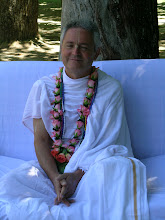
H.G. Matsyavatar Das

Thursday, 23 June 2011

The role of will power for the harmonization and development of Personality, determination and perseverance (2/2). By Matsyavatara das (Marco Ferrini)


Self-determination and
Perseverance Exercise.

Determination is a state of mind that can be cultivated and developed with a right predisposition. Like all mental states, determination arises from psycho emotional factors and attitudes like:

1. Desire. In the presence of a well defined and intense desire it is easier to develop and maintain determination for the pursuit of the target we aim at.
2. Definition of Purpose. Knowing what a person wants is the first thing, and perhaps the most important one, to develop self-determination. A strong motivation will help to overcome initial and unpredicted difficulties.
3. Self confidence. Trusting our own abilities to achieve a target, will encourage us to follow our program with determination.
4. Program definition. Organized programs, even when they are not well defined and focused, will encourage determination and strengthen perseverance.
5. The accuracy of acknowledgment. Knowing that our projects are based on solid reality and experiences that attain to our evolving nature, will favor determination. “Presumption of Knowledge” opposite to “real knowledge”, will weaken determination.
6. Cooperation. Empathy, tolerance, comprehension, harmonic cooperation among members of a team will strengthen determination for each member or element of the group.
7. Will power and planning capacity. Constant practice of will power and concentration on our thoughts – in a profitable manner – for the definition of a project, with the intention to schedule the targets we aim at, will develop determination.
8. Habit. Determination is the straightforward result of our mental frame, of a habit, of a deliberate performance, of an action used as a constant conscious behavior pattern. Our mental frame is modified in relation to our actions that, even unconsciously will influence the psychological structure with behavior models that are acquired and represented automatically in accordance with the adopted and acquired schemes. Fear, one of the worst and most powerful, destructive emotions, can be cured by the voluntary repetition of acts of courage. All the people that have made this experience know it well enough.

Friday, 17 June 2011

The role of will power for the harmonization and development of Personality, determination and perseverance (1/2). By Matsyavatara das (Marco Ferrini)


By analyzing, the relation between the inner self and will power and, on the other hand, the various psychological functions of the mind, we can very well notice how strong the link between will power and the inner self is: it is almost an identification of one another. Furthermore, by using will power, the self works on the other functions of the mind, governing and directing them. We are open to consider the existence of other two relations: firstly between the spiritual self and its reflex as a distorted self, the ego: the total of psychological contents in which the subject identifies himself. Secondly, between the individual (spiritual) self and the cosmic Self, the Supreme Soul or God for religious believers and theologists. Whereas the first relation is often contradictory, because the soul interacts with a distorted image (with the ego, the historic and transitory personality), the second version instead, related to the cosmic Self, is blessed, it is the source of complete harmony, of ecstasy. The problem of which will power to privilege depends on the relation we choose, either the first or the second one.
The unconscious process does not have a will power of its own, it is rather a self automatism, we cannot see its movement with our visual power, nor examine it with a rational thinking. However we can experience the existence of a dynamic process for which it functions spontaneously by responding to inputs that we provide for it with our conscious thinking, with or without a voluntary deliberated action. Our conscious thinking chooses the targets, selects the material, makes calculations, values and comes to a conclusion and, generally without knowing it, activates an unconscious process. Through the power of will – that represents the most immediate and direct function of the ego personality - we can produce a mental image of the target we aim at. It works straight forward in the subconscious in order to achieve its purpose, even though we do not know the way it works.
The conscious thought is not the doer of the material result, but it makes the mechanism work. Therefore, by acting here and now in the most ethical and correct way as possible (dharmya) the unconscious process is able to reach spontaneously the best results, without making any efforts. This is the reason why by acting properly and trustfully here and now, there is no need to worry about the future, because the targets will be achieved by the unconscious process that has been activated. The will power works at its best when we provide for the initial start- up and we let the unconscious elaboration to carry on naturally and spontaneously.
In order to fulfill a satisfactory and lasting success by using will power, we have to act accordingly, with no concern for the final result, rather by dealing with the psychological functions. As a matter of fact, the best way to use will power occurs when we activate and direct all the powers of the mind.
Before acting, likewise the physical world, the complex system of the ruling laws is taken into account, similarly before an action of will we need to consider the psychological dynamics and the ruling laws that such action implies.
Faith, discipline, courage, interest, optimism, to favor either an evolutionary or destructive purpose, will strengthen the power of will and vitality. Futility, pessimism, frustration, resentment, remorse, envy, jealousy, fears, nostalgia: they activate destructive dynamics that reduce the power of will, vitality and, as a consequence, the perspective of life. In turn such kind of attitude will accelerate the aging process. Every person in life feels the urge to satisfy fundamental needs, by following and realizing them in a healthy and ethical method (dharmya) they favor the development of will and strengthen it.
These major needs are:
- giving and receiving love
- finding and giving security
- being able to express one’s own creativeness and encourage others to do so
- feeling one’s own value and appreciating the value of others
- living new experiences and encourage others to make new changes
- developing self esteem and trusting mankind and divine providence
- living with a wholesome and fulfilling sense of satisfaction, inspiring others to do likewise

Tuesday, 7 June 2011

How to build up constructive and lasting relationships. By Matsyavatara dasa (Marco Ferrini)

People suffer for not being able to bring harmony in relationships and at the same time tend to start new conflicts due to their conditionings. There are more people suffering from relational difficulties than people suffering for the wars or for epidemics and, on the other hand, good relationships are the biggest patrimony we can build up for our well-being; and this doesn’t cost anything. Experiencing peaceful and tension-free relationships is the very basis for building up relationships set on a shared system of values and lofty principles. These are the grounds, while the top of the structure is made up of common purposes and of the mutual reliance on the fact that nothing can ruin the relationship anymore, not even the hardest trials or difficulties, because we don’t bring forward any suspects, doubts, misunderstandings, but, on the contrary, estimation, affection, love rule the relationship. The duration of a relationship is not the only principle on which we can judge its quality. What really makes the difference is a constructive and developing attitude.
On which basis should we found our relations?
The human being is struggling between his impelling need of freedom and harmony on one hand, and the strings with which he constantly binds himself through his bad choices, on the other. It’s a terrible paradox: we wish we could be free and happy, but we continue to bind ourselves through our own actions. For this reason human relationships are that difficult, and only few people are able to manage them at the best. Our personality is on the way: we build it up trough our decisions, one after another, and for this reason it’s essential to learn how to act with a clear consciousness. In this growing process of harmonization, our willpower has a central role. If we manage to use our willpower properly we can understand the great truth the rishi convey to us: the difference between being and not-being, between life and death. The worst suffering is caused by a situation of struggle between opposites; if we experience this situation inside ourselves, we can’t help bursting it out even outside, on our relationships with the others. Contraposition tears. It’s an engagement to make our opposite parts dialogue with one another: it implies the wish of becoming disciples of enlightened guides, because if we continue to judge people and situations from our limited subjective perspective, we will never be able to cross the threshold of our limits. In the Bhagavad-gita Krishna explains that the one who relies on Him with faith has an unbiased vision. This equanimity is the essential presupposition to cultivate good relationships. Samah darshinah is “the one who has an impartial vision”. Darshana is inner vision, the only one that allows us, despite the differences we perceive externally, to join us to the essence. Differences refer to immanence. Equanimity is the natural impulse when we experience the transcendental dimension. Even more, in the Gita Krishna says: “The one who sees everybody inside Me and Me inside everybody, is extremely dear to Me”: this is the very basis of equanimity. In the origin nobody is, from an ontological point of view, good or wicked: everybody is good. The one who has a vision which transcends time, loves the spiritual essence of any person, without disregarding the personal historical experience of that particular individual in order to understand how to relate with him at the best. Another essential element to keep good relationships is having a bent for forgiveness. The one who feels offended by the mistakes of others, often going wrong in judging his own responsibilities and those of the others, isn’t able to build up harmonic and deep relationships. If you don’t practise a spiritual discipline, you can easily mistake an ant for an elephant or vice versa, while a wise person isn’t prone to distortions; on the contrary he is an expert in the art of all arts: forgiveness. We are conquering our own freedom when we practise forgiveness in all circumstances, when we forgive small as well as big mistakes. If we learn to forgive small mistakes, step by step, we will be able to forgive even big mistakes. Another important ingredient to build up healthy relationships is the ability to understand the peculiar characteristics of the others, accepting the diversity. To do this, first we have to know ourselves deeply. In relationships concerning love we should not burn out the stages: we need to act gradually. Prudence is the life of relationships. Step by step we should try to identify the elective affinities which link us to the others, the only ones which can connect us deeply. Excitement makes us move jerkily and makes us experience the hell in this world, being unable to weigh what are the right decisions to take. Without an orientation we experience an everlasting anxiety. If we act frenetically, we lose a far-sighted view, while the control over our impulses is the essential basis to recover harmony within ourselves and with the world.

Tuesday, 24 May 2011

FAMILY, PARENTS AND CHILDREN (Part 2/2) by Matsyavatara dasa (Marco Ferrini)

Nowadays, most of people hardly consider family as a sacred entity but rather as a kind of limited liability company that can be broken up at anytime on the basis of an economical agreement. Abortion, betrayal and divorce as a result of a free and irresponsible sexual behavior, has become an ordinary practice. By dreaming of such an illusory freedom, this idea of moral degradation is mistaken for emancipation. Parents work hard to provide for the increasing pseudo demands required by a consumerist culture. On the other hand it is a negative attitude for the youngsters, who suffer the lack of education and the lack of a leading example from parents. Children education is always more often delegated to strangers and to the media. According to the traditional Indovedic culture, the family (griha) is one of the four evolving stages of human path towards liberation, with the final aim to offer affection, protection and education to its members. The traditional family used to be a solid institution because it was built on the strong ethical and spiritual principles. The family members included grandparents, parents, brothers and sisters, uncles and aunts, cousins. Responsibilities and roles were well defined and used to be learnt since childhood. Social values included respect for civil laws, respect for the elderly, for the sages and love for God. The Creator, the world and all creatures, human and not human - all had the right to exist in their own earthly and cosmic dimension.
In a family only the parents had the decisive role to raise the kids. Teaching is efficient in relation to the strength of the model. Only highly-civilized parents, at the same time strong and loving, loyal to everybody, correct and generous, would be able to inspire their kids to behave in the same way.
At the time of Indovedic civilization, young people used to attend the guru school until the age of maturity. At school they used to be educated to a spiritual life by accepting family responsibilities. They were encouraged not to get married until recognition of their spiritual, social and ethical maturity by the guru, which was essential in order to begin a family life successfully. It was highly recommended not to take the role of a parent if a person resulted unable to facilitate spiritual and human progress of the children, and by means of complex liturgies, to facilitate the post-mortem journey of the elderly people in the family, by helping them towards a final liberation.
In a traditional family the father is the social-spiritual guide, he teaches with the example, he provides for the needs of the family members and protects them from any danger; he educates the kids and helps them to choose the spiritual master who will give them initiation (diksha guru) and who will gradually guide them towards their divine and luminous nature and their relation to God. A woman is brought up since early age to develop the virtues to succeed in the family life, cultivating qualities like: kindness, welcome approach, patience, faith, loving cooperation with the husband, children care and care for the guests and the household. A wife, besides being a generous and loving mother with her own children, is an indispensable teacher and the most intimate assistant to her husband too. Therefore she is loved and respected as a queen (Rig-Veda X.85, 20-47) by all the family members. On the other hand, husband is educated to take care of his wife by providing all she needs according to one’s possibilities, but most of all by helping the spouse in her spiritual growth, teaching with his own example. According to the Vedic tradition wife is treated as the better half of the husband’s personality and she knows that she cannot reach liberation (moksha) without fulfilling her duties to him and the family. A husband is aware not be able to evolve unless he takes care, from a human and spiritual point of view, of his family which depends on him. Job, prayers, food, relationships, weddings, birth and death rituals, the whole family life is seen as a series of activities aimed at a spiritual consciousness purification and development, until man can achieve the pure feeling of love and devotion to God (bhakti-yoga). In this traditional context the home is like a temple and the family is like a community permeated by spirituality: it is a tribute to devotion where man rejoices in serving and praying God; it is a place to lead a pure, simple and holy existence. Children’s education becomes the main purpose of parents so that the kids as adults would be able to organize their life successfully. Nothing is left by chance: delivering and raising of children is regulated by religious rites (samskara) with the aim to sanctify the path of their existence. In the Sanskrit language “son” is called putra, which means ‘the saver who redeems the consequences of failure’ (literally the word pu means hell). A parent who spends energies for the spiritual education of the children will gain as many rewards as those obtained by people who made every kind of sacrifice (yajna), austerities (tapas), pilgrimages (dharma, tirtha), donations (dhana) and study of the Veda (svadhyaya). A great sage who lived in India 2.300 years ago, Canakya Pandita, in his famous work about ethical behavior (Niti-shastra) taught that children have to be treated sweetly until the age of five, have to be taken care of firmly until the age of fifteen and treated as friends for the rest of their life. By speaking reproachfully to the kids in their late teens, if they did not receive a proper education and did not develop a sufficient awareness of their responsibilities, of the esteem and affection towards the parents, such behavior would make them enemies. The sage Canakya said that to have kids with no devotion for God and who do not study the sacred science, it is like having blind eyes, worthless accessories that cause only pain.
In our days social conditions have got worse so much that many people fear to create a new family; they do not trust one another and worry for the future; they fear betrayals, challenges and wrongdoings from the family members, they worry for a tormented life. However, considering the huge and objective difficulties that, nowadays more than ever, people have to face when starting a family, the one who is not willing to give up dreaming to become husband or wife, father or mother, should know that, in the modern society a constructive alternative to family life has not been created yet. All the attempts to try a different approach turned out like painful failures. If the family as it appears today does not look reliable, if husband and wife do not trust one another, if the parents and kids look at each other with suspicion, what to do then?
As human beings we suffer from our limits, but we ought not to forget our divine matrix, it is better to ask for the Lord's mercy and follow the path of spiritual progress so as to destroy unconscious conditionings, for the harmonization of our personality and the elevation of our consciousness, in order to improve the relationship with ourselves and with the others, the perception and visualization of superior levels of reality. With an enlightened consciousness it is so possible to organize the family and social life without phobia, anxiety, gradually structuring habits and human relations according to the model of universal values given by the sages of all times.

About procreation
Before making a decision on whether to give birth to a child, it would be necessary to check a series of preconditions from a physiological point of view; good health condition and age are important. By consulting a gynecologist the parent will receive all the necessary information.
Physical fitness is very important, but even more important are: tendencies, inclinations, emotions that build a good, steady and harmonious character, with qualities that inspire trustfulness and serenity. With opposite psychological conditions, consequences would be unexpected.
Far more important than a psychological state is the genuine vocation to motherhood, that means: self-abnegation, hospitality, carefulness for the others, inclination to assist, to feed, to cure, to teach, to correct, to provide for the ordinary needs knowing that this commitment will last at least thirty years for every child, a time long enough to spend with serenity, joy, dedication, perseverance and sense of responsibility.
A specific background is required for pregnancy. The house is the container, the family is the institution, the economical tools are the necessary resources, but nothing of this, although indispensable, is itself sufficient. The feeling of love is an essential quality that each parent should convey to the child.
A constant attention is required for the children, an intense desire to take care, to give affection, to sacrifice oneself for a superior wellness. If mother or father has no vocation to become so, it will affect the role of being a parent and it will be a psychological disadvantage for the child.
As the Scriptures teach and as life experience points out, becoming a parent means to accept responsibilities which require an adequate preparation so as to enlighten a trustful vocation without being conditioned by social pressure.

Tuesday, 17 May 2011

FAMILY, PARENTS AND CHILDREN (Part 1/2) by Matsyavatara dasa (Marco Ferrini)

We are living in a particular age of rapid social and cultural changes and it is our responsibility to ask ourself whether and how delicate and essential family relationships between parents and children can endure, without missing the meaning and purpose of a basic relationship, for the sake of every person and for a human and spiritual development.
Nowadays, there are parents and children whose family structure is poor of ethical and spiritual values. Therefore we risk to sink in a ‘no land man’ with uncertain boundaries, with feelings, roles and attitudes that need to be arranged and experimented by paying a high price for human, individual and collective damages.
The influence of a hedonistic-consumerist culture, has progressively diverted the attention of the majority of people from a spiritual oriented path to a pseudo-value alternative which has deeply transformed and distorted people and family concepts.
Technology has given a strong support to science in many fields, but it has not been able to develop a similar ethical model in order to solve all those problems that new technological developments have dramatically and urgently made us to face with. Some of the problems are: a low supply of energetic and nutritious ailments, uncertainty about the use of nuclear power, finance and economy, genetic contamination. Because of old and new tensions and because of the impoverishment of a religious spirit, a wide degenerated ethical behavior has spread all around.
All this has contributed to afflict the traditional relations within a family household, in particular between husband and wife, between parents and children. By taking into account modern changes, family rights have been revised. We can think, for example, of single mothers’ rights, most of whom are very young ladies. We can also think of the increased number of abortions, or of the million drug, smoking and alcoholism addiction victims. Another clear sign of sorrow is the kid’s sufferance because of divorced parents and others who suffer from family violence. In this crazy world, the first victims are children, who are always more affected by character disturbances.
By reading these facts carefully, we cannot avoid to notice the lack of ethical and spiritual values which has been the cause of its development, neither can we avoid to notice that the family has lost the motivation of its well-being: the purpose of transcendental living. Nowadays more than ever, religion has become a formality and we call God only to demand a social wellness which has become the sole purpose of life. With such low morality, parents and children, even husbands and wives, very often show egoistic interests which contrast the spirit of the family. Therefore most of them live together for convenience, sharing an empty relationship with no sacred meaning and without a superior love. When one of the two parents, in fact, does not gain anything in return, very soon one shows weariness, lack of spirit of sacrifice and without thinking and with no regret leaves the family.

Monday, 2 May 2011

A DAY DEDICATED TO LOVE. By Matsyavatara dasa (Marco Ferrini)

March 18th 2011,
the day before Shri Gaura Purnima
Ponsacco, PI

Dear fellow devotees, please accept my obeisances; all praises and glories to Shrila Prabhupada and to Shri Shri Gaura Nitai! Shri Gaura Purnima, ki jay! He Krishna! He Govinda! He Gopala! Param vijayate Shri Krishna Sankirtanam! I'd like to share with you the rasa with which I hope we can spend the time tomorrow, celebrating the sacred recurrence of Shri Caitanya Deva's birth in this world.
I wish we could celebrate Gaura Purnima dipped in God’s Love, praying the merciful Lord by an uninterrupted invocation of His sacred Nouns, in order to give Him the chance of purifying us from all contaminations. Even though there are great faults in our personality which trouble our spiritual life, you have to know that the day of tomorrow is so powerful - thanks to Shri Caitanya Deva’s mercy - that, if we devote ourselves to Nama-yajna with a sincere longing for freeing and for purifying ourselves from all material desires, in a short time we can make great improvements on the way towards real Happiness and real Love. From mangala arati until evening we will devote ourselves to chanting japa, to singing bhajans, to reading from the Scriptures, meditating on episodes of Shri Caitanya’s life, in order to get dipped in His spiritual qualities, relying for our salvation on that extremely powerful strength - God’s love - which has become human through the divine figure of Shri Caitanya himself. May the Divine Name resound in our minds, straight into the deepness of the soul, and may we appeal to the unconditioned mercy of Shri Caitanya, begging sincerely with mind, body, intellect and soul to take part in His Love. As Shri Caitanya is God’s Love himself in its highest expression of pitifulness and mercy, for all of us the day of tomorrow could be an unforgettable day, if we dedicate it to that divine Love which can allow us to turn towards the right, constructive, virtuous and spiritual direction all our energies, our wishes and affection, in order to turn them to clear, flowing water that nourishes and gives life, instead of keeping them as foul stuff that taints with the conditionings, the claims and the greediness of the ego. The day of tomorrow should be spent merged in the invocation of God’s glories, in order to go back to our original purity, to that Happiness and Love which are already inside ourselves, but which in daily life are hardly able to show themselves and for which we feel an undescribable longing. Shri Caitanya Deva, ki jaya! Shri Gaura Purnima, ki jaya! Hoping you can be with us tomorrow at Bhakti Bhavan to celebrate Shri Caitanya Deva, with love!

Friday, 15 April 2011

Being or becoming conscious of God. By Matsyavatara dasa (Marco Ferrini)


24th march 2011
Morning class at Bhaktivedanta ashrama,
Perignano (PI)

In the conditioned state it is a difficult undertaking to be Krishna conscious, due to the heavy and uninterrupted conditionings we are subject to. A thought which has helped me many times and which I offer you, hoping it will help you too, is the one which leads you to concentrate your attention non only on being, but on becoming Krishna conscious. The idea as well as the wish of “becoming” it, has an enormous power, extraordinarily greater and stronger than the one of “being”. Indeed, “becoming” points out a dynamic movement, it implies that you have to apply yourself to a task with devotion and clear orientation. While the idea of “being” is static, the one of “becoming” includes the awareness of the need of one’s application and engagement to reach what we know is the result of a daily achievement. To become Krishna conscious means thus uninterrupted devotion and engagement, considering that at the moment our consciousness is conditioned. We live neither inside a bell-glass which protects us from every contamination, nor in a state of definitely and irrevocably obtained bliss. In the most blissful moments we can taste states of happiness which follow one another, but each of these is the result of an uninterrupted work on ourselves to renew in every moment our connection to God. Unfortunately we are not Krishna conscious, but thanks to His unconditioned mercy, we are trying to become it. I think that the following image could be of some inspiration: let’s think about ourselves as on the way, marching towards perfection, towards spiritual realization, liberation and, beyond that, towards bhakti. As we live states of consciousness which are still subject to conditioning, we should always keep a good watch on ourselves, pointing straight towards the goal. We haven’t yet reached our destination, so anything but resting or taking our attention off: it can take just a moment to be heavily off road. For us it’s essential to have a constant sadhana, an uninterrupted discipline, abhyasa. The mood we have when we know we have to conquer something is much more stimulating and productive than the thought that we already achieved a goal and just have to maintain it. To tell the truth, to maintain an achievement is very difficult, because the idea of having already achieved the goal leads you to a condition of mental steadiness and makes the task even harder. As it is difficult to keep the balance on a stationary bike, similarly it is difficult to maintain personal balance or the achieved spiritual goal if our interior life is not dynamic. Only if you pedal you can win the trend of losing the balance, and even more: you can restore the balance by pedalling. This uninterrupted movement and acting in view of the goal is essential and exactly in this lies the sadhana carried on unceasingly, abhyasa. For the mentioned reasons, maintaining oneself Krishna conscious is much more difficult than becoming it. Becoming conscious of God doesn’t imply in this case greed for contaminating material objects. Having the wish of becoming God conscious means acting to escape from the snare of the gunas and it is the most beautiful and the biggest discovery we can make: it’s the discovery of our divine nature. In the ordinary state of embodied life our consciousness is dominated by two basic impulses: sexuality and aggressiveness, which are functional to the survival of the species. The reconquest of a divine consciousness, which exceeds the limits of the ordinary, conditioned one, is the result of an uninterrupted effort, undertaken deliberately thanks to an aware and strong will which, blessed by Divine Grace, can lead us where we always long to be and stay. I wished to offer you this reflection in an attitude of spiritual friendship; as during time, always with a renewed consciousness, it has been helpful to me, I hope it will be for you, too. All that is true, that concerns spiritual reality, blossoms again and again as in spring, bringing renewed vision, faith and enthusiasm and stimulating an always greater effort in order to reach the goal”.