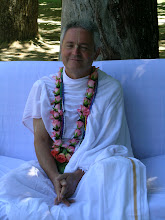
H.G. Matsyavatar Das

Showing posts with label ACTION. Show all posts

Tuesday, 11 March 2014

How to Build Good Relationships


Every our action implies a feedback from others (as a rule, the response we get is very much the same as our approach, whether it has just happened in the present or it happened in the past), this is the meaning of relationship.
A:B = C:D
The relation between A and B, affects the relation between C and D too. We are all connected in the big game of life.
It is just through the relationships that we have the possibility to express our divine nature, that is developing and experiencing our best original spiritual qualities. However we can experience a lot of sufferance as well.
Our inner well-being greatly depends on the way we trust people in the relationships and the way others respond to us. A sensible, caring person usually realizes within a short time, whether his or her words, actions and even thoughts has a positive or destructive effect on the others.
When a person suffers and seeks relief, compassion and trust, turning to somebody who can help, how can one find the cause of sufferance? Where do disbelief, depression, pain or negative feelings come from, what is missing? The deep cause is often rooted in the relationships.
Everything in the universe is ruled by the divine laws and this order is based on a dialogue, as Galileo’s quote recites: “Dialogue between Two Chief World Systems". Dialogue re-establishes an order, and such order should govern our relations too, so in any dialogue the first priority is to meet the needs of other person through attentive listening and sincere interest.
The more virtuous relations are, the higher is their quality and greater the standard quality of listening and speech skills.
Sattva is order, virtue, harmony. It is the condition that most of all favors our evolution. It is a conditioning state, it is not complete freedom, therefore even sattva guna is to be transcended. The conditioning that arises from sattva guna is the feeling of attachment to a kind of freedom that is always anchored to a mundane layer, in spite of a prevalent virtuous nature. Someone may think: sattva guna is good enough for me, because I am satisfied with one kind of pleasure and one kind of mundane virtues. However a person cannot be satisfied with this vision because there are negative sides and sorrows that cannot be avoid with sattva guna alone, unless one ascends to a spiritual awareness.
Among such sorrows, which cause a great deal of sufferance, is old age. Aging is a heavy humiliation because the person is not able to take care of one’s own basic personal needs, and sattva guna itself cannot free us from such great pain. Sattva is the condition we can easily obtain in our embodied life, although we ought to make another step forward to approach transcendence, in order to reach the abode and original nature of our spiritual eternal Self.

Monday, 21 May 2012

Action or Renunciation (part 2/2). By Matsyavatara dasa (Marco Ferrini)


The perfection of renunciation

In Bhagavad-Gita Krishna explains that the perfection of renunciation is not a simple physical detachment from the objects of the senses, but rather an emotional detachment from them (vayragya).
Tyaga is a first phase which must necessarily be exceeded in order to mature the real detachment, the emotional one, because an artificial detachment from things and people while going on longing for them, is a behavior that Krishna defines with the term “hypocrite.” (Bhagavad-gita III.6)
Therefore a true success in renunciation can only be achieved by getting rid of the egoistic desires and regarding this point there is an important teaching of Krishna:  “Both parting with action and the devotional action lead to the path of liberation but, of the two, devotional action is better”. (Bhagavad-gita V.2)  
The mere avoiding of the objects of the senses is a hard way that is not sufficient to achieve perfection (Bhagavad-gita III.4); transformation and sublimation of desire is possible by undertaking  the evolutionary path that starts from tyaga (physical detachment), passes through vairagya (emotional detachment) and reaches Bhakti (a devotional action offered to God).
The final teaching of Bhagavad-gita describes the best form of renunciation, that is, the action performed without egoistic motivation or attachment to its results, but in a pure spirit of love and service to the Supreme Lord. This highest form of renunciation is defined yukta-vairagya, the renunciation of the one who, having purified one's consciousness, offers everything to God. 
Such a devotional action performed in Bhakti spirit leads to transformation and sublimation of all the energies of the being, and thus it is considered even superior to renunciation, as it allows the human being to taste the complete and blissful relationship with God that can not be experienced due to a simple renunciation. 
Krishna exhorts Arjuna: “Perform your duty in order to satisfy Vishnu and you will stay forever free from the conditionings of the matter” (Bhagavad-gita III.9).
Bhagavad-gita teaches an attitude far both from an illusory identification with the immanence (the “world” and the  “flesh” of the Gospel), and from some abstract spirituality that denies the matter and neglects the physical body. 
Krishna urges to act efficiently, fully and with detachment, but without a desire for power and possession, a sacred action offered to God with joyful devotion.
In Taoist terms, it suggests a dynamic balance of opposites, action and inaction, obtained due to the superior knowledge that allows to live fully in the material world fulfilling one's duties without pseudo-meditative evasions and, at the same time, to be open to a real meditative dimension, that is meta-historical and meta-temporal one, of communion with the Divine.

Monday, 7 May 2012

Action or Renunciation. (part 1/2) By Matsyavatara dasa (Marco Ferrini)


The Art of Perfect Action

In the third and fifth chapters of Bhagavad-gita Krishna explains to his disciple Arjuna the art of  perfect action.
The perfection of action – karma yoga – can not be reached unless one obtains a clear understanding and a proper discernment of what is beneficial and what is harmful for the spiritual evolution of the individual, that is why the right behavior, or acara, can be achieved only if the right knowledge, jnana, has already been acquired. Jnana can be completed and improved only with a proper practice that leads to vijnana, realized knowledge, the wisdom: the knowledge transformed in action and applied with creativity in the right time, in the right place and under the right circumstances. 
Bhagavad-gita answers to a complex question raised by Arjuna to Krishna: what is better - action or renunciation?
Krishna, in an admirable way, explains that it is impossible to give up acting completely: in reality the so-called inaction does not exist. Everyone in the world is inevitably obliged to act, there is no life without action, even a single breath implies some movement, by a rhythm which is integral to life (B.g. III.5). As Krishna states everybody acts according to the tendencies acquired during the previous life experiences; even the wise cannot refrain from action, not even for a moment, but his way of acting is completely different in nature compared to the one who is unaware of true knowledge and whose motivation is impure.
Krishna urges Arjuna with the following words: “Carry out your duty as action is better than inaction. Without acting the man is unable even to maintain his body” (B.g. III.8).
Therefore renunciation should be understood not just as a complete abstention from acting – that would be impossible – but as an abstention from the impure activities, that implies avoiding the objects of the senses (tyaga), people and experiences that can lead us astray from our spiritual path.
Once Arjuna has understood this important teaching, Krishna reveals higher truth and, in the fifth chapter, declares that both renunciation from action and devotional action lead to liberation but, of the two, the devotional action is better.