The psychological experience of Hell, Purgatory and Paradise for contemporary man
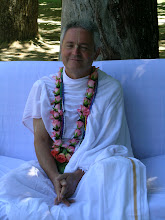
Saturday, 26 September, in Florence Palazzo Vecchio, Bhagavad-Gita from the Vedic-Vaishnava Tradition translated and spread by Shrila Prabhupada, and the Divine Comedy of Dante Alighieri met in such a suggestive location which inspired and charmed about six hundred people from all over Italy.
This Historical-Artistic context has hosted this event conducted by Matsyavatara Prabhu in a superb fashion. It was held in the De' Cinquecento Room and projected in the De' Dugento Room. The battle scenes of Vasari’s paintings, the Victory Genius of Michelangelo and the statues of Vincenzo De Rossi, representing Hercules fatigues seemed to evocate the crucial moments of the existential journey of Arjuna in Bhagavad-Gita and Dante's in the Divine Comedy. The anguishing crisis that they both live, which seems to them worse than death, takes them through a hard battle (la Guerra si del cammino e si de la pietade) from which they both come out victorious.
At first, Matsyavatara Prabhu, drew a cultural and social-historical-political contextualization of both works. He described the peculiar traits of the ancient Hindu-Vedic tradition and the medieval civilization of Dante’s times with reference to their respective sources. The speaker offered a widespread cultural prospective through a stimulating comparison-dialogue between East and West, tracing the connections between cultures that are only apparently far from each other: the great Greek and Classic Latin works, the ancient Vedic Rishi, the alchemic medieval tradition and the Dolce Stil Novo, the Islamic literature and the mystical sufi, Christianity and the tradition of the Vaishnava Bhakti.
On two big screens there were images that showed the contents of both works. Meanwhile Ferrini explained the psychological profiles of Arjuna and Dante’s characters in their surprising convergences. Two great political individuals, a prince and a prior who, in their existential and social drama, passionately undertake the search for an evolutionary path which will take them from the dark forest to the light of high consciousness, which are the nice intellect for Dante and the buddhi-yukta from Krishna in Bhagavad-Gita.
Through Matsyavatara Prabhu's explanations, the voices of Arjuna and Dante seemed to talk to each other and express the same existential problems of which we can experience the surprising reality. These crucial questions were answered by Krishna in Bhagavad-Gita and Virgilio and Beatrice’s teachings in the Divine Comedy and offered convergent solutions and values of reference. In both cases, the crisis experience shows to be the greatest stimulus for ones evolution which passes through the recognition and the overcome of one’s limits all the way to his illumination and his meeting with God. Dante re-conquers light through his descent into hell where he recognizes his vices and human mean actions and Arjuna finds his peace by fighting in spirit of offer to God, a battle that each individual is called to face in his life.
By answering questions from the public the characteristics of the levels of conscience of inferno, purgatory and paradise emerged vividly. They correspond to bhur, bhuvah, svahah in the Hindu-Vedic psycho-cosmogony.
The protagonists of Bhagavad-Gita and of the Divine Comedy were identified and represented in their deepest meaning. By exiting the halo of a merely literal and academic interpretation, they have strongly and clearly expressed their instances. The spectators were able to see themselves in their vicissitudes, they have met them in their lives, they have found them inside themselves because they are a surprising expression of weakness and virtues and of different tendencies and levels of consciousness.
Following are some subjects discussed during the comparison between Bhagavad-gita and the Divine Comedy. The archetypical image of the teacher, the obstacles found in a journey, the individual-society relationship, the alchemic ways of purification of the hearth and mainly, love as the top of the realization experience in both initiative paths. Bhakti in Hindu-Vedic tradition and the divine love of the Divine Comedy represent in both works the common goal to reach and, at the same time, the common way that leads to that supreme goal. In this goal is the sense of life before death and beyond death.
The journey between Earth and Heaven, between death and immortality, darkness and light, man and God, and egoistical passions and immortal love is the adventurous journey undertaken by Arjuna and Dante in parallel fashion and it is the same journey that each individual had the chance to undertake to regain his harmonic position in the universe and realize himself beyond the conditioners of ego, time and space.
Bhagavad-Gita and the Divine Comedy, Matsyavatara Prabhu concluded, are operas of never ending value and their extraordinary convergences remove the contrapositions between Orient and the West. They destroy lay and religious fanaticisms and teach to integrate the human being with the Divine and realize the Divine without neglecting the human being. Bhagavad-Gita and the Divine Comedy cannot only profitably talk between each other, but also enable the dialogue between today’s people, the individual and society, the creatures, the create and the Creator, by leading, with their highest expressions, to the realization of the divine wisdom and immortal love. “L’amor che move il sole e le altre stelle. “
Bhakti is such a supreme purifying strenght and transcendes time and space and constitutes the peak of any authentic spiritual journey.
We can provide a video of this event to those that are interested.
For more informations please contact us at csbinternational@c-s-b.org.


 Posts