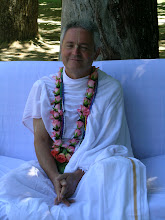
Thirty-eight
years ago, on 30 August 1976, for the first time I met Shrila
Prabhupada in a personal darshana... it was a turning point of my
life, a wonderful inner journey!
I was in an ashram in Rishikesh, at the foot of the Himalayas, studying the Yoga Sutras of Patanjali. In Italy I had been a successful designer, the manager of six companies. Upon returning from the trip I was supposed to get married, but at the time, in that place, I was seriously thinking of leaving everything and settle in India. That pseudo worldly success made me feel like prison, as not only it was no longer a source of satisfaction, but it became clear to me that it was the biggest obstacle to achieving happiness that I have been aspiring.
The recurring thought was to start a new life dedicating myself to the search of God and my spiritual essence. When I became aware of the voice of my soul I felt a strong appeal - it was an urgent need to revise my life, to think over my motivations and purposes. I understood that it was a turning point.
On that trip I was with a friend who has been always sick. Feverish, he remained for most of the time in our ashrama right on the banks of the Ganges. There was no furniture in the room, only two mats on the floor, his huge suitcase, my smaller one, a small window with a grate and a door with a latch. Each time we left the room, through the grates of the window the monkeys came in; they were having a lot of fun, especially with the bottles of medicines that the doctor had given to my friend.
It was in that ashrama that I met a sadhu, the person who has changed my life. Instead of attending the lectures on Patanjali, we walked together on the banks of Mother Ganga.
One day he said: “If you do not discover Bhakti, nothing will satisfy you.” Bhakti, Bhakti ... I asked to explain the meaning of this word.
"If I explain its meaning to you, you won't understand me.”
This sadhu spoke English with difficulty, but there was no need in too much words, it was a kind of telepathic communication.
"Bhakti is difficult to explain, only your heart can define it." And he began to chant this mantra:
Hare Krishna Hare Krishna
Krishna Krishna Hare Hare
Hare Rama Hare Rama
Rama Rama Hare Hare
We would spend hours chanting along with this mantra, then we would immerse in the waters of Mother Ganga: a rushing stream that takes away everything.
"You have to meet Bhaktivedanta Swami Prabhupada: he will make you know Krishna. Go to Vrindavan to meet him."
Hearing that voice deep inside me, without pondering too much, I left for Delhi along with my sick friend. From Delhi we took a train to Mathura and then in Mathura we took a cart for Vrindavan. Having arrived to Vrindavan in two days, I began to look for Bhaktivedanta Swami Prabhupada.


 Posts