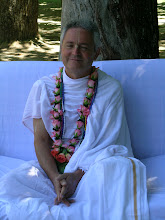
H.G. Matsyavatar Das

H.G. Matsyavatar Das

Wednesday, 11 November 2009

Dante's Journey and the Bhagavad-gita


The psychological experience of Hell, Purgatory and Paradise for contemporary man


Saturday, 26 September, in Florence Palazzo Vecchio, Bhagavad-Gita from the Vedic-Vaishnava Tradition translated and spread by Shrila Prabhupada, and the Divine Comedy of Dante Alighieri met in such a suggestive location which inspired and charmed about six hundred people from all over Italy.


This Historical-Artistic context has hosted this event conducted by Matsyavatara Prabhu in a superb fashion. It was held in the De' Cinquecento Room and projected in the De' Dugento Room. The battle scenes of Vasari’s paintings, the Victory Genius of Michelangelo and the statues of Vincenzo De Rossi, representing Hercules fatigues seemed to evocate the crucial moments of the existential journey of Arjuna in Bhagavad-Gita and Dante's in the Divine Comedy. The anguishing crisis that they both live, which seems to them worse than death, takes them through a hard battle (la Guerra si del cammino e si de la pietade) from which they both come out victorious.


At first, Matsyavatara Prabhu, drew a cultural and social-historical-political contextualization of both works. He described the peculiar traits of the ancient Hindu-Vedic tradition and the medieval civilization of Dante’s times with reference to their respective sources. The speaker offered a widespread cultural prospective through a stimulating comparison-dialogue between East and West, tracing the connections between cultures that are only apparently far from each other: the great Greek and Classic Latin works, the ancient Vedic Rishi, the alchemic medieval tradition and the Dolce Stil Novo, the Islamic literature and the mystical sufi, Christianity and the tradition of the Vaishnava Bhakti.


On two big screens there were images that showed the contents of both works. Meanwhile Ferrini explained the psychological profiles of Arjuna and Dante’s characters in their surprising convergences. Two great political individuals, a prince and a prior who, in their existential and social drama, passionately undertake the search for an evolutionary path which will take them from the dark forest to the light of high consciousness, which are the nice intellect for Dante and the buddhi-yukta from Krishna in Bhagavad-Gita.


Through Matsyavatara Prabhu's explanations, the voices of Arjuna and Dante seemed to talk to each other and express the same existential problems of which we can experience the surprising reality. These crucial questions were answered by Krishna in Bhagavad-Gita and Virgilio and Beatrice’s teachings in the Divine Comedy and offered convergent solutions and values of reference. In both cases, the crisis experience shows to be the greatest stimulus for ones evolution which passes through the recognition and the overcome of one’s limits all the way to his illumination and his meeting with God. Dante re-conquers light through his descent into hell where he recognizes his vices and human mean actions and Arjuna finds his peace by fighting in spirit of offer to God, a battle that each individual is called to face in his life.


By answering questions from the public the characteristics of the levels of conscience of inferno, purgatory and paradise emerged vividly. They correspond to bhur, bhuvah, svahah in the Hindu-Vedic psycho-cosmogony.

The protagonists of Bhagavad-Gita and of the Divine Comedy were identified and represented in their deepest meaning. By exiting the halo of a merely literal and academic interpretation, they have strongly and clearly expressed their instances. The spectators were able to see themselves in their vicissitudes, they have met them in their lives, they have found them inside themselves because they are a surprising expression of weakness and virtues and of different tendencies and levels of consciousness.


Following are some subjects discussed during the comparison between Bhagavad-gita and the Divine Comedy. The archetypical image of the teacher, the obstacles found in a journey, the individual-society relationship, the alchemic ways of purification of the hearth and mainly, love as the top of the realization experience in both initiative paths. Bhakti in Hindu-Vedic tradition and the divine love of the Divine Comedy represent in both works the common goal to reach and, at the same time, the common way that leads to that supreme goal. In this goal is the sense of life before death and beyond death.

The journey between Earth and Heaven, between death and immortality, darkness and light, man and God, and egoistical passions and immortal love is the adventurous journey undertaken by Arjuna and Dante in parallel fashion and it is the same journey that each individual had the chance to undertake to regain his harmonic position in the universe and realize himself beyond the conditioners of ego, time and space.


Bhagavad-Gita and the Divine Comedy, Matsyavatara Prabhu concluded, are operas of never ending value and their extraordinary convergences remove the contrapositions between Orient and the West. They destroy lay and religious fanaticisms and teach to integrate the human being with the Divine and realize the Divine without neglecting the human being. Bhagavad-Gita and the Divine Comedy cannot only profitably talk between each other, but also enable the dialogue between today’s people, the individual and society, the creatures, the create and the Creator, by leading, with their highest expressions, to the realization of the divine wisdom and immortal love. “L’amor che move il sole e le altre stelle. “


Bhakti is such a supreme purifying strenght and transcendes time and space and constitutes the peak of any authentic spiritual journey.

We can provide a video of this event to those that are interested.

For more informations please contact us at csbinternational@c-s-b.org.

Friday, 9 October 2009

PREDISPOSITION

From a lecture of Matsyavatara das held at the Bhaktivedanta Ashram on 25 September 2009

In every endeavor, good predisposition pays a decisive role. If there is no good predisposition, there is no success. Real success is spiritual success. All the rest has no consistence, it doesn’t last and has no value.

Since the Shastra undoubtedly explain that power, energy and strength come from purity, we deduct that the most important aspect to prepare ourselves for action is purification of the mind and of the heart. We could read and study many books but from this we would not draw strength for acting good and the capability of inspire others.

Strength comes from purity and purity couples with transparency. As it is possible to see an object through clear water, it is not possible to see it if the water is murky. The same is for a veiled mind, a mind that is dimmed, darkened by conditioners and doesn’t allow for the vision and discernment of reality. To see reality we need a state of transparency and inner purity.

The necessity of a good predisposition to act, funded on purity, must be understood well beyond its merely literal meaning because superficial or dogmatic interpretations cannot help us in times of need.

Even in communication, to be successful it is indispensible to have a good attitude for both who is talking and who is listening. When one of the interlocutor misses this sensibility and of this engagement, the dialogue inevitably is interrupted and doesn’t lead to the expected results. The intense desire of communicate of one of them is not sufficient. It is necessary for both to have the same desire.

The Lord talks to us through our heart, but if we do not have a good predisposition to listen we could not understand what He is saying to us. Shri Krishna is the highest Goodness, the Immortal Love, the Clemente, the Merciful, the Lord of Grace and Mercy toward every creature. The Lord loves us and the love that we can experience is nothing else than a reflection of His Supreme Love. It is His Love that makes us falling in love with Him, with life, with every creature and gives joy to our heart. So that we don’t disperse or contaminate our sentiments we must feel them only for what has value, without contaminate them with lasiviousness, greed, egoism and greedy. By cultivating purity we can reconstruct our whole reservoir of love and invest it all in our relationship with God and with His creatures. When this happens, visible signs will manifest in the person. This signs are: peacefulness, serenity, inner satisfaction and faith in the Divine providence.

He who is satisfied within his soul doesn’t need gold, silver or brilliants, doesn’t need recognition or honors because he has already found everything that satisfy him within himself. As Krishna explains in Bhagavad-Gita (XVIII.54), this person as no regrets, nor craving. He is deeply humble because he has realized that the illusory power of the energy of the matter is insuperable and that only by letting ourselves go to God we can overcome the borders of appearance and enter into reality (ref. Bhagavad-Gita VII.14). In its higher teaching, Yoga is that renewed vision, it is the reintegration of the Inner Self into the universal reality, the reconnection of love with God and with all of His creatures.

Inner freedom, the inalienable patrimony of each living being, must be utilized to turn to purification and pursue the supreme wellbeing. Even though many dynamics can escape our control, we always have the chance to modulate and choose our response to events and our inner attitude. If there are disturbing thoughts that hamper the correct acting, we can evoke exactly their opposite, as Patanjali rishi teaches in Sadhan a Pada (II 33): vitarka badhane pratipaksha bhavanam. For example, proudly thinking of being the center of the attention and aspiring only to our egoistical selfishness is lethal for our conscience. If we get such though, we must move to the opposite such as: “I act not for me but for the wellbeing of all creatures. I offer my actions to God with all my love. I hope God likes my sincerity and my humble offer, despite my limitations, and that He, in His endless mercy would give it real value.”

If Shri Krishna sees our humbleness and the sincerity of our efforts, He will give us the necessary intelligence and strength to act in any circumstance in a constructive way for our and other’s evolution. The secret of success is pure spirit of offering, predisposition to humility, tolerance, faith and joy, being ready to recognize other’s value and act for common wellbeing. With this attitude we can positively face any endeavor or event, even an illness, a serious loss or a betrayal.

When we face obstacle we must be determined and tenacious. Never get disheartened but rather face difficulties with serenity and trust, like an athlete that practices with enthusiasm for the hurdle race knowing that the hurdles spur him to improve his performance and overcome his limits.

Every event must be accepted as an important chance to grow and learn in the great school of life to realize a harmonic integration between body, psyche and soul, between varna and ashram, between individual and society, between immanence and transcendence.

On the worlds stage we see a game of opposed forces. Sometimes negative weaves submerge us and hamper the realization of our projects. By maintaining our goal fixed, we must learn to swim in the great sea of the being to find our safe harbor, our center, our balance, no matter how many continuous sollecitations that we are exposed to. In this hard but charming endeavor, good predisposition is essential.

Wednesday, 23 September 2009

THE VALUE OF RELATIONSHIPS - Part II


By Matsyavatara Dasa


Undertaking a project for our life and following it with coherence means funding ourselves and our existence on solid basis, which will resist to the many crisis that after all we all must face and that only in this fashion they can be transformed into chances to elevate ourselves through the recognition and overcoming of our limits by accelerating ever more our work toward objectives that value our journey in the world. We have a year, a life, an eternity in front of us.

Undertaking a life project and working on it with continuity will stimulate us to know ourselves deeply. It will help us discerning between our historical ego and the true Self, between illusory objectives and valuable ones, between ephemeral relationships and relationship propaedeutical to the awakening of the conscience. This would favor the great journey of every human being toward the most elevated consciousness and the realization of the inner and outer Divine. With every thought, desire, word and action we can express with intensity and every day with renewed freshness our deep instance to know and love ourselves, others and God, by loving God in every being and every being in God. In this way, inside ourselves and in every person that we meet we will put the seeds of pure love, that pure and universal sentiment that can satisfy the soul completely.

To develop this supreme love we must develop the qualities of the soul such as fidelity, loyalty, chastity, transparence, cleanliness, truthfulness, sense of responsibility, reliability, compassion, courage, friendship, determination and perseverance, by impressing them in our mind and mainly in our heart. We must not use a sterile willpower and cold rationale which will risk to makes stubborn or harsh. We must use the vital impetus of the soul, which makes us even stronger but flexible, determinate, however sweet, enthusiastic and patient at the same time thanks to the faith realized in the infinite potentialities of the inner Self and to that developed capability of dynamic balance that holds us straight even when we are pushed or when someone provokes us or disturbs us with an offensive behavior.

If we would follow the impulses of our mind we would reach with rage, with anger by using the worse part of ourselves, but, thanks to the practice of a lifetime discipline, we can transform these drives, by channeling them in a constructive fashion their energetic potential. Rage is then transformed into words that shake people from illusion without hurting them or making them lose their hopes, but giving them the vision instead.

This dynamic balance is indispensable to be developed all the way to the highest spiritual realization. The Indo Vedic tradition recommends the sadhana-bhakti method, which has been tested for millennia and its effectiveness has been experimented by countless people. It is a great level of inner discipline for the achievement of the highest endeavor in human life, self-realization. This necessitates of all of our commitment and a sure orientation because every great deed must undergo great challenges. If we desire valued relationships, many people will try us, with temptations and provocations. However, if we maintain our mind focused, the ephemeral pleasures will gradually lose any attraction, received offenses will seem to us as great chances to overcome our limits. The Lord of our heart, Shri Kamadeva, Who speaks to us from His heart to ours, will satisfy every most intimate desire of our soul, every aspiration, every joy that we wish to offer to the service of God.

He who desires to become ascetic, will become a true ascetic, he who desires to be a good head of the family, will become a good head of the family, he who will want to produce wealth for the benefit of all will develop the intelligence and the resourcefulness to do so if he behaves in accordance with the cosmos-ethical order of divine origin who sustains every being of the whole universe. However, he who grabs for himself will never produce anything, nor for himself, nor for others. He cannot be happy if he is not in a stable evolutionary trend.

To undertake this evolutionary trend we must commit ourselves to overcome our limits. Those limits that are genetically structured and are the consequences of the environment in which we lived and those that are the result of mistakes that we have made.

We can be successful if we invest in faith in ourselves, in our intrinsic qualities and in the qualities of others by rediscovering that treasure that hides in each one of us and that matches our deep essence. The defects, the conditioners and the limitations that we are suffering for are layers that cover our true identity.

Do not get discouraged if you don’t see immediate results. In reality these results are already structuring themselves at a subtle level even if you don’t perceive them with physical eyes. However, who is expert and knows how to look inside his heart, can see them.

Since everything in this world is inseparably connected and due to the universal law of reciprocity all that is done is returned, to value ourselves we must value others and we can do it if we put trust in their qualities by expressing the persuasion that they can do much more than what they believe they can. We must be always ready to offer words of comfort in time of need, so that the memory of us will help even when we are no longer with them and they are no longer with us. We need to ensure that our words and our life example help them facing the hardest moments, the toughest trials, by offering that energy and faith that is needed to proceed even when the road is uphill, to maybe later discover that, after the curve, the uphill road ends and la downhill one begins. Many of us may already have had this comforting experience.

Every individual can realize himself if he undertakes constructive activities toward spiritual realization, the only ones that deeply satisfy us by allowing us to express our creativity for the best. He can realize himself if he entertains relationships that have evolutionary purposes, those that fill the heart with joy and can be shared by all because true love is not exclusive. Most of all we should privilege our relationship with God, however, since every creature is an expression of the Divine, respect, attention, appreciation and affection should be given to every being.

The destiny of the body is uncertain, we could die suddenly for a serious illness, an accident or who know what. We don’t know what could happen to this structure of the matter in which we live, but we have a great certainty. If here and know we undertake an evolutionary journey it will continue even after we depart this physical body and what we have sow here will bloom elsewhere and will make our progress happy and fast.

We will come back in a favorable environment, from parents that will educate us with love and we will meet special people who will orient our journey.

Let’s try to live in the most humble way possible by engaging our energies that the Lord has given us to serve Him for the wellness of all. Let’s not complain if we are called to sit on a throne or on the floor. If usefulness is the principle and usefulness is functional to an evolutionary purpose, we must be available to do anything that we are asked to do, beyond our egoistical preferences. The Katha Upanishad explains that true pleasure that lasts and satisfies completely comes from duty.

Talking of subjects like these with those that are dear to our heart and those that are mostly receptive, means exchanging love gestures. These are the true effusions of true love, the expressions of the most noble among the sentiments.

Love, act with your heart, with playful spirit to favor the great evolution project of life. This attitude will give you every joy and will allow you to develop all perfections.

Friday, 18 September 2009

Dante's Journey and the Bhagavad Gita


Tuesday, 15 September 2009

THE VALUE OF RELATIONSHIPS - Part I


By Matsyavatara dasa


The quality of any relationship is guaranteed only if we know how to appreciate the qualities of others and the quality of realization per se. The lack of such appreciation produces lack of relationships. To overcome this, the first indispensable step is learning how to recognize the value of others.

What to say, when and to who is not always easy to understand or guess. Human relationships are a complex universe. Sometimes we put our hearts into a relationship; we try to develop it at the best of our capability; however we are not successful in building with the counterpart what was within our intentions. We should commit ourselves to do the maximum with the intention to evolve, with joy and desire to grow together, however without expectations. We should always be open to answer to the other person in respect to his freedom. If we really want to learn to love others, we should not lay passively on them by developing unhealthy relationships, depending on others by loading them with our expectations and egoistical claims thus suffocating the chances for interaction and operate favorably for the well-being of all. He who cannot practice this basic principle falls with the falling of the relationship. He loses height and falls on the ground without having the chance to realize it.


Let’s invest our best energies, all of our intelligence and our heart into our relationships. Let’s do it however without falling into perfectionism, thus being humbly conscious of human limitations (ours and others’). Even this will help us appreciated the value of what we are building.

To build a relationship, whether a love one or a friendship, with relatives or between Guru and disciple, you must consider three fundamental principles that were established by Vitruvio as priority:

  1. stability

  2. functionality

  3. beauty


A building must be stable, sturdy and strong enough to withstand the collision of time and of natural events. The same is for a relationship. We cannot build on a frail soil that doesn’t hold. We must necessarily choose solid grounds. If we deal with frail grounds, we must first of all begin with solidifying the ground itself before we initiate the construction. We cannot solidify the ground and at the same time begin the construction. It won’t work. Certainly the building will not stand, just like a relationship will not withstand the collision with time and trials of life if it is not well based, well prepared, cultivated, enforced and matured.


To enable the manifestation of our and other’s talents and qualities, develop the siddhi, or perfection in relationships, and make them ever shiner, in all their expressed potentiality, we must build on solid basis. To do this we must operate with continuity, without intermittence, distractions or dispersion of energy. Vice versa, our chances for development and realization will remain unaccomplished and feeble like little fireflies that turn on and off in the darkness of the night. Discontinuity and consequent mood swings ruin relationships and everything that we do. They are the Minotaur that must be dealt with and overcome if we want to pursue our goals.


Other than operating with continuity to favor the vigor, the uphold and the stability of our relationships, we must set up our relationships based on what is most functional. Functional to what? To our and other’s evolution.


The relationship could be stable and beautiful per se, but if it is not functional for the high purpose that we have pre-defined, what would be its value?

To learn to set up our relationships in accordance to the principle of functionality, it is important to develop the qualities of flexibility, ductility and elasticity that allow us to choose, in accordance with the situation that we find ourselves in, the proper behavior for that time (kala), place (desha) and circumstance (patra) in relation to the values that we have undertaken and that we intend to pursue.


Lastly, other than being stable and functional, a building, in accordance with Vitruvio must be also beautiful and the same is for a relationship.

As much man has made all kind of efforts in establishing aesthetical standards, the sense of beauty has always remained outside of strict schemes or pre-defined categories. Beauty is proportion, harmony, perfection of the form, but also that certain “don’t know what” that represents the charm of a certain thing, person or relationship, its uniqueness. Therefore if we sharpen our look, elevate our conscience and purify our hearing, we can discover charm and beauty in every being and relationship by realizing that beauty is beyond mere appearance. It corresponds to the intimate essence of what it is. In the tradition, in fact, beauty was inseparable from goodness and from the qualities of the soul. Engaging in affective relationships based on superficial aesthetical criteria, the deceitful criteria of the forms, means settings ourselves up for sure failure. “Don’t be fouled by the width of the entrance”, said Minosse to Dante and also “Pay attention to who you trust”. This is important so we do not get into relationships that come from sudden choices which only result in frustration, suffering and many times depression and desperation.

Let’s commit ourselves to interact with others with the constant and unique desire to benefit them, to pursue their success, the true one, which is of spiritual nature. This would represent the best protection for our life, ourself and our relationships. It would be the powerful principle, even though invisible, that will lead in the evolutionary way every choice that we make and will orient us always toward the right direction at every crucial intersection of our life. Let’s learn to relate always by leaving to others the chance to accept or refuse our offer of love, because love lives of freedom.

Let’s listen to our inner voice when we act and operate in the world and we entertain relationships. If this voice gives us advice, if it urges us to be cautious, let’s pay attention to it and let’s act carefully. Let’s not jump into situations or relationships that could be dangerous and that could harm us or others more than what our little intellect could understand. The gradualness in establishing and entertaining relationships is essential. Once you have made your decision with reflection and farsightedness, do not change plans suddenly, by following indiscriminately the impulses of your mind or senses and letting instinct take over and overcome the basic principles of stability and coherence. Unfortunately the predominant setting of modern society leads to act in superficial and sudden mode, regardless of times and relationships. However, if we want to build valuable relationships, we must invest in time and attention, sensibility, maturity, care, preoccupation, sense of responsibility, coziness, tolerance, capability of open ourselves to others to communicate and listen deeply.

Lets avoid to entertain those relationships or actions that are not coherent with our life project that we intend to realize because, without a project and without following with continuity the method that will lead us to its realization, we would only start every time from scratch, wasting time and energies and showing to ourselves and to others the worst side of our personality.


Friday, 11 September 2009

La India del Auto-Conocimiento


Inauguracion Viernes 11 de Septiembre de 2009 20:30 hrs.
hasta el domingo 20 de Septiembre de 2009 Casa de Cultura de Nuevo Leon, Monterrey, Mexico.

ENTRADA LIBRE

Logos: Conarte - Casa de Cultura - Artes Visuales

NL Estado de Progreso

Wednesday, 9 September 2009

AKINCANA (devoid of material possessions)


By Matsya Avatara Dasa

From the book: The 26 Qualities of the Spiritual Researcher

Other meanings: not searching for material objectives, simple, non-possessive

We find this principle in an important passage of Patanjali's Yogasutras1, where it is said that in order to attain perfection or samadhi, the yogi must renounce two attitudes: asteya and aparigraha, respectively misappropriating things we do not own and cultivating a sense of possession towards things or persons.

Many psycho-pathologies are not very explicit; in the name of affection some people morbidly control others, something that is absolutely not favorable to anyone's growth, development or maturity, including one's children, spouse, patient or disciple. When there is a sense of possession, the carrier of this sensation is unable to grow and remains on a childish stage for the rest of his life, frivolous and incapable to cope with the needs and problems of everyday life, unable to think with his own brain.

We should never desire to deprive others of their ability to reason and decide, of their intellectual faculties, by blocking and inhibiting them. On the contrary, we should favor the development of such abilities and potential.

Someone could think that if we seriously consider Krishna's words in Bhagavad-gita we could remain conditioned by them, but this would be an excellent conditioning: it would be an honor to depend on the words spoken by Krishna or by the Spiritual Master; only when the Master is blocking us in our development we need to understand that we are not facing a Guru but something else.

The Guru is a friend and facilitates the expression of all potentials, virtues, qualities and talents. He rather tries to offer some orientation and to purify the qualities that are often covered by innumerable anarthas.

A person who is culturally and spiritually immature will think he needs to keep a distance from everything and everyone lest he compromises the principle of akincana; actually we need to keep our distance from the sense of possession, not from the utilization of what is useful. The money that we need to live in a healthy, honest, sattvic way is called lakshmi and is a blessing, while the extra money, that serves vice and mere sense gratification generate attachment, and we should be wary against it. To own warm clothes for the winter does not break the virtue of akincana; possessing a collection of overcoats does. Having a pair of sandals to walk and spread the glories of the Lord is very good, while having wardrobes filled with shoes produces confusion in the mind.

In order to be in harmony not only with the principle of akincana but also with the principle of ahimsa, we should avoid purchasing leather clothes or shoes: they are not required to protect ourselves from cold and rain. Fur coats are much better suited to the animals: killing animals to get clothes or food belongs to a barbarous and unevolved mentality.

If for some reason we had to live at the North Pole and there was no other way, then eating fish or meat would be acceptable, but in the place where we live there is no need to inflict violence to other beings.

The sense of possession blocks, inhibits, dulls our consciousness. Even persons who have serious personality disturbances still have intact talents deep in their consciousness, but they do not know how to activate them any more, because they are not even aware they have them. Our intention is to operate in such a way that our interlocutor rediscovers it and reclaims his natural talents.

Akincana is an important virtue; one who possesses it does not desire anything for himself, he only wants to have the instruments to benefit others and be useful. He finds satisfaction in awakening others and because he is not interested in their body, their possessions or their minds, he can be trusted. Such a person sees others as traveling companions, helpers to spread his mission. Abstention from material and psychic possessiveness helps us to unblock our complexes.

This is why dhana (donating) has a crucial importance in the culture of classic India. One can donate things and eventually oneself; we must remember that if we are not trained to donate objects, we will never come to the level of donating ourselves.

The beautiful prayer called "Gurudev" asks the Master to liberate us from the desire for personal honors: this is undoubtedly one of the greatest and most important acts of renunciation. In fact, as stated in Isha Upanishad, we are not owners of anything, nothing belongs to us in this world and the proof is that at the time of death we must leave everything. So for what reason should we desire honors? The radiant path of bhakti rather asks us to respect and honor all creatures, not to feed our thirst for personal honors.

Some people make important choices for the life of others, thinking that in this way they will be possessing them; this is a very widespread phenomenon. Instead, we should start from the concept that our interlocutor has his own personality and the right to decide. We can offer some perspective but we cannot demand anything from anyone. In some relationships, such as between parent and child, Guru and disciple or therapist and patient, there is naturally a pact or we make a pact by which the one who is responsible for the other can have a justified measure of authority, but he should always use it very cautiously. There is also a pact between parents and children, by which parents have the duty to educate the children, but we need to make a distinction between educating and controlling choices.

A head of State in a dictatorial regime decides by himself also for the others, disregarding the will and wishes of innumerable persons, creating discomfort, dissatisfaction, fear and resentment.

Some foolish and ignorant people read the stories of the Puranas, Mahabharata2 and Ramayana3, and confuse the Vedic kings with the modern kings, but the monarchs of the classical Indian times used to take care of their subject as their own children. Kings of this type have disappeared long ago, and considering the trends of the present kings, the disappearance of monarchy has been a blessing.

Nobody can have dominion or possession on the lives of others. We must teach people to think with their own head, to take care of their own needs, to respect others and to express genuine sentiments. This is the purpose of a master, a therapist, a parent. Being surrounded by capable and self-sufficient persons is a great satisfaction; on the other hand it is very painful to be around people who move like robots, without any creative ability.

If we do not re-establish our spiritual health we will simply chase mirages, because it is precisely this loss of connection that caused the pathology. The disconnection on the ontological level where we belong is the origin of alienation. When we say we care about someone we should demonstrate it with what we do to wake him up spiritually. Even those who will not listen to deeper, metaphysical discussions can be offered unlimited information and be greatly influenced by our personal behavior. A person can pretend he is not watching, he may act as if he is not interested, but in time the model will become ingrained because it is already engraved into the heart, because it is Truth, Reality. For example, everybody knows that animals have the right to live; simply they pretend they do not know.

The model has an archetypal function. We can make good sculptures only when the model has penetrated deep within ourselves, thus we first need to absorb it. This is why it is important to have a relationship with the Guru, to work with him and perform activities that enable us to be corrected; this helps us proceed towards perfection.

Akincana is the practice of detachment, a sort of vairagya, it means renouncing what is unfavorable to spiritual realization and immediately utilizing all that is favorable.

1 Author of the famous aphorisms on Yoga (Yoga-sutras) and codifier of the Yoga Darshana. Tradition also ascribes to him a study on Panini's Sanskrit grammar and an authoritative treatise on medicine.

2 Famous epic poem of ancient India, the greatest ever written by mankind, constituted by more than one hundred thousand stanzas in classical Sanskrit, a vast catalogue of divine and human personalities, an encyclopedic poem expressing the spiritual, ethical and social values of Indo-Vedic society. Also called "the fifth Veda", Mahabharata is traditionally ascribed to the great sage Krishna Dvaipayana Vedavyasa.

3 Literally, 'Rama's journey'. Epic story (Itihasa) composed by Valmiki in 24.000 stanzas in splendid classical Sanskrit. It narrates the descent and the divine deeds of Rama in the role of the perfect monarch.