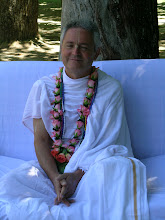
H.G. Matsyavatar Das

Showing posts with label Bhagavad-gita. Show all posts

Saturday, 8 August 2015

What is devotional service?

Devotional service, as it is referred to in the Bhaktivedanta tradition, is made up by all those free and voluntary activities which the bhakta, or person who dedicates his entire life to a spiritual quest, carries out by offering them in a devotional attitude to God and to whom he has chosen as his own spiritual guide, that means his Guru.
Such activities are carried out, after an accurate aforethought choice, in the terms and ways which he feels most suitable for himself, in order to foster his ethical and spiritual development and to support society with a contribution to the common well-being in a spirit of selflessness and solidarity.
In fact, devotional service is the most important tool which can guarantee a permanent connection of the individual consciousness with the cosmic consciousness: when consciousness is connected to God, it goes beyond the dualism of good and evil, of excitement and depression or of elation and dejection. In this way even the mind gets firmly connected to God, and so the willpower is strengthened and becomes determined.
Bhagavad-Gita II.50:
“A man engaged in devotional service rids himself of both good and bad actions even in this life. Therefore strive for yoga, which is the art of all work”.

Matsyavatara das

Friday, 6 September 2013

School of Life: How to Learn from Good and from Evil.


The Sacred Texts tell us that without receiving mercy from the Spiritual Master and from the Supreme God it's impossible to overcome for good the egoistic attachment toward mundane things. In order to succeed, not only we need to have received divine benevolence, we must have kept it too.
In which way we can receive mercy? Firstly by seeking it ardently, and behaving consequently, by dedicating ourselves with diligence and faith to spiritual practices and so awaken Love and Awareness.
And in which way we can keep it? By offering it to others. Then and only then, through constant and coherent efforts toward achieving Bhakti in our lifespan, we will be increasingly able to discriminate reality from illusion, the essence from appearance, the eternal from ephemeral.
Mice see the cheese but not the trap. In the same way conditioned souls see the promises of pleasure in this world's things, but hardly can understand that this pleasure hides a trap. A mortal trap.
How to be detached from the world and its overwhelming beauties? How can we resist when we see something appealing, pleasing, good smelling and shining? We should think about it in connection to God. It is difficult to deny this world; the more we deny it the more we are attracted to it, risking to become hypocrites who refuse the world's attractions outwardly while inwardly craving them (Bhagavad-gita III.6). Therefore we should not refuse this material world's beautiful things, but to use them to serve God with Love, correlating them to our spiritual origin, and living them in the vision of eternity. Accordingly, in any circumstance of our life we can connect to the Lord and to our deepest spirituality. Even bitter experiences, the biting words we received, the mistakes we made, at the end can turn into gifts, only if we can learn from the lessons they offer us. Gratitude and appreciation can permeate everybody and everything appear in this world, because we make use of every experience to get closer to God.
This gratitude can be felt and can be expressed both when we receive "good things", and when we get "bad things", being conscious that the light of the day cannot be appreciated without the night's darkness.
As you would expect, it is necessary that we learn how to discriminate between vice and virtue, between good and evil, so we can choose once far all righteousness and be firm in sattva-guna, but also we must be aware that Reality is beyond. It is that pure spiritual dimension in which mundane good and evil are transcended, and they merge in the "sommum bonum": the supreme goodness beyond duality. And supreme goodness is unconditioned pure Love that change and purify everything. Such dimension can be reached when any desire we have becomes an offering to the Lord and all our perceptions are dedicated to His service.
By living in this perspective we will find treasures around each corner, hidden in any occurrence of our life. And we will walk toward death full of gratitude because we understood that by practicing Bhakti even death leads us to life.

Wednesday, 6 February 2013

How Can I Become a Peacemaker?


Part I 


Peace is the result of coordinated efforts and persevering attitude, but first of all it is the result of deep awareness of the concept of peace, in all its countless nuances and implications. The acquisition of this kind of awareness implies a broad-minded vision of all the dynamics implied that is in fact an indispensable way to start, in order to find in every circumstance the correct way of action, the one able to provide for a concrete development of peace at all levels (individual, familiar, social, political, economical).
Science and religious traditions of all times, agree by stating that there are universal laws which govern the universe (in Greek the word is cosmos, its meaning is either ‘order’ or ‘universe’). Such laws rule and support the whole creation and every manifestation of life, from mankind to the microscopic insect, and are the expression of an order that the modern quantum physics defines as “implicit order”, which is beyond mere appearance; a veiled, subtle reality from which derives “the explicit order” visible through natural phenomena.
In the Vedic Vaishnava tradition, this order is found by the reunion of life and the world and is known with the word dharma, from the Sanskrit root dhr which means ‘hold, support’, or else with the noun rtam, defined as "fixed or settled order, rule, divine law or truth” which derives from the Sanskrit root  ṛ- "to move, rise, tend upwards" that, in this case means  “regular flowing of things”.
By being really interested to build a world of peace we intend to be interested with knowledge and harmonization of these universal laws, which the religious tradition of all times consider the expression of a superior Intelligence, the cosmic Consciousness, God. Peace means to synchronize one’s own inner dynamics with the cosmos’ dynamics; by learning to move in harmony with that universal order which already exists (there is no need to make it up),  and whose infraction is the cause of unsteadiness, wounds, conflicts, within us and outside. Peace is not a need for a  moral order, it is an indispensable factor for man whose life, in order to live in harmony, is tightly connected to the whole universe and all the creatures in it. Without such awareness, the value of peace becomes a meaningless concept designed to remain ambiguous and prompt to be jeopardized by those who persevere in other purposes. In the name of such kind of peace, all the crimes committed in the present and the past, testify it as true.