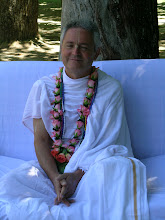
H.G. Matsyavatar Das

Tuesday, 26 May 2009

The Science of Meditation - Part V


THE SCIENCE OF MEDITATION”

Lecture by Matsya Avatara Dasa

Naples, Castello Angioino, 20th December 2008

Conference “The Science of Meditation”


HARMONIC INTEGRATION OF THE INDIVIDUAL IN THE UNIVERSE

Another important factor in meditation is social integration: not in a corporate sense, and not even in a sense of caste. In this case, social integration means the ability to interact harmonically in a constructive and evolutionary sense, with all creatures - the vision that values each creature, birds, reptiles, fish, what to speak of human beings, potential fellow travelers from whom we can learn to progress in our development. In one sense, what we have described could be a part of the most important abstentions mentioned by Patanjali, non-violence, or ahimsa

Finally, the fundamental factor for an effective practice of meditation is spiritual tension, that irrepressible need in each human being to turn and follow ideality. Meditation cannot exist without this need to realize this ideality within ourselves.

The principles of freedom, justice and love cannot be stopped and everyone of us tends to realize them, so as much as we dedicate to develop our idealities, we become ecologic in our environment, we favor not only the persons with whom we live, but the environment in general, and we integrate with mankind and with all creatures. This ideality, that can initially be experimented sporadically with an inconsistent practice of meditation, should become the model of our entire life, constantly and daily, if we want to attain perfection in meditation. Perfection does not exist on the human level - we can have a tendency, a movement towards something, we can walk towards something, but we do not need to be afraid of acting, thinking that because we are not perfect, our actions will be imperfect. Our actions will be imperfect anyway, but if we start walking into the proper direction and we move towards perfection, each step will bring joy, that essential, inner joy that is full satisfaction, samtosha, contentment, tushti, that makes a person extremely tolerant and humble. The level of realization we have attained is not shown by our social position, by the flags we carry or by the colors of a uniform: it is shown by our humility and tolerance.

EMOTIONAL DETACHMENT AS THE KEY FOR A HIGHER PLEASURE

For this reason knowledge and wisdom must be transformed into emotional detachment, a detachment from what is not useful but damaging, that obstructs our evolution. The first level of detachment to be applied is to withdraw the senses from their objects (pratyahara), so that they do not become wild horses - we should not restrain them with violence and repression, but rather we should channel them in an evolutionary project that is functional to our inner growth. This renunciation is not brutal deprivation dictated by dogmatism or prejudice, rather it is attractive and effective abstention that we naturally apply in the moment when we experiment something higher.


The embodied souls can abstain from the enjoyment of the senses, although the taste for the sense objects remains. But if he loses this taste by experiencing a higher taste, he will remain fixed in spiritual consciousness. (BG II.59)


In Sanskrit, param literally means "higher" and drishtva "having seen": when we have developed a higher vision we can renounce a lower vision. We should not be afraid of inhibitions: some areas of the brain and some organs of the body are inhibited when we do something that requires our attention. This inhibition will certainly not prevent us from a journey of evolution, on the contrary it is something that we directly dominate and therefore we can manage in a sensitive and expert way, renouncing something inferior for the benefit of something superior. This act can be described as asceticism, in Sanskrit tapas, the ability to renounce with an act of will, a deliberate choice, leaving something inferior in order to obtain something superior. It implies an extraordinary consistency with a planning aimed at liberation from conditionings, and thus to the dissolution of all the virulent samksaras that condition the individuals, moving them with irresistible force. This benefit extends to all the guilt feelings or complexes that thrive in our unconscious and were created at some time in the history of our existence: their negative effects are dissolved and the individual becomes free from the prison where he was languishing.

Asceticism in itself does not exhaust the meaning of meditation, but constitutes an important component; it must be accompanied by prayer and right action, in other words by actions that are beneficial for all creatures, creating the least possible damage (ahimsa), for example eating only foods that were obtained with the least possible violence: grains, vegetables, pulses.


Our objective should be the structuring of our life in a really planned way, aimed at attaining the highest level of evolution in this segment of existence, and consequently aspiring to a more evolved body in our next life. Vishnu Purana explains that there are 400,000 levels of evolution within the human species: there are humans, sub-humans, super-humans, saints and criminals, so many different types as there are different psychic structures and their chthonian pushes that come from the deep. These impulses can even control and dominate man inexorably, and when they are destructive and anti-social they can push him to commit horrendous crimes. Recognizing that some of these impulses are uncontrollable and irrepressible, the judicial system has decided that such individuals should not be sent to jail but rather treated in special structures called judiciary mental facilities. However, before coming to such extreme and compromised situations, it is possible to apply preventive measures, treatments, plans and methods of which meditation is a part and a concrete example.


Tuesday, 19 May 2009

The Science of Meditation - Part IV

THE SCIENCE OF MEDITATION”

Lecture by Matsya Avatara Dasa

Naples, Castello Angioino, 20th December 2008

Conference “The Science of Meditation”


THE PSYCHIC ORIGIN OF BEHAVIOR AND PERSONALITY

Actions have an extraordinary effect on us, creating a sort of photocopy in the substance of the mind that becomes impressed into our psychic structure; everything we do, everything we say, think or desire, leaves a trace. Thus, following the path of the great teachers, who know the human psyche and the soul of the human being, and especially his real divine nature and his prison, as Plato describes, and without despising the physical body, we can say that we are where we are because we have wished, thought, spoken and acted in a particular way. This vision is only apparently deterministic because it constantly evolves: in the very moment we are speaking and you are reading there is already a modification in your understanding and in your samskaras.


Each desire, thought or word, creates corresponding physical manifestations; in the Vedas the word, called vac, is described as the source of creation. It creates the worlds - and this is really a fact, because through words we express our state of mind, and therefore words must be as truthful as possible, because even before cheating others we are cheating ourselves. However just like action the word remains an external manifestation of an inner process, the process of reflection, vicara, of thought and, even before that, of desire. The Brihadaranyaka Upanishad explains that "man is nothing but desire": thus it is essential to select desires because the unconscious contains a great quantity of them, "an entire herd of restless horses", to use Plato's metaphor. We have the duty to direct and guide these impulses that surge from the unconscious, as soon as they pass the threshold of conscious thought or consciousness where we can become aware of them. Ultimately our temperament is the result of a chain of desires, thoughts, reflections, words, actions, patterns of behavior that interact with emotional components of various strength to become tendencies, characteristics of our personality that dictate our actions if we do not channel them in the correct way. In order to act on these almost unconscious stages we need to access that dimension that is beyond the threshold of awareness, and for this we may use various paths: meditation, prayer and dreams, considered by Fraud as the "royal access to the unconscious". All these paths can help us to investigate our inner dimension and to expand the radiance of our consciousness more and more, shrinking the darkness of the unconscious, of the unknown, to know ourselves in a deeper way. The practical application of such techniques requires a theoretical and practical knowledge that we can experience in everyday's life. The experience of meditation can continue while we talk, walk, eat, or sleep: we do not simply meditate when we sit cross-legged. However, to attain a continuous state of meditation and therefore to be always aware of our deep nature and of the interaction we have with the external phenomena, it is important to consider a few aspects and especially the fact that our psyche is like an arena where titanic forces of opposite tendencies constantly fight one another. These tendencies are sometimes entropic, sometimes syntropic, evolutionary and involutionary, bringing health or disease. We could express this struggle with the powerful mythological language, describing it as the endless fight between Good and Evil.

There are obstacles to meditation. According to Patanjali, such obstacles are distraction (vikshipta), and the fogging of consciousness, the dullness, the fall of the level of attention (mudha), while selective and constant attention is essential for a good result in the practice of meditation.

INDIVIDUALITY

Another central aspect we need to consider about meditation is about individuality: each individual is only equal to himself, each one is an individual, each person has his own journey. There is no real equality in this sense, because each person has lived a different life and had different personal experiences.


I have created the four divisions of human society'

on the basis of the three influences of material nature

and of the activities connected with them; however,

know that although I am the creator of this system

I do not act within it, because I am unchangeable


At the time when the individual, the spiritual being, leaves a particular physical body, he travels in a psychic bubble constituted by samskaras and vasanas, where he is enclosed, and the stronger tendencies will be the ones that will specifically determine the nature of his subsequent qualities and therefore the place, the species, and other factors connected to another material body destined to be inhabited by that particular jiva. The psychic structure is thus different from the experiences we carry on from previous lifetimes and, lifetime after lifetime, determines different births even for twins born from the same ovum - what to speak for "mere" brothers, fellow villagers, or people from the same country or culture.

The influence of the three archetypal forces, or gunas, that constitute material nature, prakriti, and the luggage of the fruits of actions performed in recent or distant times, or karma, are different for each individual and therefore, when a person wants to approach the practice of meditation, we need to know him at a personal level because each person must be helped and guided in a special way, peculiar to him on the basis of his guna and karma.


FREEDOM

If individuality, the specific character of that particular model of personality, is unique, we need to reflect on the concept of freedom as natural implication. No practice should deny freedom to the individual, and no Master should deprive his disciples from freedom. There should be no pressure, but a free choice of obedience to an offer, a proposal by a model we consider more elevated than others. The relationship with the person who meditates must always be based on freedom, because a person can meditate as much as he is able to be free. There will certainly be mistakes, he will probably not be able to escape some automated mental patterns that might have been influencing him for so many lifetimes, he will not be immediately able to renounce something - an obstacle, a conditioning, a habit, a food, a drink, a relationship - but if we understand freedom and recognize the specific nature of that model of transient personality, the individual will be free to express himself according to his own level of consciousness without destructive impositions, but rather with offerings inspired by the pure spirit of bhakti, loving relationship, of prema, with an investment in affection, because by definition love does not need anything in return: it is sufficient in itself.


Friday, 8 May 2009

“When we dedicate ourselves to spirituality or science, we are not doing something extra. We should not think like “let priests or scientists deal with it”. Nowadays we should go beyond this kind of mentality and we hope that the new millennium will help in this sense. For his/her own complete self-realization, each one of us primarily needs to satisfy both the rational needs of the intellect and the deep aspirations of the soul”.
Matsya Avatar Das

Wednesday, 6 May 2009

The Science of Meditation - Part III

THE SCIENCE OF MEDITATION”

Lecture by Matsya Avatara Dasa

Naples, Castello Angioino, 20th December 2008

Conference “The Science of Meditation”


THE UNCONSCIOUS "PEOPLE"

During our introspective journey we encounter a number of experiences that the individual lives unconsciously, almost unknowingly, but that keep interacting with him every day. These unconscious experiences can be individual or common to various creatures, and constitute an integral part of this universe in its entirety. This is the case of the collective unconscious described by Jung. The collective unconscious constitutes the world of archetypes, the world of symbols, where eventually an American, an Indio, a person who lives in Cape of Good Hope, an Eskimo or a Chinese, have the same essential reference systems: this is indeed the universal nature of symbols. Such is the crucial importance of the concept of memory or remembrance, in Sanskrit smritaya: what can be remembered both at conscious and unconscious level.

These memories are all the more conditioning when they are unconscious, because a memory or a conscious thought can be temporarily or voluntarily put aside by a person who may be trying to concentrating on something else, while an unconscious memory, precisely due to its nature, cannot be directly and consciously managed by the individual, who becomes agitated by such memories. Similar experiences stored in the deep unconscious or karmashaya are called samskara, where sam means "together" and kara comes from the Sanskrit root kr meaning "to do". In themselves these experiences have no positive or negative value, but their importance is in the powerful influence they have on the individual, who generally and incorrectly thinks that he is the author of his actions. Similar experiences attract one another and dig deep grooves into the unconscious psyche, veritable paths on which the individual always treads, reinforcing them more and more. Such psychic grooves are constituted by the individual tendencies, vasanas, that are also positive or negative. So we are often agitated by the unconscious without knowing it, pushed by our tendencies that may be artistic, scientific, harmonizing or oppressing, pacific or hostile, and obviously in order to really become the masters of ourselves, we must clean out such tendencies, especially the negative ones. There are very precise and effective techniques that enable us, through the use of will power, to transform the contents of the unconscious: a fundamental work in order to engage in the path of meditation. Only in this way we will be able to free our intuition power, the "path of the heart", that we can successfully walk only if the heart has been properly purified.


INSTRUMENTS OF KNOWLEDGE: INTUITION BEYOND PERCEPTION

In order to attain knowledge we can not depend on sense perception, that as we have seen already, allows us to know maybe the 0.1% of the external and internal reality, and we cannot even depend on the information broadcast in society, especially in a society like the one we live in, highly technological, completely extroverted and finalized to the realization of external projects, where judgments are often prejudices. In this case discrimination constitutes the application of Socrates' motto, "knowing we do not know", and is an invitation to question oneself, to not accepting something blindly only because it appears to our senses or to our reason, to constructively question our deep beliefs. In this way it will be possible to overcome the concept of reality that is anchored to the physical and psychic world, overcoming the mere rational function, the "short-winged" intellect (in Dante's words) and by rediscovering the pure intuition faculties, typical of the child psyche, that are at the basis of modern scientific research. In this perspective we do not want to deny intellect in general, the "treasure of intellect" (again, in Dante's words), because it constitutes a valuable instrument of research when it is not misused to damage other channel of knowledge, that must be properly used but with detachment - just like in pole jumping, the athlete must use the pole to make the jump and then drop it in order to complete the leap. 

All the great discoveries come from brilliant intuitions and only later they are verified experimentally through positive sciences such as mathematics, physics and chemistry, so that they become evident for all and not only for those who have "given birth" to them in the first place. Explaining, or sharing our discoveries and realizations with others, constitutes the sentiment of compassion, karuna, and transmitting them in a convincing manner with the typical respect of the spirit of offering, is fundamental for the growth of the individual as well as for the good of others around us. Because whatever we give to others always comes back to us, and there is no better way of benefiting ourselves but doing good to others, offering them what is most precious for ourselves.


Wednesday, 29 April 2009

The Scienze of Meditation - Part II

THE SCIENCE OF MEDITATION”

Lecture by Matsya Avatara Dasa

Naples, Castello Angioino, 20th December 2008

Conference “The Science of Meditation”


YOGA: THE SCIENCE OF UNION

The word Yoga comes from the Sanskrit root yuj, literally meaning "to unite, to connect". In fact Yoga is the science for the reintegration of the individual self with the supreme Self, of the infinitesimal consciousness with the cosmic Consciousness.

Bhagavad-gita describes various types of Yoga and in his very famous treatise on the Yogasutras constituting one of the foremost and most important Psychology Schools created by mankind, Patanjali defines eight stages of development of the Yogic discipline (Ashtanga Yoga) where meditation, dhyana, only constitutes the second-last stage.

Before entering a meditative state, the aspirant yogi must purify his mind and heart, abstaining from those activities that are contrary to the spiritual evolution (yama) and engaging in the activities that favor it (niyama). Next, one should become expert in keeping postures, or asanas, that enable us to become less disturbed by our body, and then learn the art of breathing, pranayama. By turning within and withdrawing the senses from their objects (pratyahara) and trying to focus our attention resources towards one direction (dharana) the yogi prepares for meditation proper, called dhyana, where the flow of one's attention is not distracted any more by external interference. This meditation will enable him to attain a stage of complete inner absorption, defined as samadhi. The stages that precede samadhi are required to solve the conflicts between the various psychic structures and functions, through the harmonization of personality, before aspiring to a complete absorption in the meditation seed, the bija, what to speak of the self. 

The approach to meditation must be gradual, because first we need to develop some knowledge derived from the attainment of the awareness of small truths, without the recurring presumption of having conquered Reality, Truth, and final enlightenment. What happens during meditation is a continued and progressive realization of Reality that is slowly revealed until it becomes apparent, manifest, clear and natural, so natural that it is impossible to conceive something different from it.

For example, regarding the awareness of our being different from the body, it can come all of a sudden, as in the case of a diagnosed terminal disease, an irreversible degenerative pathology that forces the patient to concentrate not on the physical structure that is subject to that devastation, but on his real self. In this perspective, as reported in many ECM works in various Italian hospitals and health assistance centers, death should not be seen as a physical event, as something concrete, but rather as an abstract concept, because there is not a real end of something, but rather a transformation in something else. On the other hand, de-identification can happen as a progressive goal of an introspective process that enables us to understand the body as something that is external to us, with which we are not identifying. However, in this realization we see the body as a valuable instrument, useful and treasured, we can employ for further knowledge and experience. 


THE SPIRITUAL BEING AND HIS BODIES


The human body and the human personality are not the all-in-all of the person, but they are merely aspects of the person. The eminently divine part of ourselves considers such aspects, and thus the human dimension in general, as a limitation, a stricture, a sort of prison - the soul's cage in Plato's metaphor. However, we should not see it as something obsessive and oppressive, because it is a structure evolved by matter and its degree of evolution is comparable to the degree of elevation of the consciousness that lives in it. Therefore every person inhabits a particular body and, with it, carries a particular pathology or state of health. 

The science of health or Ayurveda (the Sanskrit word ayur means life, strength, health) studies in details the nature of the human being and his relationship with a vast array of energies. It expands the scenario of interaction between body, psyche and intra-individual consciousness to an inter-individual level, therefore the behavior, as the sum of the actions of the individual, is considered as the result not only of one's individual apparatus, but also as the result of its interaction with the body, psyche and consciousness of others. This factor is very important because it is the basis of many conflicts that afflict man at present both at an individual level and at the collective level; often conflicts that we cannot solve internally are projected externally, on the people around us, both near and far.

The connection between the various elements of creation cannot simply be reduced to relationships but it permeates the entire Universe: just think of Bell's Theorem, enunciating that two particles in contact, sharing the same experience, remain in resonance and synchrony even when they are separated, and by activating a modification on one of them this variation also simultaneously extended to the other, in no time.

Thus in the Universe there is nothing that is separated from something else: everything is inside the network and, as on the micro level we can identify networks and neural circuits, on the macro level we can see much greater webs, that extend beyond the single individual.

In Vedas, in Gita, in the Upanishads, in the Yogasutras and in other texts of the Indo-Vedic tradition we can find descriptions of these concepts expressed in an incredibly specialized language and in general we find the vision of man as a creature that is composed by many "bodies" or layers, that go from the grossest to the subtlest and are not limited only to the material and psychic bodies. 


In the above diagram we can notice that the material body is only the most external covering of man; this layer, made of gross matter and visible to all, is called annamaya kosha. Annamaya means energy of the food, because the physical body is sustained by food. At a subtler level it is possible to identify the energy field, prana, belonging to each human being, individual and specific for each living entity: this level is called pranamaya kosha. The physical body has no energy of its own, and would not even be able to stand without this vital energy, the energy sheath of prana, that enables it to move and makes it so valuable. This energy field is utilized by acupuncture, for example: when the energy that supports the physical body is not properly distributed, we can have some energy blockages. 

Rising toward increasingly subtle levels, after the energy level we find the mind level, manomaya kosha, therefore the energy sheath depends on the mind. Thus pranamaya kosha directly depends on our mind, on our state of mind, and therefore it is not possible to develop ecological energies to support the body if we do not take care of the rehabilitation of the mind first. This is the message transmitted by the rishis, the Spiritual Masters that belong to the Indo-Vedic Tradition, a basic teaching on which we need to work immediately, because as explained by Krishna in Bhagavad-gita, the mind can be our best friend or our worst enemy. It can be the vehicle for the healing process or the cause for disease, infirmity or paralysis. Thus the mind is the priority in the search for health, even before the physical body, because the physical body depends on it, as in Juvenal's motto, “mens sana in corpore sano”. In general, mind and body are so inter-dependent and so interacting, that some damage in either of them is almost immediately transmitted to the other, therefore they must be treated at the same time. For this reason, Patanjali teaches that the first step on the path of spiritual realization, codified in his Yogasutras, some fundamental ethical norms (yama and niyama) for the harmonization of the psycho-physical structure. The mind sheath is supported by the intellectual sheath, vijnanamaya kosha. At the level of the psychic dimension intellect (buddhi) is constituted by deep beliefs on which people built their lives, consciously or unconsciously. Such deep beliefs lie in the intellect and are the support of the mental structure. Ananda means inexhaustible happiness, bliss. It cannot be compared to sense pleasure, as sense pleasure does not even constitute the shadow of such happiness. Euphoria, excitement, orgasm: they all have a beginning and an end, and therefore the wise people consider them as illusory products of human life. When the living being is completely satisfied in the self he does not have any other aspiration; one who feels ananda experiences a sense of communion with all creatures, wants to be a friend for everyone and becomes benevolent towards all living beings. In fact, conflicts are a symptom of dissatisfaction and suffering. Ananda is essential in order to remain healthy: a popular Neapolitan saying goes, "God helps the merry hearts". The intellectual sheath is thus supported by a sheath of bliss or essential joy, anandamaya kosha, fundamental for our physical well being, because inner satisfaction guarantees the harmonization and the balance of all the other structures - physical, energetic, psychic, while a depressed mood and negative emotions affect the immune system by depressing it through hormonal de-synchronization, as it was also explained in the lecture of Professor Genovesi.

Ananda belongs to atman: the real source of energy of the person is of spiritual nature. It is neither physical nor psychic, but spiritual energy, and besides ananda, its characteristics are eternity, sat, and consciousness, cit. We are spiritual entities, we are atman and sat, cit, ananda are characteristics that we cannot possibly lose, no matter what happens, because they are intrinsic, they cannot be separated from what we objectively and intimately are, although they may become more or less veiled by ignorance, neglected or atrophied.


Monday, 27 April 2009

The Science of Meditation - Part I

THE SCIENCE OF MEDITATION”

Lecture by Matsya Avatara Dasa

Naples, Castello Angioino, 20th December 2008

Conference “The Science of Meditation”

MAN'S SEARCH FOR HIS OWN IDENTITY

First of all I would like to draw your attention on some cosmogonical aspects that will help us to understand the context where man stands. Today's man has forgotten where he is coming from, he does not know where he is going any more, but above all he does not know who he is, because he is totally identified with an external and temporary identity. This de-contextualization of man is one of the most serious problems that afflict present society and cannot be solved simply through scholarship. The research on one's own self constitutes the basis for meditation, as confirmed by the great texts of the Indo-Vedic tradition such as the Samhitas, Upanishads, Itihasas and Puranas, that can be compared for a very interesting dialogue with the contemporary Western Tradition. Among the many writers and Masters of knowledge that have explored instruments the immense Vedic Culture to get inspiration and concepts for their doctrines and theories, we can mention Carl Gustav Jung and his “individuation of the self”. Individuating one's self means knowing one's deep nature, without being limited by a fallacious and superficial level such as the level of sense perception.

The signals and the information that come to our consciousness from the external environment through the sense organs and the subsequent elaboration at the cortex level only represent a small part of reality, even below the 10% indicated by Prof. Genovesi during the previous presentation. Sense perception is zero compared with the knowledge of reality, and this also applies to our power of comprehension because it is subject to, and thus conditioned by, our sense perception. Therefore not only the senses (indriya) are fallacious, but the mind (manas) that constitutes the collecting area of the perceptive information is fallacious, too, precisely because it is based on sense perception.

The tendency (vasana) of the mind to depend on sensory data leads to the development of a pre-constituted, rigid and generally structured perception of the world, and when this perception is not integrated, it can not be useful to the definition of individual identity. The issue of the nature of personal identity is crucial to the effect of meditation. Indo-Vedic psychology identifies man in his entirety: just like the universe is called "the three worlds" as it is constituted by Earth, intermediate dimensions and Heaven, similarly incarnated man, too, has a threefold nature: physical, psychic and spiritual. The earthly constitution, solid and physical, is the material body, comprising that complex structure - the most complex material structure known to date - that is the Nervous System, but it also possesses a system that, although still material, has a subtler nature that cannot be graphically defined or positioned in space, or even measured in terms of time. Finally, there is the most intimate nature of man, the engine of life itself, its real essence and identity: the spiritual nature. According to Vedic wisdom, each living entity is ontologically atman, an eternal spiritual spark.

To simplify further, we could say that man's identity is split between two aspects connected to the different psycho-physical conditions that the individual has experienced along the various existential cycles of his history. One is the historical or false ego, that is the sum total of the psychic contents with which the individual identifies, called in Sanskrit ahamkara. The other is real, eternal and unchanging, beyond any space and time: his spiritual nature.

The fundamental faculty to access the dimension of meditation is constituted by attention that, contrarily to what is claimed by extreme positivism embraced by modern Western psychology, is not controlled by the Nervous System, but is supported first and foremost by the atman, the unifying center that keeps the personality together and that ultimately offers a unique and special character to the personality. The spiritual self uses the physiological and biological parts of the so-called "human" individual only as an instrument, nourishing and moving his energies. All the Schools of the classic Indian tradition (Sampradayas), all the lineages of the great Masters (acharyas) who have lived the Vedic teachings in their daily life, recognize the atman as the fundamental principle.

In Bhagavad-gita, one of the most popular texts shared by the different Schools of thought of the Indian continent, Krishna defines knowledge as that which distinguishes the field (the body) from the knower of the field (the self). Distancing oneself from the body does not mean rejecting or despising it; this would not be real detachment as what attracts us will eventually repel us. Heraclites also explained this point. In order to go beyond the duality of the opposites - attraction and repulsion, respectively raga and dvesha in Sanskrit - we need to rebalance the opposites, and to find the connection, the harmonization between them. In this harmonization, in this search for balance, in this case in Yoga, meditation is particularly important.

Monday, 30 March 2009

Sentiment and Resentment


By Matsya Avatara Dasa

Re-sentment means, literally, to feel once again in a certain way. In such cases one remains trapped into psychic bubbles created in the past, making thus sense only in the past and having nothing more to do with the present. To feel resentment means, therefore, to go back to past events with our feelings. This is really a big mistake; if we act like this we will have no chance of success, as the only way to get some benefit from every experience is to become emotionally detached from anything that happened and to take care of the effects in our present time. The solution to our problems is to be looked for in the present; the past doesn't exist, apart from its effects today; the future is not yet manifested, so we can worry about that only in case it will turn into present. People usually live as prisoners of the past and at the same time they are projected in the future. Our ego likes to keep the past alive because in the past it keeps its false identity alive, but it also likes to run towards the future hoping to find some pleasure in order to survive (that's what the ego thinks). Generally people look at the present with the eyes of the past, or just as a means to conquer a future goal. Those who live in the present with the awareness that the only reality is their “here and now” are very few. Realized souls, instead, live in the present and visit the past and the future only to face necessary, practical aspects of their present life.

In the XVI century astronomy went through an amazing turning point known as Copernican Revolution (the solar system was conceived as theocentric and heliocentric); the comprehension that the present is the only reality could now represent another astonishing turning point. To remain prisoners of the past or to project ourselves in the future are both two ways of evasion, but those who act rightly today have no reasons to be worried about tomorrow. Due to a powerful psychic law, people who do good today, will probably do the same in the future, and those who do evil at present, will do so also in the future, unless they put into action their potential evolutional drive.


When they say that someone is like this and someone else is like that, it has to be understood that one becomes of the nature of his own actions. Who does good becomes good, who does evil becomes evil; one becomes virtuous by a virtuous action and bad by a bad action” (Brihadaranyaka Upanishad, IV.4.5).


Resentment is never good; not even when we feel it for real iniquities we have undergone. It prevents us to live well and sometimes looking for unfairnesses turns into a real dependence, for we become addicted to resentment and if there are no objective injustices we end up imagining some. This is the feature of an insane mind. A wise person sees an injustice (towards him/herself) and reduces it to zero by tolerating the offender's behaviour thanks to his/her mature understanding: those who commit an injustice do it pushed by strong conditionings and are therefore already damaged enough, so they don't need a further punishment.


When someone gets the habit to play the victim, it is rather simple for him to find the “evidence” of the injustice, or to convince himself that he was wronged, even when what happend was just an innocent, trivial circumstance. If resentment becomes usual, it inevitably takes to self-pity, one of the worst feelings one can feed: those who let themselves go to this kind of feeling spend all their energies trying to justify their lacks and defects, often blaming others for that. In this way they lose the chance to invest such energies to think positive, look for the solution and practically apply it to solve the problem.

There are people who feel good only when they think themselves wronged and we can suppose that this perverse mechanism is the root of the so called masochism. Resentment and self-pity, of course, go hand in hand with a negative image of ourselves: a victim created to feel unhappy. But resentment is not provoked by others, by events or circumstances; it is generated by our emotional answer to the situations. We have the power to choose the best answer, especially if we understand that resentment and self-pity always lead to defeat and unhappiness. Someone stuck in the feeling of resentment can't be confident, autonomous, able to guide his life and to become responsible for his own destiny. On the contrary, his life will be guided by others who will tell him what to do and the way he has to feel. And when he will meet a person who makes him happy, the moment it all will be over he will feel resentment.

If you think you deserve eternal gratitude, esteem or some kind of award, the time you don't get it you will be resentful. But resentment is just the way to failure: nobody owes you anything, you are the protagonist of your life, you only are responsible for your happiness and success.