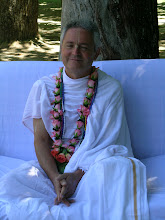
H.G. Matsyavatar Das

Monday, 8 February 2016

Winning the Shadow – Part II


"Valuing people's talents."
It seems perfectly useless to deny and remove the Freudian envy, as it will go on working within the psychic structure and thus reinforced, it would do even worse.
On a practical level it can be purified and transformed by learning to value the talents of others, inspiring people to offer their talents in Krishna consciousness. This propensity will draw us nearer to the qualities of the eternal inhabitants of Vaikuntha so we'll become extremely beneficial to all the living creatures, ourselves included. In this way people can get closer to the Lord beginning to taste this new spiritual relation but how can it become true if they do not even know who is Krishna? Let us help them to put their talents to His service. For example, if someone cooks well, we can suggest a menu and offer the meal to Krishna: "Please, Lord Krishna, accept this food and bless the person who has prepared it."
Although in a first stage such service is indirect as accomplished without awareness, still the person will get a great benefit that will gradually increase in the process of serving. Once the meaning of service is intimately understood, the attraction to serve will be empowered with the taste and thus the person reaches further important step of awareness, up to a higher level when the service is offered not only as an act of one's own will and pleasure, but also consistently and without egoistic motivations. Yet if the person commits offenses, almost always because of residual envy, there is still a risk to crash down to the lower states of consciousness even from this level thus descending to the darker regions of mind. In such a state these people appear like shooting stars that, having made a light path in the sky, become obscured. Even in this case we should not forget the infinite mercy of divine forgiveness, that comes promptly to our rescue when, once repented, we start over following our path towards perfection.

Tuesday, 15 September 2015

Winning the Shadow - Part I


I would like to offer the following reflection, divided into some topics.
" Spiritual Cosmology".
In the spiritual world,
Paravyoma, all living beings are perfect.
The highest heaven coincides with the abode of Vishnu,
Vishnu paramam padam, which manifests the highest perfection.
Gradually descending from the highest spiritual dimension, we can reach the boundary of the Vaikuntha planets, the abode of the creatures without conditionings. Their desires are perfect, as long as they continue to desire in a pure way. The perfection of desire coincides with the freedom to desire. At the same time, it is just the free will that favors the potential risk of falling from that dimension, but an attempt to explain this phenomenon with the rational mind will bear no fruit, because the mind is the instrument of
prakriti that can not contemplate or grasp the spiritual dimension (purusha).
Descending to the lower heavenly planets, one can find the
Siddha Loka, where the living creatures are endowed with special siddhis or perfect capacities. The inhabitants of these planets are perfectly intelligent beings: beautiful, strong, gifted with special talents; each one vibrates with a characteristic virtue, as if it were a ray [of the sun] of Vishnu.
From the lowest heavenly planets, the living beings can easily fall to the median planets like the earth, Bhumidevi, where the human beings temporarily stay. Conversely there are people from the median planets like the Earth are to be reborn on the heavenly planets, lower or higher, but yet they can not be defined as freed
Jivas as these living beings still have residues of the material attachments and are still identified with the contents of their psyche. Finding themselves in such a condition, they can not reach the dimension sat-cit-ananda-vigraha of Vaikuntha.
"Envy: a major cause of the fall."
The overview that I have offered is to introduce a fundamental concept: it is envy that most oppresses and plunges the consciousness into the lower states of being. Even in the biblical tradition and in the three derivative traditions of monotheism of the Middle East, Lucifer, the brightest angel, falls from his position out of envy towards God. As Krishna states in Bhagavad-gita, among the five categories of
anartha, envy is the most dangerous. Dante in The Divine Comedy identifies lust, anger and greed (which envy is an immediate derivative) as the three doors that bring to hell. One must never indulge, never cross the threshold of these three gates of hell, even when the entry appears gold, large, inviting and studded with diamonds.
What mostly prevents a conditioned psyche from getting back on the upper heavenly planets? We'll find the answer to this question in the second part of the article.

Thursday, 10 September 2015

Union

The genuine spiritual realization, which is to be found on a much higher level than that of religiousness, is the experience of a fulfilled soul, of a sage, of an enlightened person who, precisely for being wise, sees the creation, the creatures and the Creator simultaneously and as an integrated unity. For this reason the service he offers to the Creator works automatically also for the well-being of the creatures and of the creation as a whole.
The philosophical concept of ahimsa, non-violence, obviously is not to be limited to human beings, as the respect for life includes all living entities and the creation itself.
The research for spiritual realization, for the highest self, focal point of the personality, corresponds to the discovery of God and to a loving relationship with Him.
When we are placed out of our centre, not only we vanish as an identity, but even God disappears, and it is only when we find again God that we find again ourselves, inconceivably two and One at the same time.

Matsyavatara das

Wednesday, 9 September 2015

Tribute to Shrila Prabhupada


Dear Shrila Prabhupada, please accept my respectful obeisances. All glories to your Divine Grace!

Namo om vishnu padaya krishna preshtaya bhu-tale 
Shrimate Bhaktivedanta Swamin iti namine 

Om ajnana timirandhasya 
jnananjana shalakaya 
cakshur unmilitan yena 
tasmai shri gurave namah 

With a touch of bitterness mixed with so much joy I write to celebrate the holy day of your Vyasapuja, your holy and salvific appearance in this world. This world otherwise horrible host of incarnations marked by joy and pain that obsessively would end each time with the tragedy of death, harbinger of the next rebirth in the infinite cycle of samsara. 
You came and you have given us the opportunity and the means to redeem ourselves, save ourselves and fall in love with God. 
Glory and infinite gratitude to You for bringing the divine light of hope and faith in the darkness of our existence! 
My mother, Anandavrindavana Devi Dasi, a fervent devotee of yours, your admirer and servant, recently left her old and exhausted body, and her physical presence has disappeared from the sight of our eyes, thus exiting at the same time from our relationships, and this has left a large void, yet filled by an infinite and poignant feeling of Love at a distance. 
I’m telling You this, not to sadden You, but to offer my experience of how this event made me realize, once again, the infinite luck we received to have known You, immediately welcomed You into our heart, and later served You, by shaping my life, both of my parents life and the life of my whole biological and spiritual family in accordance with Your divine teachings. 
The writing of this letter implies every year - at least once a year- a honest and deep look into the mirror of our consciousness, and every time, it is for me both arduous and highly beneficial because, by seeing the good and the bad in me allows me to adhere strongly to the first one and even more decisively take distance from the second one. So I offer You the conclusions I have drawn from this immersion by seeking what unites me to You.
When I think of whom, in the course of this incarnation has had the greatest influence on the human and spiritual forming of my character, no doubt it's You. 
When I think of whom, who over the last forty years I have turned to, every time I found myself faced with crucial choices, no doubt it's You. 
When I think of whom my heart bestows the utmost gratitude on, no doubt it's You. 
You are the source of my inspiration. You are my model of active and contemplative Bhakti. 
You are the one whom I dedicate my every initiative to, because I know that the success of my offer to God depends on obtaining Your Divine Grace under the form of intercession.
You, with Your behavior, teaching and works, are the most divine thing that I could see in this life. 
You are to me more than a father and a mother, whom I love dearly, because I was born from You into Knowledge and Love. 
I honor You and give You all my gratitude for what I have accomplished. 
I ask You for forgiveness for any lack in my behavior and the blessing of being able to serve You with ever increasing commitment, purity and spiritual strength. 
With infinite gratitude and devoted affection I offer the remaining years of my life, waiting, when it will be, to come to You, by Krishna, among the blessed people! 
Your servant, 
Matsyavatara dasa

Ultimate goal

We haven’t arrived in this world to build houses, to create organizations, to erect churches or temples and turn the earth into a garden; this is not the purpose of our existence.
We are here to gain spiritual realization; everything else is just a means to this goal, everything else is to be used by us for the purpose of our development.
We have to act, because without acting we would starve, we would die from thirst or from sleep… but action is functional and what counts is the goal for which we act.
What elevates us on the platform of spiritual evolution and what shows us the Truth behind appearances, is the spirit with which we offer our action.

Matsyavatara das

Spiritual Vision

This divine energy of Mine, consisting of the three modes of material nature, is difficult to overcome. But those who have surrendered unto Me can easily cross beyond it”Bhagavad-gita VII.14
In the Bhagavata Purana the “ocean” of the material existence is described as something scaring, terrifying, in which the jivabhuta – the conditioned living entity – life after life is forced to experience birth (jati), old age (jara), disease (vyadhi) and death (mrityu).
Only by the mercy of Guru and Krishna this ocean of obstacles becomes like the water contained in a calf’s hoof-print.
All in all, there is no real dichotomy between nature and spirit, as both energies arise from the same supreme Consciousness, God, Who permeates the entire universe, exactly as the individual consciousness permeates the entire body of the living entity.
Therefore in the world everything is tightly connected: the subject to the object, spirit to nature, the living entities to each other and each of them to the Supreme, the individual bodies to the cosmic body, the individual mind to the universal mind.
A deep comprehension of these thick connections and relationships between micro- and macrocosm is an essential requirement on the path of spiritual realization, which in the vaishnava-vedic tradition does absolutely not imply an escape from the world, but rather means the development of an organic and complete vision of the absolute Reality.
Matsyavatara das

Saturday, 8 August 2015

What is devotional service?

Devotional service, as it is referred to in the Bhaktivedanta tradition, is made up by all those free and voluntary activities which the bhakta, or person who dedicates his entire life to a spiritual quest, carries out by offering them in a devotional attitude to God and to whom he has chosen as his own spiritual guide, that means his Guru.
Such activities are carried out, after an accurate aforethought choice, in the terms and ways which he feels most suitable for himself, in order to foster his ethical and spiritual development and to support society with a contribution to the common well-being in a spirit of selflessness and solidarity.
In fact, devotional service is the most important tool which can guarantee a permanent connection of the individual consciousness with the cosmic consciousness: when consciousness is connected to God, it goes beyond the dualism of good and evil, of excitement and depression or of elation and dejection. In this way even the mind gets firmly connected to God, and so the willpower is strengthened and becomes determined.
Bhagavad-Gita II.50:
“A man engaged in devotional service rids himself of both good and bad actions even in this life. Therefore strive for yoga, which is the art of all work”.

Matsyavatara das

Wednesday, 5 August 2015

Nourishing consciousness

Every morning the meditation on the Mahamantra offers us the possibility to discover important things, for example to achieve those intuitions which are rarely obtained during other moments of the day, because usually we are too busy in carrying out our worldly activities or mundane duties, which, of course, are also useful if we make them functional to our spiritual development.
But those sweet and sharp, enlightening and inspiring intuitions we can obtain during the Brahma Muhurta hours through the meditation on God’s Holy Names are the essential life lymph of our consciousness.
Through the practice of meditation, when we engage in it rigorously and intensely, many veils are lifted, some dark sides of our inner depths are enlightened; we get profound perception and sudden insights of concepts and solutions which are not part of the logical or mental world, but, on the contrary, of the hi
gher dimension of inspired intuition. These intuitions arise, they become clear, and we become aware of these events happening inside us, as if they were facts that reveal themselves in our deepest part; we then have to be able to hand them down to the practical and relational situations we go through, that means in everything we do.
If life couldn’t be nourished with these intuitions and spiritual emotions, with these inner discoveries, with these intense and lively energies of change, it would be smothered by routine, just as something rolling up itself, and people would remain plastered, stuck in their conditionings. It’s these spiritual intuitions which give vitality and value to our life.
Matsyavatara das

Saturday, 13 September 2014

The Turning Point


Thirty-eight years ago, on 30 August 1976, for the first time  I met Shrila Prabhupada in a personal darshana... it was a turning point of my life, a wonderful inner journey!
I was in an ashram in Rishikesh, at the foot of the Himalayas, studying the Yoga Sutras of Patanjali. In Italy I had been a successful designer, the manager of six companies. Upon returning from the trip I was supposed to get married, but at the time, in that place, I was seriously thinking of leaving everything and settle in India. That pseudo worldly success made me feel like prison, as not only it was no longer a source of satisfaction, but it became clear to me that it was the biggest obstacle to achieving happiness that I have been aspiring.
The recurring thought was to start a new life dedicating myself to the search of God and my spiritual essence. When I became aware of the voice of my soul I felt a strong appeal - it was an urgent need to revise my life, to think over my motivations and purposes. I understood that it was a turning point.
On that trip I was with a friend who has been always sick. Feverish, he remained for most of the time in our ashrama right on the banks of the Ganges. There was no furniture in the room, only two mats on the floor, his huge suitcase, my smaller one, a small window with a grate and a door with a latch. Each time we left the room, through the grates of the window the monkeys came in; they were having a lot of fun, especially with the bottles of medicines that the doctor had given to my friend.
It was in that ashrama that I met a sadhu, the person who has changed my life. Instead of attending the lectures on Patanjali, we walked together on the banks of Mother Ganga.
One day he said: “If you do not discover Bhakti, nothing will satisfy you.” Bhakti, Bhakti ... I asked to explain the meaning of this word.
"If I explain its meaning to you, you won't understand me.”
This sadhu spoke English with difficulty, but there was no need in too much words, it was a kind of telepathic communication.
"Bhakti is difficult to explain, only your heart can define it." And he began to chant this mantra:

Hare Krishna Hare Krishna
Krishna Krishna Hare Hare
Hare Rama Hare Rama
Rama Rama Hare Hare

We would spend hours chanting along with this mantra, then we would immerse in the waters of Mother Ganga: a rushing stream that takes away everything.
"You have to meet Bhaktivedanta Swami Prabhupada: he will make you know Krishna. Go to Vrindavan to meet him."
Hearing that voice deep inside me, without pondering too much, I left for Delhi along with my sick friend. From Delhi we took a train to Mathura and then in Mathura we took a cart for Vrindavan. Having arrived to Vrindavan in two days, I began to look for Bhaktivedanta Swami Prabhupada.

Monday, 21 July 2014

Spiritual Values to Win the Shadow.


Many people look for tangible and concrete things in life, but it is important to know that the so-called "abstract values" are even more substantial than those perceived through the senses – the true values which we should refer to in our life, such as compassion, freedom, happiness and Love.
The empiricists are prone to "measure and touch" happiness, to grasp all the things in the world. Such attitude is not an evil in itself, it becomes such when a man ignore his spiritual essence, sometimes even denying it completely. As far as, according to the positivist criterion, happiness is not tangible, in its absence a person falls into the dark malaise and depression.
Thus, lacking the feelings of compassion, charity, devotion to God and affection towards all His creatures, without solidarity with the creation, the experience of love cannot be realized. As a result, one's life turns to be boring and meaningless due to the lack of spiritual awareness.
Why do we make mistakes and suffer
so much?
The reason is that we do not cultivate spiritual values sufficiently. Slowly forgetting these real values ​​that substantiate the human life, one tries to compensate such values by attachments to the worldly projects and goods, as illusory as ephemeral. Thus, while creating one's false identity, a man lives in a sort of a perpetual alienation.
In such a state of alienation, oblivious of his spiritual nature and ultimate destination, an individual lose the sense of life. Joy and sorrow, health and disease, birth and death follow each other as impermanent manifestations of existance.
Therefore a spiritual being,
incarnated in the material world, despite an overwhelming aspiration for eternity, wisdom and happiness, experiences a considerable frustration, helplessness and fear because of an inability to access the bliss of its ontological nature, while struggling in the duality of the material world.
A wise man does not dream of becoming happy due to the impermanet things of this world. In all the traditions, albeit with different words, it was stated that "man cannot live on bread alone."
If we learn what to desire and how to value our life, we will become happy enjoying every moment of it, in spite of any psychophysical limit. By the grace of God, living in the prospect of immortality and love for God, a man can overcome loneliness and suffering so to experience fulfillment and spiritual satisfaction, always and everywhere.

Wednesday, 21 May 2014

True Freedom


A sober person who can tolerate the urge to speak, the mind's demands, the flashes of anger and the urges of the tongue, belly and genitals is really qualified to educate the disciples all over the world”
The Nectar of Instruction” (Upadeshamrita) Verse 1

The Vedic Rishis (the wise’ seers’ of the Vedas) were not only mystic poets, they were experts of the deep knowledge of the mind; these sages widely observed and experimented all the psychic functions of the human being. The rishis could clearly see that the so-called spontaneousness of the human being with the ordinary level of consciousness is just a satisfaction of the conditionings, imposed by one's mind; therefore, in an ultimate analysis, it is the exact opposite of a free, healthy and spontaneous attitude. In order to make free decisions without being affected by conditionings and attachments, a person has to conquer the six urges mentioned above.
Only then a progressive realization of the Self will take place, so that the individual will be able to reach the pure feeling of Love for God. In order to overcome obstacles and to achieve high levels of awareness, one should proceed with a harmonious transformation of personality, along with well pondered choices. Such choices are the result of wisely coordinated and constant efforts, so as to allow the passage from human understanding of things to the spiritual awareness and protection, until a complete development of the most elevated qualities of the Soul.
If we learn to re-direct passionate egoistic feelings and emotions towards spiritual goals, they will enhance a propensity to inner evolution and will lead to a supreme bliss of Bhakti and Love in freedom.

Thursday, 24 April 2014

How to build good relationships


PART II
The loss of awareness of our original essence results in a deep dissatisfaction and inner deterioration. People do not behave in a bad manner because they just wish so, rather because they are dissatisfied within.
How can we help people to feel satisfied?
Sensitiveness is not enough to empathize with the others so knowledge and discipline are required.
What about those people who do not even show sensitiveness?
We may learn to acquire, develop, find sensitiveness, which in Latin is called pietas. Sensitiveness can be found in atman, our spiritual matrix. We cannot trust the mind because when external circumstances change, our mental frame modifies consequently. For this reason we have to help people to start an inner search, to rediscover their real self. In this way, by developing such awareness, we can face the situations that otherwise could have become our limits, according to the changeable circumstances of life.
Our relations should not depend on external circumstances, we ought to learn to overcome them.
A great daily effort within needs to be done if we want to achieve this target. By conquering the inner enemies one after another, we lead ourselves to steadiness, tolerance, peacefulness. By practicing such attitude we learn not to react automatically to events, provocations, offences, abuses.
A person needs to modify one’s point of view. One may wear a heavy shield to protect oneself, but it will not be strong enough because it is only by switching and elevating our point of view that we reach a steady and broad inner confidence.
We miss a great deal of life which cannot be reproduced in the present span of time, if we carry on to identify as real what real is not. By modifying our point of view, our efforts, our dedication towards such an elevated mission will unveil to us the meaning of living.
It is not easy to succeed because we were born with a superficial mental attitude, with prejudices and tendencies acquired through behaviors we have brought back from previous lives. Performance of actions are pressing from our subconscious and lead us to repeat the same old mistakes. Therefore we need great care and attention to avoid circumstances that may put us at risk.
A person does not learn by punishment, rather by improving through education on an ethical and spiritual level, so that one may distinguish and filter between experience and its interpretation and between experience and reaction to events.

Tuesday, 11 March 2014

How to Build Good Relationships


Every our action implies a feedback from others (as a rule, the response we get is very much the same as our approach, whether it has just happened in the present or it happened in the past), this is the meaning of relationship.
A:B = C:D
The relation between A and B, affects the relation between C and D too. We are all connected in the big game of life.
It is just through the relationships that we have the possibility to express our divine nature, that is developing and experiencing our best original spiritual qualities. However we can experience a lot of sufferance as well.
Our inner well-being greatly depends on the way we trust people in the relationships and the way others respond to us. A sensible, caring person usually realizes within a short time, whether his or her words, actions and even thoughts has a positive or destructive effect on the others.
When a person suffers and seeks relief, compassion and trust, turning to somebody who can help, how can one find the cause of sufferance? Where do disbelief, depression, pain or negative feelings come from, what is missing? The deep cause is often rooted in the relationships.
Everything in the universe is ruled by the divine laws and this order is based on a dialogue, as Galileo’s quote recites: “Dialogue between Two Chief World Systems". Dialogue re-establishes an order, and such order should govern our relations too, so in any dialogue the first priority is to meet the needs of other person through attentive listening and sincere interest.
The more virtuous relations are, the higher is their quality and greater the standard quality of listening and speech skills.
Sattva is order, virtue, harmony. It is the condition that most of all favors our evolution. It is a conditioning state, it is not complete freedom, therefore even sattva guna is to be transcended. The conditioning that arises from sattva guna is the feeling of attachment to a kind of freedom that is always anchored to a mundane layer, in spite of a prevalent virtuous nature. Someone may think: sattva guna is good enough for me, because I am satisfied with one kind of pleasure and one kind of mundane virtues. However a person cannot be satisfied with this vision because there are negative sides and sorrows that cannot be avoid with sattva guna alone, unless one ascends to a spiritual awareness.
Among such sorrows, which cause a great deal of sufferance, is old age. Aging is a heavy humiliation because the person is not able to take care of one’s own basic personal needs, and sattva guna itself cannot free us from such great pain. Sattva is the condition we can easily obtain in our embodied life, although we ought to make another step forward to approach transcendence, in order to reach the abode and original nature of our spiritual eternal Self.

Friday, 31 January 2014

Remembering Shrila Prabhupada


 PART II
Due to God's mercy, Shrila Prabhupada was able to undertake the adventurous and difficult missions to satisfy the desire of his Guru Maharaja. He knew how to deal with risks, dangers, loneliness, sickness and temptations... Krishna blessed Shrila Prabhupada with such a success that, while originally owning nothing, his movement gradually reached a huge development, comparable to that of the richest and most envied companies, but even so Shrila Prabhupada remained always the person of the great inner qualities: no pride, no arrogance, no material ambitions or futile interests. He was exactly the same person when He went, with only 40 rupees in his pocket, to America, always dedicated to love for Krishna and for all creatures. Shrila Prabhupada had many talents, he was versatile, with great skills, but He was first and foremost a pure Devotee of the Lord.
He loved everyone, because in Shrila Prabhupada's opinion everyone was a potential devotee. He had always the same mood and the same tone of voice, sometimes He got vibrant, speaking with strong words, sometimes He reprimanded, sometimes He praised, sometimes He was moved, but His interest was always to improve the understanding of the devotees, their health, the image of the Movement. We must unmask the so fashionable artificial way to see an Acarya as detached from everyone and everything. Prabhupada was very interested in the success of the various services, he cared about everything working and running the best way, thus satisfying Krishna and encouraging the spiritual elevation of so many people.
Spiritual life does not mean a cold, detached attitude towards the world, we cannot live without relations, without affection, without empathy, without love. We just have to be careful to those we direct these feelings to. We should not
prioritize what calls on the material level, but strive to fulfill our spiritual desires that represent our true essence. Prabhupada had Krishna in His heart and He was always thinking of what he could say or do to bring people closer to God. Krishna had a special relationship with Shrila Prabhupada who had a special relationship with Krishna: this was visible in every activity He had undertaken, either in those particular moments when, for example, He took the initiative to modify a service that maybe was stagnating, or when in the last days of life in this world He was brought in front of the Divinities on a palanquin because He was in a condition of extreme physical weakness and He could no longer walk. In every circumstance Shrila Prabhupada has proved to be a pure devotee of Krishna.
When I read the Bhagavad-gita, chapter twelve, shloka 13 to 20, I see Shrila Prabhupada. I have known many lovely devotees, but Prabhupada is the model for me.
Prabhupada was always connected to Krishna and helped everyone to offer their talents and
energies to the service of the Lord.
The most beautiful part of Shrila Prabhupada is his being so devoted!
He was good at many things: a very good cook, a grammarian, a great preacher, a prominent philosopher and scholar; He was expert in playing music and in offering praise to the Lord, but His main feature was the pure and ardent devotion to God and His constant commitment to the spiritual education, in order to help others to become pure devotees of the Lord. Great it was, and surely still is, the satisfaction of Shrila Prabhupada to see people take seriously the path of Bhakti. And this satisfaction is the source of strength to all those devotees who carry Shrila Prabhupada in their heart.
Despite the apparent departure the Acarya lives forever with us, if we live with Him. As Satsvarupa Maharaja says in his book: "He lives forever ..."

Tuesday, 19 November 2013

Remembering Shrila Prabhupada


PART I
In the sacred occasion of the departure of Bhaktivedanta Swami Shrila Prabhupada, we pray Shri Krishna to empower us with strength so that we could carry in our hearts the example of His extraordinary life, character, deeds and works forever. Those who were able to witness His life and teachings, had the greatest luck to testify the changes in their lives and in the lives of so many people.
These transformations are the great events from which we can draw an inexhaustible inspiration: Shrila Prabhupada gave us the opportunity to live in the spiritual awareness. The path traced by Him is followed by hundreds of thousands of people, and the most favored are those who welcomed Him in the heart, dedicating their service to the realization of His dream, that is make available the love of God to as many people as possible regardless of race, creed, culture, social position, politics or religion.
36 years ago Shrila Prabhupada left His physical body and this material world to return to where He came from, the spiritual universe. We pray Bhagavan Shri Krishna to give us the purity to be able to celebrate His glories properly. By celebrating His glories we become aware of his greatness, and becoming aware of the greatness of a pure devotee of the Lord, we can experience the greatness of God. In this way, practicing the nine paths of Bhakti, we can realize our divine nature and become purified from the distortions of psychic structure and its conditionings.
We take this special opportunity to increase our sincere attachment to the lotus feet of Shrila Prabhupada, to humbly serve His teachings and His way of life so as to bring us closer to Him and to Shri Krishna through the nine paths of love mentioned before.
Shrila Prabhupada allowed hundreds of thousands of people to transform their lives by changing their vision, allowing them to get rid of the identification with the material structure that covers their eternal Self. Shrila Prabhupada gave the possibility to understand the difference between the spiritual Self, the body and the mind and to realize the divine potential of each person regardless of age, gender, social status and culture. The term Acarya means exemplary. Through His example and model of life, Shrila Prabhupada made the teachings of the Shastras feasible.
A person can take the Bhagavad-gita, read some sublime passages and reflect: "How nice it would be to live like that, but who is able to? I would not be capable of doing that for sure." We need a model, an example, there must be someone who lives the teachings of the Bhagavad-gita constantly, faithfully, coherently, and joyfully. The sacred work becomes a person, and the highest aspirations become applicable in our lives. It is exactly what happened to all of us. Why? Because Shrila Prabhupada experienced Bhakti so intensely and joyfully, no matter what life presented to Him in terms of ordeals, difficulties and obstacles to overcome. His relying on Krishna at all times without ever becoming fatalistic allowed this great Acarya to live in this world in pure spiritual consciousness. Faith is not a fatalism, it is an evolutionary creativity for searching the best solution for the existential problems; if we direct our efforts towards the spiritual evolution with commitment and faith, such solution will appear as Paramatma in the heart, as well as through the expert guidance of the Spiritual Master in the outer world.

Monday, 28 October 2013

The Real Success.


The  experiences of accomplishment that one can reach in her or his lifespan, sometimes can be conflicting with the self-image, possibly being the one of an unconfident person, a weak individual, too reliant on someone else’s opinions. If this self-image will not change, the outer accomplishment will be followed by inner troubles and unsteadiness. This is because the new higher equilibrium is such only when it is achieved with harmony and stability. To avoid this kind of situation one should conceive and support a self-image corresponding to what one would like to be and should be. If one will shape her or his personality in depth, then this person will be psychologically ready when an accomplishment or a better position will be achieved. Conversely, some individuals are afraid of their own success because they have not built yet an objective and positive self-image.
Powerful desires move things and alter reality. A person becomes what she or he craves to be. Egoistical ambitions do not lead to real accomplishment: the apparent success sooner or later will turn into calamity.
The immature management of resources and of desire's energy produces derangement and deep emotional troubles. Any waste and any improper use of the above is the cause of personal failure.
Anything we have: objects, affections, talents, must be employed to reconnect ourselves to the deep divine matrix, the raison d'être and foundation of our existence. If we do not do this, as explained by Shrila Rupa Gosvami, one of the greatest Vedic Tradition Master, anything gets contaminated and turns into poison. 
The perfection of existence (yukta vairagya) can be archived if we are closely connected to the Istha Devata and place all our resources to its service. Ambarisha Maharaja was the sovereign of the world, in spite of this he was not ruling it for his own egoistic enjoyment, but as a tool to serve God.  In order to run suitably that function maturity and awareness were needed, because who has so much energy can do great good things, but, if one is not cautious and do not have uncontaminated motivation in the way this energy is used, can cause great damages and bring harm to himself and everybody nearby. 
The most valuable resources, never to be neglected and never to be abused, are our fellow human beings, with their desires for advancement, their wishes for good, their projects, with their search for self-realization. We should not dare to waste even the smallest bit of their energy, we have to support instead their convergence, channeling, and sublimation toward elevated motivations of real good and real success. Sublimation will be possible if we encourage for taking a solid commitment for spiritual activities, with an active and energetic service offered with awareness and dedication to our spiritual Master and the Istha Devata. According to one of the most important and recurrent Shrila Prabhupada’s statements: "Bhakti Yoga is not just an idle meditation". Nor meditation means escaping from the world.
 Authentic meditation inspires and motivates actions in the world, and it is able to solve real problems, to disentangle knots that grew in the mind. Authentic meditation does not evade or remove practical problems: it resolves them. It is based on the consciousness of spiritual matrix of all things, and the understanding of the subtlest psychological phenomena: how minds get entangled or stuck, and how it is possible to jump-start them, reactivate them, and purify them.

Saturday, 5 October 2013

The Great Departure.


Dear devotees, please accept my obeisances;

All glories to Shrila Prabhupada and Shri Shri Radha Govinda Deva.

Jaya Shri Shri Nityananda Gauranga!

Jaya Shri Jagannath, Shri Baladeva, Subhadra Maharani Shrimati!

I hope to find you in good health and spiritually inspired.

Some days ago my dear disciple - Omkrishna Mataji - left the body and this mortal world and headed for the supreme eternal abode of Shri Krishna.

The two sons, daughters in law and grandchildren attended to her all the time in high spiritual consciousness, lovingly and with devotion.

Besides being herself a sincere devotee, Omkrishna Mataji had the great blessing in this life to live in a family of special devotees, all of them very dear to me.

One of her sons was next to her at the very moment she passed away, and has accompanied and sustained her by chanting uninterruptedly the Holy Names.

My most fervent prayers go to this disciple so dear to me, who was always cheerful, playful and joyful, who was so moved every time we met, and I’m also asking you to pray for her too.

I pray she can soon play happily in the company of Lord Krishna and His eternal companions and friends.

With deep emotion,

Matsyavatara dasa

Friday, 6 September 2013

School of Life: How to Learn from Good and from Evil.


The Sacred Texts tell us that without receiving mercy from the Spiritual Master and from the Supreme God it's impossible to overcome for good the egoistic attachment toward mundane things. In order to succeed, not only we need to have received divine benevolence, we must have kept it too.
In which way we can receive mercy? Firstly by seeking it ardently, and behaving consequently, by dedicating ourselves with diligence and faith to spiritual practices and so awaken Love and Awareness.
And in which way we can keep it? By offering it to others. Then and only then, through constant and coherent efforts toward achieving Bhakti in our lifespan, we will be increasingly able to discriminate reality from illusion, the essence from appearance, the eternal from ephemeral.
Mice see the cheese but not the trap. In the same way conditioned souls see the promises of pleasure in this world's things, but hardly can understand that this pleasure hides a trap. A mortal trap.
How to be detached from the world and its overwhelming beauties? How can we resist when we see something appealing, pleasing, good smelling and shining? We should think about it in connection to God. It is difficult to deny this world; the more we deny it the more we are attracted to it, risking to become hypocrites who refuse the world's attractions outwardly while inwardly craving them (Bhagavad-gita III.6). Therefore we should not refuse this material world's beautiful things, but to use them to serve God with Love, correlating them to our spiritual origin, and living them in the vision of eternity. Accordingly, in any circumstance of our life we can connect to the Lord and to our deepest spirituality. Even bitter experiences, the biting words we received, the mistakes we made, at the end can turn into gifts, only if we can learn from the lessons they offer us. Gratitude and appreciation can permeate everybody and everything appear in this world, because we make use of every experience to get closer to God.
This gratitude can be felt and can be expressed both when we receive "good things", and when we get "bad things", being conscious that the light of the day cannot be appreciated without the night's darkness.
As you would expect, it is necessary that we learn how to discriminate between vice and virtue, between good and evil, so we can choose once far all righteousness and be firm in sattva-guna, but also we must be aware that Reality is beyond. It is that pure spiritual dimension in which mundane good and evil are transcended, and they merge in the "sommum bonum": the supreme goodness beyond duality. And supreme goodness is unconditioned pure Love that change and purify everything. Such dimension can be reached when any desire we have becomes an offering to the Lord and all our perceptions are dedicated to His service.
By living in this perspective we will find treasures around each corner, hidden in any occurrence of our life. And we will walk toward death full of gratitude because we understood that by practicing Bhakti even death leads us to life.

Thursday, 25 July 2013

Pilgrimage: a Journey of Search and Discovery.


Part II
It is not by chance that Masters of Bhakti speak of an inseparable unity which is necessary for our evolution: Bhagavata sacred work and Bhagavata person, both of them are able to transfer the knowledge and the consciousness of  the Divine, Bhagavan.
If our visit to a sacred place is made with these predispositions, it may become an experience of great meaning that allows us to get in touch with timeless memories that bring us in other elevated dimensions of consciousness, and allow us to hear and accept the messages conveyed to mankind from another dimensions.
At times life faces us with very difficult situations so that we have to be ready and able to make our pilgrimage even in a hospital's room after the announcement of a terrible medical report, in front of the lifeless body of a dear person, suffering a devastating moral pain because of the betrayal of the person we most loved; or in a prison's cell where we had been locked in spite of our innocence, destroyed  by defamation. In these circumstances we need to start our journey even sooner, loading ourselves with inspiration and starting our inner journey to find a safe place, a shelter, an oasis in which to connect with our spiritual eternal self, which is unchangeable, together with God who is the giver of Knowledge, Love and Mercy. More than ever in these situations, in order to withstand sufferance, we have to fight against time in order to reach the space in the centre of our heart, where, the Upanishads say, time and space ultimately do not exist. That dimension is pure Transcendence. It is the place where all our desires are fulfilled. But the human being, deviated by the unreal world of vanishing impressions,  has lost the route to find it, because that dimension is invisible to the senses and to the physical eyes, the voice of that place speaks to the soul and the ears are not meant to hear it. For this reason Krishna says to Arjuna in the Bhagavad-gita: “In order to see me the way I am, I give you spiritual senses”. Why does Krishna offer to Arjuna such a great opportunity? Because Arjuna asked Him with a humble manner, because he desired it with intensity, because he wanted to get in touch with Krishna in his original and intimate divine nature.
Only with a burning desire to perceive a spiritual dimension and connect with God, a person may receive the divine strength to achieve it, to make the journey that from the realm of death will take us to immortality, from darkness to light, from sufferance to beatitude. A pilgrimage is that journey, it is rejoining.
How long does that journey last? Patanjali in the Yoga-sutras explains that the distance depends mainly on two factors: continuity and intensity of desire, and the required effort. In order to reach our target soon, we need to keep our course steady, with constant determination, and to increase the speed of motion by rising the intensity of the desire. Dante in the Divine Comedy accomplishes that journey too. At one point he describes his emotion as “feeling a pull from the sky while being still alive”. Once we loosen our conditionings and get rid of  bad habits, ascending is fast.
A pilgrimage  is that  ascension, it is an upward shift, it means heading toward holiness, and the spirit we hold while facing the journey is crucial. If we have the right attitude, that feeling of serenity we  have been looking for, the one that we thought we would experiment only once we reached our destination - instead it arrives step by step during our pilgrimage: then we find it in the predetermined place we have chosen and elected as our home, the heart.
Life will become then, day after day, a wonderful journey of research and discovery.