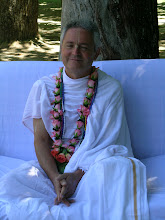
H.G. Matsyavatar Das

Showing posts with label Vedic Tradition. Show all posts

Saturday, 13 September 2014

The Turning Point


Thirty-eight years ago, on 30 August 1976, for the first time  I met Shrila Prabhupada in a personal darshana... it was a turning point of my life, a wonderful inner journey!
I was in an ashram in Rishikesh, at the foot of the Himalayas, studying the Yoga Sutras of Patanjali. In Italy I had been a successful designer, the manager of six companies. Upon returning from the trip I was supposed to get married, but at the time, in that place, I was seriously thinking of leaving everything and settle in India. That pseudo worldly success made me feel like prison, as not only it was no longer a source of satisfaction, but it became clear to me that it was the biggest obstacle to achieving happiness that I have been aspiring.
The recurring thought was to start a new life dedicating myself to the search of God and my spiritual essence. When I became aware of the voice of my soul I felt a strong appeal - it was an urgent need to revise my life, to think over my motivations and purposes. I understood that it was a turning point.
On that trip I was with a friend who has been always sick. Feverish, he remained for most of the time in our ashrama right on the banks of the Ganges. There was no furniture in the room, only two mats on the floor, his huge suitcase, my smaller one, a small window with a grate and a door with a latch. Each time we left the room, through the grates of the window the monkeys came in; they were having a lot of fun, especially with the bottles of medicines that the doctor had given to my friend.
It was in that ashrama that I met a sadhu, the person who has changed my life. Instead of attending the lectures on Patanjali, we walked together on the banks of Mother Ganga.
One day he said: “If you do not discover Bhakti, nothing will satisfy you.” Bhakti, Bhakti ... I asked to explain the meaning of this word.
"If I explain its meaning to you, you won't understand me.”
This sadhu spoke English with difficulty, but there was no need in too much words, it was a kind of telepathic communication.
"Bhakti is difficult to explain, only your heart can define it." And he began to chant this mantra:

Hare Krishna Hare Krishna
Krishna Krishna Hare Hare
Hare Rama Hare Rama
Rama Rama Hare Hare

We would spend hours chanting along with this mantra, then we would immerse in the waters of Mother Ganga: a rushing stream that takes away everything.
"You have to meet Bhaktivedanta Swami Prabhupada: he will make you know Krishna. Go to Vrindavan to meet him."
Hearing that voice deep inside me, without pondering too much, I left for Delhi along with my sick friend. From Delhi we took a train to Mathura and then in Mathura we took a cart for Vrindavan. Having arrived to Vrindavan in two days, I began to look for Bhaktivedanta Swami Prabhupada.

Monday, 21 July 2014

Spiritual Values to Win the Shadow.


Many people look for tangible and concrete things in life, but it is important to know that the so-called "abstract values" are even more substantial than those perceived through the senses – the true values which we should refer to in our life, such as compassion, freedom, happiness and Love.
The empiricists are prone to "measure and touch" happiness, to grasp all the things in the world. Such attitude is not an evil in itself, it becomes such when a man ignore his spiritual essence, sometimes even denying it completely. As far as, according to the positivist criterion, happiness is not tangible, in its absence a person falls into the dark malaise and depression.
Thus, lacking the feelings of compassion, charity, devotion to God and affection towards all His creatures, without solidarity with the creation, the experience of love cannot be realized. As a result, one's life turns to be boring and meaningless due to the lack of spiritual awareness.
Why do we make mistakes and suffer
so much?
The reason is that we do not cultivate spiritual values sufficiently. Slowly forgetting these real values ​​that substantiate the human life, one tries to compensate such values by attachments to the worldly projects and goods, as illusory as ephemeral. Thus, while creating one's false identity, a man lives in a sort of a perpetual alienation.
In such a state of alienation, oblivious of his spiritual nature and ultimate destination, an individual lose the sense of life. Joy and sorrow, health and disease, birth and death follow each other as impermanent manifestations of existance.
Therefore a spiritual being,
incarnated in the material world, despite an overwhelming aspiration for eternity, wisdom and happiness, experiences a considerable frustration, helplessness and fear because of an inability to access the bliss of its ontological nature, while struggling in the duality of the material world.
A wise man does not dream of becoming happy due to the impermanet things of this world. In all the traditions, albeit with different words, it was stated that "man cannot live on bread alone."
If we learn what to desire and how to value our life, we will become happy enjoying every moment of it, in spite of any psychophysical limit. By the grace of God, living in the prospect of immortality and love for God, a man can overcome loneliness and suffering so to experience fulfillment and spiritual satisfaction, always and everywhere.

Wednesday, 21 May 2014

True Freedom


A sober person who can tolerate the urge to speak, the mind's demands, the flashes of anger and the urges of the tongue, belly and genitals is really qualified to educate the disciples all over the world”
The Nectar of Instruction” (Upadeshamrita) Verse 1

The Vedic Rishis (the wise’ seers’ of the Vedas) were not only mystic poets, they were experts of the deep knowledge of the mind; these sages widely observed and experimented all the psychic functions of the human being. The rishis could clearly see that the so-called spontaneousness of the human being with the ordinary level of consciousness is just a satisfaction of the conditionings, imposed by one's mind; therefore, in an ultimate analysis, it is the exact opposite of a free, healthy and spontaneous attitude. In order to make free decisions without being affected by conditionings and attachments, a person has to conquer the six urges mentioned above.
Only then a progressive realization of the Self will take place, so that the individual will be able to reach the pure feeling of Love for God. In order to overcome obstacles and to achieve high levels of awareness, one should proceed with a harmonious transformation of personality, along with well pondered choices. Such choices are the result of wisely coordinated and constant efforts, so as to allow the passage from human understanding of things to the spiritual awareness and protection, until a complete development of the most elevated qualities of the Soul.
If we learn to re-direct passionate egoistic feelings and emotions towards spiritual goals, they will enhance a propensity to inner evolution and will lead to a supreme bliss of Bhakti and Love in freedom.

Thursday, 24 April 2014

How to build good relationships


PART II
The loss of awareness of our original essence results in a deep dissatisfaction and inner deterioration. People do not behave in a bad manner because they just wish so, rather because they are dissatisfied within.
How can we help people to feel satisfied?
Sensitiveness is not enough to empathize with the others so knowledge and discipline are required.
What about those people who do not even show sensitiveness?
We may learn to acquire, develop, find sensitiveness, which in Latin is called pietas. Sensitiveness can be found in atman, our spiritual matrix. We cannot trust the mind because when external circumstances change, our mental frame modifies consequently. For this reason we have to help people to start an inner search, to rediscover their real self. In this way, by developing such awareness, we can face the situations that otherwise could have become our limits, according to the changeable circumstances of life.
Our relations should not depend on external circumstances, we ought to learn to overcome them.
A great daily effort within needs to be done if we want to achieve this target. By conquering the inner enemies one after another, we lead ourselves to steadiness, tolerance, peacefulness. By practicing such attitude we learn not to react automatically to events, provocations, offences, abuses.
A person needs to modify one’s point of view. One may wear a heavy shield to protect oneself, but it will not be strong enough because it is only by switching and elevating our point of view that we reach a steady and broad inner confidence.
We miss a great deal of life which cannot be reproduced in the present span of time, if we carry on to identify as real what real is not. By modifying our point of view, our efforts, our dedication towards such an elevated mission will unveil to us the meaning of living.
It is not easy to succeed because we were born with a superficial mental attitude, with prejudices and tendencies acquired through behaviors we have brought back from previous lives. Performance of actions are pressing from our subconscious and lead us to repeat the same old mistakes. Therefore we need great care and attention to avoid circumstances that may put us at risk.
A person does not learn by punishment, rather by improving through education on an ethical and spiritual level, so that one may distinguish and filter between experience and its interpretation and between experience and reaction to events.

Tuesday, 19 November 2013

Remembering Shrila Prabhupada


PART I
In the sacred occasion of the departure of Bhaktivedanta Swami Shrila Prabhupada, we pray Shri Krishna to empower us with strength so that we could carry in our hearts the example of His extraordinary life, character, deeds and works forever. Those who were able to witness His life and teachings, had the greatest luck to testify the changes in their lives and in the lives of so many people.
These transformations are the great events from which we can draw an inexhaustible inspiration: Shrila Prabhupada gave us the opportunity to live in the spiritual awareness. The path traced by Him is followed by hundreds of thousands of people, and the most favored are those who welcomed Him in the heart, dedicating their service to the realization of His dream, that is make available the love of God to as many people as possible regardless of race, creed, culture, social position, politics or religion.
36 years ago Shrila Prabhupada left His physical body and this material world to return to where He came from, the spiritual universe. We pray Bhagavan Shri Krishna to give us the purity to be able to celebrate His glories properly. By celebrating His glories we become aware of his greatness, and becoming aware of the greatness of a pure devotee of the Lord, we can experience the greatness of God. In this way, practicing the nine paths of Bhakti, we can realize our divine nature and become purified from the distortions of psychic structure and its conditionings.
We take this special opportunity to increase our sincere attachment to the lotus feet of Shrila Prabhupada, to humbly serve His teachings and His way of life so as to bring us closer to Him and to Shri Krishna through the nine paths of love mentioned before.
Shrila Prabhupada allowed hundreds of thousands of people to transform their lives by changing their vision, allowing them to get rid of the identification with the material structure that covers their eternal Self. Shrila Prabhupada gave the possibility to understand the difference between the spiritual Self, the body and the mind and to realize the divine potential of each person regardless of age, gender, social status and culture. The term Acarya means exemplary. Through His example and model of life, Shrila Prabhupada made the teachings of the Shastras feasible.
A person can take the Bhagavad-gita, read some sublime passages and reflect: "How nice it would be to live like that, but who is able to? I would not be capable of doing that for sure." We need a model, an example, there must be someone who lives the teachings of the Bhagavad-gita constantly, faithfully, coherently, and joyfully. The sacred work becomes a person, and the highest aspirations become applicable in our lives. It is exactly what happened to all of us. Why? Because Shrila Prabhupada experienced Bhakti so intensely and joyfully, no matter what life presented to Him in terms of ordeals, difficulties and obstacles to overcome. His relying on Krishna at all times without ever becoming fatalistic allowed this great Acarya to live in this world in pure spiritual consciousness. Faith is not a fatalism, it is an evolutionary creativity for searching the best solution for the existential problems; if we direct our efforts towards the spiritual evolution with commitment and faith, such solution will appear as Paramatma in the heart, as well as through the expert guidance of the Spiritual Master in the outer world.

Saturday, 5 October 2013

The Great Departure.


Dear devotees, please accept my obeisances;

All glories to Shrila Prabhupada and Shri Shri Radha Govinda Deva.

Jaya Shri Shri Nityananda Gauranga!

Jaya Shri Jagannath, Shri Baladeva, Subhadra Maharani Shrimati!

I hope to find you in good health and spiritually inspired.

Some days ago my dear disciple - Omkrishna Mataji - left the body and this mortal world and headed for the supreme eternal abode of Shri Krishna.

The two sons, daughters in law and grandchildren attended to her all the time in high spiritual consciousness, lovingly and with devotion.

Besides being herself a sincere devotee, Omkrishna Mataji had the great blessing in this life to live in a family of special devotees, all of them very dear to me.

One of her sons was next to her at the very moment she passed away, and has accompanied and sustained her by chanting uninterruptedly the Holy Names.

My most fervent prayers go to this disciple so dear to me, who was always cheerful, playful and joyful, who was so moved every time we met, and I’m also asking you to pray for her too.

I pray she can soon play happily in the company of Lord Krishna and His eternal companions and friends.

With deep emotion,

Matsyavatara dasa

Saturday, 22 June 2013

Pilgrimage: a Journey of Search and Discovery.


Part I
A pilgrimage is a journey in search of the Divine inside and outside us.
It does not take place within a physical space, rather it occurs in one's mind and consciousness. Its most intimate purpose is a deep purification of the heart, of the intellect, of the memory, and of our being in its wholeness. If we live the Pilgrimage deeply and authentically, it may represent a turning point, a special experience, that, due to an extraordinary combination of elements, favouring the purification of consciousness, may allow us a sudden advancement, which possibly we would have not been able to achieve even through a number of  previous lives.
According to the Indovedic literature, the spiritual vitality of the pilgrimage location is related to the daily renovation of its sanctity by the holy people living there.
In the Shrimad Bhagavatam this concept is explained very clearly: they believe that holy people themselves are pilgrimage places. In the first canto of this wonderful masterpiece,  King Yudhisthira says to the great sage Vidura:

Noble soul, the devotee who have the qualities of Your Divine Grace are themselves regarded as pilgrimage places. As you bring God in your heart wherever you go, the places you visit become holy places” (I.13.10)

When we enter a sacred place, in Sanskrit called tirtha, we meet the Divine (murti) and awaken people, sadhu, and this way, if we incline ourselves  properly, we can be pervaded by a great spiritual power, the same energy that permeates those places, behaviours and gestures of ancient sacred value.  This spiritual energy, which, in holy places, is brilliant and vibrating, can strengthen us in order to improve our personality and our changes in life, that, otherwise, we would have  never accomplished for lack of will and courage. Like a magnet that energy and spiritual strength attracts our  deepest thoughts and feelings, our ideal aspirations,  and brings us along a path of wonderful search for rediscovering ourselves, the origins of our life, and our highest realization.
First of all the pilgrimage place is an instrument to acquire virtue and knowledge, not a “horizontal” knowledge, limited to the things of this world, but a “vertical” knowledge that rises up to the highest pinnacles of awareness. For this reason we consider a pilgrimage like a journey between the earth and the sky: from the earth it takes us to the sky and from the sky it brings us back to earth, transferring in our daily life the intuitions, the comprehensions, and the realizations that we have experienced, welcomed, and harboured during the Journey.
All the efforts and inconveniences connected to travelling are part of the path of elevation. They should not to be seen as obstacles, rather they are extraordinary opportunities to overcome our limits, to dispose of  illusions and attachments. When we travel, it is easier to understand that none of the things outside of us belong to us. Who can claim to own wealth? Can we have power over youth or health? For how long? Those resources are given to us for a brief length of time and their quality and evolving utility depends on how we use them. Who can say “I possess a body”?  In truth, we are not even the owners of our body, and if we want to keep it forever, we would not be able to do it: it would be impossible. Sooner o later it will be taken away from us regardless of our will. We do not own whatever is outside us, we can only take care of it temporarily. However the soul and its powers belong to us, and they are inalienable and immensely great: the knowledge of the truth, the joy of the self, the nature of eternity. The essence of  life is to regain awareness of those intrinsic qualities we have lost, choked by the conditionings, and the contaminations of our character. During the Journey each one of us has the rare opportunity to achieve the discovery of the soul’s treasures.
Furthermore the journey exhorts us for a continuous effort of discerning, to separate virtuosity from vice, reality from illusion, sacredness from profane, the inner world from the outside world, aimed to avoid the mistake of exchanging the pure from the impure and vice versa. Holy places are not meant to be seen with your own eyes, we need to predispose ourselves with an elevated consciousness and visit them with the company of people who live and search santity, otherwise we run the risk to limit our vision at the physical level, and to be confused by external appearances.
The sacred place is a state of mind, not a physical reality. It is the reality of the soul where there is genuine love, control over impulses, caring for each other, awareness of the presence of God. During our pilgrimage in sacred places we may come across holy scenes, moments of eternal sacredness, but also situations of degradation and low civilization, exactly like one person may harbour elevated expressions of geniality and kindness together with abysses of degradation. This is why it is fundamental to develop and keep a clear vision about brightness and darkness, without letting slip from memory what is holy just because we saw what is not holy, taking a distance from the degradation only because it is often placed next to what is sacred.
For this reason, in order to feel the spirit of a holy place with this high sense of discernment, it is fundamental to be in company of people motivated like us, sharing the same purposes, and even better - with people who are already able to perceive the essence separated from what is redundant and superficial, via the teachings of the sacred scriptures.

Wednesday, 6 February 2013

How Can I Become a Peacemaker?


Part I 


Peace is the result of coordinated efforts and persevering attitude, but first of all it is the result of deep awareness of the concept of peace, in all its countless nuances and implications. The acquisition of this kind of awareness implies a broad-minded vision of all the dynamics implied that is in fact an indispensable way to start, in order to find in every circumstance the correct way of action, the one able to provide for a concrete development of peace at all levels (individual, familiar, social, political, economical).
Science and religious traditions of all times, agree by stating that there are universal laws which govern the universe (in Greek the word is cosmos, its meaning is either ‘order’ or ‘universe’). Such laws rule and support the whole creation and every manifestation of life, from mankind to the microscopic insect, and are the expression of an order that the modern quantum physics defines as “implicit order”, which is beyond mere appearance; a veiled, subtle reality from which derives “the explicit order” visible through natural phenomena.
In the Vedic Vaishnava tradition, this order is found by the reunion of life and the world and is known with the word dharma, from the Sanskrit root dhr which means ‘hold, support’, or else with the noun rtam, defined as "fixed or settled order, rule, divine law or truth” which derives from the Sanskrit root  á¹›- "to move, rise, tend upwards" that, in this case means  “regular flowing of things”.
By being really interested to build a world of peace we intend to be interested with knowledge and harmonization of these universal laws, which the religious tradition of all times consider the expression of a superior Intelligence, the cosmic Consciousness, God. Peace means to synchronize one’s own inner dynamics with the cosmos’ dynamics; by learning to move in harmony with that universal order which already exists (there is no need to make it up),  and whose infraction is the cause of unsteadiness, wounds, conflicts, within us and outside. Peace is not a need for a  moral order, it is an indispensable factor for man whose life, in order to live in harmony, is tightly connected to the whole universe and all the creatures in it. Without such awareness, the value of peace becomes a meaningless concept designed to remain ambiguous and prompt to be jeopardized by those who persevere in other purposes. In the name of such kind of peace, all the crimes committed in the present and the past, testify it as true.

Tuesday, 7 June 2011

How to build up constructive and lasting relationships. By Matsyavatara dasa (Marco Ferrini)

People suffer for not being able to bring harmony in relationships and at the same time tend to start new conflicts due to their conditionings. There are more people suffering from relational difficulties than people suffering for the wars or for epidemics and, on the other hand, good relationships are the biggest patrimony we can build up for our well-being; and this doesn’t cost anything. Experiencing peaceful and tension-free relationships is the very basis for building up relationships set on a shared system of values and lofty principles. These are the grounds, while the top of the structure is made up of common purposes and of the mutual reliance on the fact that nothing can ruin the relationship anymore, not even the hardest trials or difficulties, because we don’t bring forward any suspects, doubts, misunderstandings, but, on the contrary, estimation, affection, love rule the relationship. The duration of a relationship is not the only principle on which we can judge its quality. What really makes the difference is a constructive and developing attitude.
On which basis should we found our relations?
The human being is struggling between his impelling need of freedom and harmony on one hand, and the strings with which he constantly binds himself through his bad choices, on the other. It’s a terrible paradox: we wish we could be free and happy, but we continue to bind ourselves through our own actions. For this reason human relationships are that difficult, and only few people are able to manage them at the best. Our personality is on the way: we build it up trough our decisions, one after another, and for this reason it’s essential to learn how to act with a clear consciousness. In this growing process of harmonization, our willpower has a central role. If we manage to use our willpower properly we can understand the great truth the rishi convey to us: the difference between being and not-being, between life and death. The worst suffering is caused by a situation of struggle between opposites; if we experience this situation inside ourselves, we can’t help bursting it out even outside, on our relationships with the others. Contraposition tears. It’s an engagement to make our opposite parts dialogue with one another: it implies the wish of becoming disciples of enlightened guides, because if we continue to judge people and situations from our limited subjective perspective, we will never be able to cross the threshold of our limits. In the Bhagavad-gita Krishna explains that the one who relies on Him with faith has an unbiased vision. This equanimity is the essential presupposition to cultivate good relationships. Samah darshinah is “the one who has an impartial vision”. Darshana is inner vision, the only one that allows us, despite the differences we perceive externally, to join us to the essence. Differences refer to immanence. Equanimity is the natural impulse when we experience the transcendental dimension. Even more, in the Gita Krishna says: “The one who sees everybody inside Me and Me inside everybody, is extremely dear to Me”: this is the very basis of equanimity. In the origin nobody is, from an ontological point of view, good or wicked: everybody is good. The one who has a vision which transcends time, loves the spiritual essence of any person, without disregarding the personal historical experience of that particular individual in order to understand how to relate with him at the best. Another essential element to keep good relationships is having a bent for forgiveness. The one who feels offended by the mistakes of others, often going wrong in judging his own responsibilities and those of the others, isn’t able to build up harmonic and deep relationships. If you don’t practise a spiritual discipline, you can easily mistake an ant for an elephant or vice versa, while a wise person isn’t prone to distortions; on the contrary he is an expert in the art of all arts: forgiveness. We are conquering our own freedom when we practise forgiveness in all circumstances, when we forgive small as well as big mistakes. If we learn to forgive small mistakes, step by step, we will be able to forgive even big mistakes. Another important ingredient to build up healthy relationships is the ability to understand the peculiar characteristics of the others, accepting the diversity. To do this, first we have to know ourselves deeply. In relationships concerning love we should not burn out the stages: we need to act gradually. Prudence is the life of relationships. Step by step we should try to identify the elective affinities which link us to the others, the only ones which can connect us deeply. Excitement makes us move jerkily and makes us experience the hell in this world, being unable to weigh what are the right decisions to take. Without an orientation we experience an everlasting anxiety. If we act frenetically, we lose a far-sighted view, while the control over our impulses is the essential basis to recover harmony within ourselves and with the world.

Tuesday, 24 May 2011

FAMILY, PARENTS AND CHILDREN (Part 2/2) by Matsyavatara dasa (Marco Ferrini)

Nowadays, most of people hardly consider family as a sacred entity but rather as a kind of limited liability company that can be broken up at anytime on the basis of an economical agreement. Abortion, betrayal and divorce as a result of a free and irresponsible sexual behavior, has become an ordinary practice. By dreaming of such an illusory freedom, this idea of moral degradation is mistaken for emancipation. Parents work hard to provide for the increasing pseudo demands required by a consumerist culture. On the other hand it is a negative attitude for the youngsters, who suffer the lack of education and the lack of a leading example from parents. Children education is always more often delegated to strangers and to the media. According to the traditional Indovedic culture, the family (griha) is one of the four evolving stages of human path towards liberation, with the final aim to offer affection, protection and education to its members. The traditional family used to be a solid institution because it was built on the strong ethical and spiritual principles. The family members included grandparents, parents, brothers and sisters, uncles and aunts, cousins. Responsibilities and roles were well defined and used to be learnt since childhood. Social values included respect for civil laws, respect for the elderly, for the sages and love for God. The Creator, the world and all creatures, human and not human - all had the right to exist in their own earthly and cosmic dimension.
In a family only the parents had the decisive role to raise the kids. Teaching is efficient in relation to the strength of the model. Only highly-civilized parents, at the same time strong and loving, loyal to everybody, correct and generous, would be able to inspire their kids to behave in the same way.
At the time of Indovedic civilization, young people used to attend the guru school until the age of maturity. At school they used to be educated to a spiritual life by accepting family responsibilities. They were encouraged not to get married until recognition of their spiritual, social and ethical maturity by the guru, which was essential in order to begin a family life successfully. It was highly recommended not to take the role of a parent if a person resulted unable to facilitate spiritual and human progress of the children, and by means of complex liturgies, to facilitate the post-mortem journey of the elderly people in the family, by helping them towards a final liberation.
In a traditional family the father is the social-spiritual guide, he teaches with the example, he provides for the needs of the family members and protects them from any danger; he educates the kids and helps them to choose the spiritual master who will give them initiation (diksha guru) and who will gradually guide them towards their divine and luminous nature and their relation to God. A woman is brought up since early age to develop the virtues to succeed in the family life, cultivating qualities like: kindness, welcome approach, patience, faith, loving cooperation with the husband, children care and care for the guests and the household. A wife, besides being a generous and loving mother with her own children, is an indispensable teacher and the most intimate assistant to her husband too. Therefore she is loved and respected as a queen (Rig-Veda X.85, 20-47) by all the family members. On the other hand, husband is educated to take care of his wife by providing all she needs according to one’s possibilities, but most of all by helping the spouse in her spiritual growth, teaching with his own example. According to the Vedic tradition wife is treated as the better half of the husband’s personality and she knows that she cannot reach liberation (moksha) without fulfilling her duties to him and the family. A husband is aware not be able to evolve unless he takes care, from a human and spiritual point of view, of his family which depends on him. Job, prayers, food, relationships, weddings, birth and death rituals, the whole family life is seen as a series of activities aimed at a spiritual consciousness purification and development, until man can achieve the pure feeling of love and devotion to God (bhakti-yoga). In this traditional context the home is like a temple and the family is like a community permeated by spirituality: it is a tribute to devotion where man rejoices in serving and praying God; it is a place to lead a pure, simple and holy existence. Children’s education becomes the main purpose of parents so that the kids as adults would be able to organize their life successfully. Nothing is left by chance: delivering and raising of children is regulated by religious rites (samskara) with the aim to sanctify the path of their existence. In the Sanskrit language “son” is called putra, which means ‘the saver who redeems the consequences of failure’ (literally the word pu means hell). A parent who spends energies for the spiritual education of the children will gain as many rewards as those obtained by people who made every kind of sacrifice (yajna), austerities (tapas), pilgrimages (dharma, tirtha), donations (dhana) and study of the Veda (svadhyaya). A great sage who lived in India 2.300 years ago, Canakya Pandita, in his famous work about ethical behavior (Niti-shastra) taught that children have to be treated sweetly until the age of five, have to be taken care of firmly until the age of fifteen and treated as friends for the rest of their life. By speaking reproachfully to the kids in their late teens, if they did not receive a proper education and did not develop a sufficient awareness of their responsibilities, of the esteem and affection towards the parents, such behavior would make them enemies. The sage Canakya said that to have kids with no devotion for God and who do not study the sacred science, it is like having blind eyes, worthless accessories that cause only pain.
In our days social conditions have got worse so much that many people fear to create a new family; they do not trust one another and worry for the future; they fear betrayals, challenges and wrongdoings from the family members, they worry for a tormented life. However, considering the huge and objective difficulties that, nowadays more than ever, people have to face when starting a family, the one who is not willing to give up dreaming to become husband or wife, father or mother, should know that, in the modern society a constructive alternative to family life has not been created yet. All the attempts to try a different approach turned out like painful failures. If the family as it appears today does not look reliable, if husband and wife do not trust one another, if the parents and kids look at each other with suspicion, what to do then?
As human beings we suffer from our limits, but we ought not to forget our divine matrix, it is better to ask for the Lord's mercy and follow the path of spiritual progress so as to destroy unconscious conditionings, for the harmonization of our personality and the elevation of our consciousness, in order to improve the relationship with ourselves and with the others, the perception and visualization of superior levels of reality. With an enlightened consciousness it is so possible to organize the family and social life without phobia, anxiety, gradually structuring habits and human relations according to the model of universal values given by the sages of all times.

About procreation
Before making a decision on whether to give birth to a child, it would be necessary to check a series of preconditions from a physiological point of view; good health condition and age are important. By consulting a gynecologist the parent will receive all the necessary information.
Physical fitness is very important, but even more important are: tendencies, inclinations, emotions that build a good, steady and harmonious character, with qualities that inspire trustfulness and serenity. With opposite psychological conditions, consequences would be unexpected.
Far more important than a psychological state is the genuine vocation to motherhood, that means: self-abnegation, hospitality, carefulness for the others, inclination to assist, to feed, to cure, to teach, to correct, to provide for the ordinary needs knowing that this commitment will last at least thirty years for every child, a time long enough to spend with serenity, joy, dedication, perseverance and sense of responsibility.
A specific background is required for pregnancy. The house is the container, the family is the institution, the economical tools are the necessary resources, but nothing of this, although indispensable, is itself sufficient. The feeling of love is an essential quality that each parent should convey to the child.
A constant attention is required for the children, an intense desire to take care, to give affection, to sacrifice oneself for a superior wellness. If mother or father has no vocation to become so, it will affect the role of being a parent and it will be a psychological disadvantage for the child.
As the Scriptures teach and as life experience points out, becoming a parent means to accept responsibilities which require an adequate preparation so as to enlighten a trustful vocation without being conditioned by social pressure.

Tuesday, 17 May 2011

FAMILY, PARENTS AND CHILDREN (Part 1/2) by Matsyavatara dasa (Marco Ferrini)

We are living in a particular age of rapid social and cultural changes and it is our responsibility to ask ourself whether and how delicate and essential family relationships between parents and children can endure, without missing the meaning and purpose of a basic relationship, for the sake of every person and for a human and spiritual development.
Nowadays, there are parents and children whose family structure is poor of ethical and spiritual values. Therefore we risk to sink in a ‘no land man’ with uncertain boundaries, with feelings, roles and attitudes that need to be arranged and experimented by paying a high price for human, individual and collective damages.
The influence of a hedonistic-consumerist culture, has progressively diverted the attention of the majority of people from a spiritual oriented path to a pseudo-value alternative which has deeply transformed and distorted people and family concepts.
Technology has given a strong support to science in many fields, but it has not been able to develop a similar ethical model in order to solve all those problems that new technological developments have dramatically and urgently made us to face with. Some of the problems are: a low supply of energetic and nutritious ailments, uncertainty about the use of nuclear power, finance and economy, genetic contamination. Because of old and new tensions and because of the impoverishment of a religious spirit, a wide degenerated ethical behavior has spread all around.
All this has contributed to afflict the traditional relations within a family household, in particular between husband and wife, between parents and children. By taking into account modern changes, family rights have been revised. We can think, for example, of single mothers’ rights, most of whom are very young ladies. We can also think of the increased number of abortions, or of the million drug, smoking and alcoholism addiction victims. Another clear sign of sorrow is the kid’s sufferance because of divorced parents and others who suffer from family violence. In this crazy world, the first victims are children, who are always more affected by character disturbances.
By reading these facts carefully, we cannot avoid to notice the lack of ethical and spiritual values which has been the cause of its development, neither can we avoid to notice that the family has lost the motivation of its well-being: the purpose of transcendental living. Nowadays more than ever, religion has become a formality and we call God only to demand a social wellness which has become the sole purpose of life. With such low morality, parents and children, even husbands and wives, very often show egoistic interests which contrast the spirit of the family. Therefore most of them live together for convenience, sharing an empty relationship with no sacred meaning and without a superior love. When one of the two parents, in fact, does not gain anything in return, very soon one shows weariness, lack of spirit of sacrifice and without thinking and with no regret leaves the family.

Monday, 2 May 2011

A DAY DEDICATED TO LOVE. By Matsyavatara dasa (Marco Ferrini)

March 18th 2011,
the day before Shri Gaura Purnima
Ponsacco, PI

Dear fellow devotees, please accept my obeisances; all praises and glories to Shrila Prabhupada and to Shri Shri Gaura Nitai! Shri Gaura Purnima, ki jay! He Krishna! He Govinda! He Gopala! Param vijayate Shri Krishna Sankirtanam! I'd like to share with you the rasa with which I hope we can spend the time tomorrow, celebrating the sacred recurrence of Shri Caitanya Deva's birth in this world.
I wish we could celebrate Gaura Purnima dipped in God’s Love, praying the merciful Lord by an uninterrupted invocation of His sacred Nouns, in order to give Him the chance of purifying us from all contaminations. Even though there are great faults in our personality which trouble our spiritual life, you have to know that the day of tomorrow is so powerful - thanks to Shri Caitanya Deva’s mercy - that, if we devote ourselves to Nama-yajna with a sincere longing for freeing and for purifying ourselves from all material desires, in a short time we can make great improvements on the way towards real Happiness and real Love. From mangala arati until evening we will devote ourselves to chanting japa, to singing bhajans, to reading from the Scriptures, meditating on episodes of Shri Caitanya’s life, in order to get dipped in His spiritual qualities, relying for our salvation on that extremely powerful strength - God’s love - which has become human through the divine figure of Shri Caitanya himself. May the Divine Name resound in our minds, straight into the deepness of the soul, and may we appeal to the unconditioned mercy of Shri Caitanya, begging sincerely with mind, body, intellect and soul to take part in His Love. As Shri Caitanya is God’s Love himself in its highest expression of pitifulness and mercy, for all of us the day of tomorrow could be an unforgettable day, if we dedicate it to that divine Love which can allow us to turn towards the right, constructive, virtuous and spiritual direction all our energies, our wishes and affection, in order to turn them to clear, flowing water that nourishes and gives life, instead of keeping them as foul stuff that taints with the conditionings, the claims and the greediness of the ego. The day of tomorrow should be spent merged in the invocation of God’s glories, in order to go back to our original purity, to that Happiness and Love which are already inside ourselves, but which in daily life are hardly able to show themselves and for which we feel an undescribable longing. Shri Caitanya Deva, ki jaya! Shri Gaura Purnima, ki jaya! Hoping you can be with us tomorrow at Bhakti Bhavan to celebrate Shri Caitanya Deva, with love!

Friday, 15 April 2011

Being or becoming conscious of God. By Matsyavatara dasa (Marco Ferrini)


24th march 2011
Morning class at Bhaktivedanta ashrama,
Perignano (PI)

In the conditioned state it is a difficult undertaking to be Krishna conscious, due to the heavy and uninterrupted conditionings we are subject to. A thought which has helped me many times and which I offer you, hoping it will help you too, is the one which leads you to concentrate your attention non only on being, but on becoming Krishna conscious. The idea as well as the wish of “becoming” it, has an enormous power, extraordinarily greater and stronger than the one of “being”. Indeed, “becoming” points out a dynamic movement, it implies that you have to apply yourself to a task with devotion and clear orientation. While the idea of “being” is static, the one of “becoming” includes the awareness of the need of one’s application and engagement to reach what we know is the result of a daily achievement. To become Krishna conscious means thus uninterrupted devotion and engagement, considering that at the moment our consciousness is conditioned. We live neither inside a bell-glass which protects us from every contamination, nor in a state of definitely and irrevocably obtained bliss. In the most blissful moments we can taste states of happiness which follow one another, but each of these is the result of an uninterrupted work on ourselves to renew in every moment our connection to God. Unfortunately we are not Krishna conscious, but thanks to His unconditioned mercy, we are trying to become it. I think that the following image could be of some inspiration: let’s think about ourselves as on the way, marching towards perfection, towards spiritual realization, liberation and, beyond that, towards bhakti. As we live states of consciousness which are still subject to conditioning, we should always keep a good watch on ourselves, pointing straight towards the goal. We haven’t yet reached our destination, so anything but resting or taking our attention off: it can take just a moment to be heavily off road. For us it’s essential to have a constant sadhana, an uninterrupted discipline, abhyasa. The mood we have when we know we have to conquer something is much more stimulating and productive than the thought that we already achieved a goal and just have to maintain it. To tell the truth, to maintain an achievement is very difficult, because the idea of having already achieved the goal leads you to a condition of mental steadiness and makes the task even harder. As it is difficult to keep the balance on a stationary bike, similarly it is difficult to maintain personal balance or the achieved spiritual goal if our interior life is not dynamic. Only if you pedal you can win the trend of losing the balance, and even more: you can restore the balance by pedalling. This uninterrupted movement and acting in view of the goal is essential and exactly in this lies the sadhana carried on unceasingly, abhyasa. For the mentioned reasons, maintaining oneself Krishna conscious is much more difficult than becoming it. Becoming conscious of God doesn’t imply in this case greed for contaminating material objects. Having the wish of becoming God conscious means acting to escape from the snare of the gunas and it is the most beautiful and the biggest discovery we can make: it’s the discovery of our divine nature. In the ordinary state of embodied life our consciousness is dominated by two basic impulses: sexuality and aggressiveness, which are functional to the survival of the species. The reconquest of a divine consciousness, which exceeds the limits of the ordinary, conditioned one, is the result of an uninterrupted effort, undertaken deliberately thanks to an aware and strong will which, blessed by Divine Grace, can lead us where we always long to be and stay. I wished to offer you this reflection in an attitude of spiritual friendship; as during time, always with a renewed consciousness, it has been helpful to me, I hope it will be for you, too. All that is true, that concerns spiritual reality, blossoms again and again as in spring, bringing renewed vision, faith and enthusiasm and stimulating an always greater effort in order to reach the goal”.

Wednesday, 6 April 2011

Marriage and Family (Part 2/2). Lecture by Matsya Avatar dasa (Marco Ferrini), dated May 13th, 2008

Unfortunately it is proved by several clinic experiences that ideals and values are often neglected in pathological and psychopathic families. A bossy father, for example, may block the evolution of a child for decades because of a violent leadership, likewise an irresponsible parent who wastes time fooling around may induce such negative attitude in the children, producing ill effects, which require efforts, time and suffering to be eradicated.
A preliminary, accurate education is essential before even thinking of making a family. Nowadays marriage and divorce are easy targets, but this is not a reason to think it harmless. It shows instead the sign of a degrading society. Although we can appreciate the good sides of modern society, it is also important to see the wrong doings, the stains, the incongruities, the paradox, the abuses: like considering abortion a civil right which is not, as the child is not given the right to live.
A proper education is required to get married and live marriage as a real success, lasting through time and in harmony, favouring the evolution of our own and others’ personality. A woman should be given the right education to become a wife and a mother, the same as a man to become a responsible husband able to fulfil his role, giving shelter to his wife and children. Nowadays there are no schools to teach this job, or at least they are very rare. There is a lack of culture on this topic and there are no models or living examples to inspire a correct way of thinking, acting and caring for our affectionate relationships; again, such models are very rare to find.
Once again, marriage is not about choosing a man or a woman; it is the choice of a husband or wife in order to build a family. Marriage implies procreation and procreation implies education, being aware of the psycho-spiritual laws which rule the world and the life of each human being. Education means loving continuously, caring for the children, helping them to achieve positive and developing results, so that in the future they will also contribute to spread a message of Light and Love.
Parents should never act without love, without the wish to correct and lead towards perfection. A smack given in a state of passion is highly destructive and those who are abused violently will not be able to become good parents in the future.
Children are a vital part of marriage; getting married with no intention to have children is not recommended. Canakya Pandita explained that a marriage without children is like a desert. Children are of vital importance to strengthen the union of a couple for a noble cause, that is giving education and values to the children. In so doing, the need of love and to be loved is brought to a higher level than that of a mere sensual and passionate attraction. If it is not overcome and sublimated to reach a deeper feeling, it will become otherwise the cause of anxiety, contrasts and unbalance in the relationship. A mother who holds a baby to her breast, may completely satisfy her need for affection in a constructive and evolving way; this works also for a father who takes care of his children, trying to give protection, shelter and affection to the whole family.
The education to provide for the children ought to give them protection in life against dishonest tricks, and most of all favour their ethic and spiritual evolution. In any case the greatest way to teach is not by verbal speech but by personal example. It is not necessary for the children to know in theory their parents’ lessons, rather they need to see them applied in life. A real parent is not only the physical parent, but also the producer of his conscience: his duty is to inspire, educate, give shelter.
Rishabhadeva explains to his children: do not become a father, a mother or a spiritual master if you are not able to release your family from the suffering of conditioned life. We cannot force our will on others, but we can offer a model to be proud of. A family certainly requires an economic plan to satisfy its material needs: they are not the only, nor the most important ones, yet they cannot be ignored. If one is single, he or she may take care of oneself without any further obligation to society, but a person who has a family and children cannot follow the same logic. It is also important to consider that people who lived on their own for a long time, are not easily willing to accept a different kind of mentality.
In order to understand if we are really fit for one another it is suggested to verify it for a few years, not as a married couple, but within a period of time, long enough to make a test. There is a fundamental realization of the substantial difference between complementary and elective affinities.
The spouse is not just a shoulder to hang on to or a rescue remedy to loneliness, and of course it is neither a casual friend, one among a number of friendships. It is a person to share a life with, based on a serious and deep union consisting of noble values. Today society promotes an irresponsible way to create couples and family relationships, which kind of society will then be there for our children in the future? Which kind of world will it be? They praise the principle of sense gratification and meanwhile they paralyse true justice and freedom. Abuses and disruptive activities are made legal, but what is said to be legal is not necessarily right. If you meet someone who could become your possible partner, learn to study and observe that person accurately, and most of all try to imagine him or her as the father or mother of your children. Do you see this person: active, protective, responsible, able to give good lessons and teach well, most of all with good examples? Do you think that with the help of this person you could face life crisis, such as: economic difficulties or health problems, or you consider him or her not to be ready, not well aware, with the tendency to avoid responsibilities rather than handling them with courage and maturity? Learn to be well aware of the difficulties originating from an authoritative partner, a despotic father or a jealous spouse who sees competitors and danger everywhere. Younger couples are likely to face some dangers, but developing a certain level of maturity is required to divert dangerous situations without becoming paranoid. Women and men who live with uncertain moral principles or with a low level of responsibility have to modify such attitudes and personality features trying to improve ahead of time, not just once the decision of getting married is already made.
A family education program should include these considerations, and many more to be made with a more accurate analysis.
Family could become a good instrument for evolution, but it needs to be based on healthy principles, in relation to the deeper and more spiritual instances of the human being, beside ordinary daily necessities. If a person is not interested in evolution, has no transcendental aims, he or she may of course satisfy any private ambition, change partner every six months and fulfil personal goals in life which temporarily satisfy the ego, but do keep in mind that the number of people who commit suicide is increasing out of proportion, precisely among those who develop that type of mentality.
The battles we win for our and others’ real wellness give us strength, self-confidence, deep and long lasting satisfaction, we do not gain anything if we give them up for selfish purposes. We ought to trust high values and stick to them in order to overcome any difficulties. By surrendering to our own and others’ weaknesses, we give credit to an ill belief: “I cannot do it ….. I am worthless” and, following such bad forecast, disastrous prophesies will come true.
Making a family is not compulsory, to be a father or a mother is not a must for evolution; a person may have made such an experience in previous lives and may have reached a level of awareness so as to adjust life and grow up without the need to fulfil that kind of social duty. For those who decide to make a family, it is important to take onto themselves this responsibility and keep well in mind the purpose of a family, which actually is ending the need for a family.
The target is to release ourselves from attachments and exterior needs, to develop affectionate and spiritual autonomy, therefore husband and wife ought to help one another for the sake of their union, on the grounds of gratitude and mutual self-esteem, rather than on an emotional and psychological dependence.
The aim is not to repress love, rather to elevate our ability to love and be loved, stretching it progressively so as to become universal. In fact the necessity to exchange fulfilling affection and feelings is not granted by marriage, it will depend on our ability to transfer and live love on an even higher and more conscious level. A family is to be consumed and I say it with no lack of respect, nor with the intention to downgrade the institution of the family in itself; I mean that its function is to bring to full maturity and realization, as though it were a real sacrifice, developing wisdom, wellness and benefits to all family members.
Beware of the damages caused by betrayal and unfaithfulness: these light up the fire of passion and increase the attachment to new partners and fantasies, acting as an impediment to the spiritual and ethical ascent, and their influence is even worse on the children’s welfare.
The wish to make a family – with the right motivations – is a noble desire, it is a responsible choice, the same as the path of renunciation, whose practise also requires to take responsibilities, in order to mature and be able to give and receive affection and love. The path of renunciation does not mean giving up love, on the contrary: such choice implies learning to love everybody, being aware that each human being has a common spiritual root.
In conclusion, looking back on history: before the last two or three generations there was never a time without worthy models for humanity to aim at: the hero, the mystic, the gentleman, etc. On the contrary they now try to wipe away any noble, moral principle: we are living the era of the self-made man, the man who can make up for his own living and then becomes drug-addict, depressed, restless because of conflicts, lack of self-esteem and dissatisfactions, which can even lead to suicide. Who is the icon of the television media? The soccer player, the showgirl, the successful singer, the money-faced fashion designer who can no longer live without drinking or sexual perversions. Unfortunately young people are clutched by those false stereotypes whose lives seem easy, but how much suffering, self-commiseration and desperation is hidden behind those lives! The outlook is a cheater. True success is made of continuous and serious efforts for the achievement of positive and evolving purposes. Those who live this level of consciousness remain active, productive and creative even as years go by. In history there are outstanding examples of people such as Goethe, who wrote the Faust in his eighties, or Jung, who in his late years composed his biography “Remembrance, Dreams and Reflections”; or other wise men and Masters like Bhaktivedanta Swami Prabhupada, who in the late years of their life accomplished wonderful projects for the benefit of humanity. To be young or old does not depend on the date of birth: it depends on our life-style, on our priorities, on the quality of our motivations and the dedication we apply to the pursuit of our targets. If we live to develop Wisdom and Love, we get younger with the time passing by.
Every one has to ponder on the nature and purpose of marriage and on their personal choice of social status, observing one’s own attitudes and tendencies, because what is good for one person may result ill or even damaging for another person. Both choices, either to get married or not, are worthy; it is up to us which path to follow, and live it with consistency.