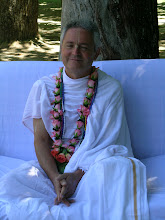
H.G. Matsyavatar Das

Thursday, 6 December 2012

The Help Everyone Needs


The path of spiritual evolution is marked by different phases, breakthroughs,  deviations and stagnations, falls, imprisonments and  progressive liberations.
Even the man who has testified the important improvements on the path of spiritual realization and is sincere in his intention to evolve, is still bound to make mistakes and therefore is subject to karmic conseguences due to the remaining unsolved conditionings. 
However it is at the time of crisis that a person needs our affection more than ever, needs our help through comprehension  and forgiveness in order to try once again and overcome the limits, that had been structured in the numerous past lives.
As I have been observing for decades, the persons meet a lot of difficulties along the path of evolution, and it is rare that one proceeds steadily and coherently, rather everyone makes steps backwards and forwards according to one's peculiar characteristics: the individuals most advanced in the inner growth are those who make more steps forwards than backwards.
Through their walking towards spiritual love and perfection all these souls in the prakriti world need encouragement, most of all when they are in the process of rolling back. A sincere help received at the most crucial moments of life is the best call in order to carry on along the right path.

Thursday, 8 November 2012

The Abysses of the Mind and the Highest Peaks of Consciousness (part 2/2). By Matsyavatara dasa (Marco Ferrini)

Although at times it seems to have no reasons to fall into a crevasse, we can witness that the gap is real for whom can perceive it. The same goes for the ecstatic experience which is usually ignored to the majority of people, but for the great personalities who has realized themselves, it may become a permanent reality, which in a single brush erases all the world attachments together with the taste for the sense gratification. One doesn't reach that experience by mere comprehension or due to the limited human efforts; it thus manifests thanks to the divine mercy and it is the divine mercy that helps us to get out of the crevasse: combined to our our personal effort, it brings clearness within us and start  to make the river of life flow again. In this way our happiness will also start to flow again freely, with no more obstacles of the past choices.   We cannot live lofty experiences at present if in the past we failed to recognize the existence of the crevasse with its characteristics, consciously choosing the way that takes us to the enlightened Hill, to the highest Sky, just like Virgilio explains  to Dante at the beginning of the Divine Commedy and like Krishna  says to Arjuna oppressed by a deep existential crisis at the beginning of the Bhagavad-gita. One does not fall into the crevasse at once, nor he reaches the peak in an instance. Such high ascent is the result of a constant work turned to avoid and correct the mistakes promptly, to coordinate all the efforts with the purpose to evolve and animated by the honest desire of spiritual self-realization.
Enviousness,  jealousy, lust, greed, anger, craving for fame – these are all the ropes that make one drift down the crevasse. On the other hand, mercy, compassion, humility, patience, forgiveness help to ascend. Those spiritual qualities, typical of authentic brahmanas, are the most elevated qualities to develop;  that is why the brahmanas who coherently practice and live them should not be submitted to power because these qualities represent the highest target. In Bhagavad-gita XVIII. 42 Krishna describes the main qualities from which many others originate; those who wish to reach the highest peaks of consciousness  do not have to learn them just by heart, but to catch the essence, how they are lived and taught.
Those qualities should become our nature, should enter each part of our being, in order to transfer ourselves gradually  from tamas to rajas, from rajas to sattva guna; only then we will avoid the risk of falling down the crevasse and our journey will be an evolution in progress towards the highest peaks of Bhakti, empowered with faithful and devoted love for Krishna. The practice of Bhakti is the most powerful instrument of evolution that allows us to develop the qualities described before and, in its greatest expansion, it is the highest  spiritual peak to reach. In the journey towards supreme Bhakti, authentic love and happiness increase step by step.

Saturday, 25 August 2012

The Abysses of the Mind and the Highest Peaks of Consciousness (part 1/2). By Matsyavatara dasa (Marco Ferrini)


Sometimes in life human beings make rather difficult, painful experiences, in which people seem to fall into a crevasse, an abyss, very close to annihilation; there are then, most seldom, other people who touch brightening peaks, with an extraordinary expansion of consciousness in which they experience – even though for a few moments – an irrepressible happiness. In the middle, between these two positions, stand the great majority of humanity that carry on an ordinary mediocrity.

Very often I witnessed the experience of the abyss among many people I met, who had asked me for help. A couple of times, between the age of 10 and 30, I found myself on the brink of the abyss, I was at risk, but thanks to the divine mercy I was supported and saved from that devastating experience. Such experience doesn't manifest itself in one's life out of conscious intention but because of a series of factors that have been produced by one's own thoughts, deeds and motivations. We can learn to foresee and recognize it from a series of features, symbols, signs and warnings, related to its original causes. I feel very much sympathetic towards people who happen to face this experience of the abyss, the black whole, a total disorientation; the person feels like drifting downward and there is no end to the crevasse. In that condition of consciousness there is no way to get any better, but only to get worse. Who wishes to do so, may accept my reflection to question oneself and try to understand if and how often, one has found oneself in life on the brink of the abyss, or close to it, when and how he managed to avoid the collapse.
By describing this state of consciousness, I would use the following metaphor: the river of life that suddenly stops flowing. Water remains still and runs no longer. There seems to be real obstacles to cause the obstruction, but they are mainly produced by the doer of that experience. It is the person itself that creates its crevasse and falls into it. Can the elevating experience be also the result of inner projections? I would be inclined to confirm and approve both statements because there is a strong logic link to it, but thinking on this delicate theme, through praying and meditating, I could deepen my comprehension as follows. We are to decide which direction to take, either into the crevasse or towards the peak, however the crevasse and the pike exist, they represent a possibility, it is up to us to decide whether to accept or refuse either one or the other. According to my comprehension, the Shastra and the Sadhu teach that abysses and peaks exist independently from us, but we make them happen in our life by everyday choices. Either a period of mourning, or the death of a child which is a desolating loss for a mother, or for the sake of our ego, any person may fall into an abyss, but the same person can also choose to transform that event in a precious and saving opportunity in order to reach the highest peaks of consciousness.

Monday, 21 May 2012

Action or Renunciation (part 2/2). By Matsyavatara dasa (Marco Ferrini)


The perfection of renunciation

In Bhagavad-Gita Krishna explains that the perfection of renunciation is not a simple physical detachment from the objects of the senses, but rather an emotional detachment from them (vayragya).
Tyaga is a first phase which must necessarily be exceeded in order to mature the real detachment, the emotional one, because an artificial detachment from things and people while going on longing for them, is a behavior that Krishna defines with the term “hypocrite.” (Bhagavad-gita III.6)
Therefore a true success in renunciation can only be achieved by getting rid of the egoistic desires and regarding this point there is an important teaching of Krishna:  “Both parting with action and the devotional action lead to the path of liberation but, of the two, devotional action is better”. (Bhagavad-gita V.2)  
The mere avoiding of the objects of the senses is a hard way that is not sufficient to achieve perfection (Bhagavad-gita III.4); transformation and sublimation of desire is possible by undertaking  the evolutionary path that starts from tyaga (physical detachment), passes through vairagya (emotional detachment) and reaches Bhakti (a devotional action offered to God).
The final teaching of Bhagavad-gita describes the best form of renunciation, that is, the action performed without egoistic motivation or attachment to its results, but in a pure spirit of love and service to the Supreme Lord. This highest form of renunciation is defined yukta-vairagya, the renunciation of the one who, having purified one's consciousness, offers everything to God. 
Such a devotional action performed in Bhakti spirit leads to transformation and sublimation of all the energies of the being, and thus it is considered even superior to renunciation, as it allows the human being to taste the complete and blissful relationship with God that can not be experienced due to a simple renunciation. 
Krishna exhorts Arjuna: “Perform your duty in order to satisfy Vishnu and you will stay forever free from the conditionings of the matter” (Bhagavad-gita III.9).
Bhagavad-gita teaches an attitude far both from an illusory identification with the immanence (the “world” and the  “flesh” of the Gospel), and from some abstract spirituality that denies the matter and neglects the physical body. 
Krishna urges to act efficiently, fully and with detachment, but without a desire for power and possession, a sacred action offered to God with joyful devotion.
In Taoist terms, it suggests a dynamic balance of opposites, action and inaction, obtained due to the superior knowledge that allows to live fully in the material world fulfilling one's duties without pseudo-meditative evasions and, at the same time, to be open to a real meditative dimension, that is meta-historical and meta-temporal one, of communion with the Divine.

Monday, 7 May 2012

Action or Renunciation. (part 1/2) By Matsyavatara dasa (Marco Ferrini)


The Art of Perfect Action

In the third and fifth chapters of Bhagavad-gita Krishna explains to his disciple Arjuna the art of  perfect action.
The perfection of action – karma yoga – can not be reached unless one obtains a clear understanding and a proper discernment of what is beneficial and what is harmful for the spiritual evolution of the individual, that is why the right behavior, or acara, can be achieved only if the right knowledge, jnana, has already been acquired. Jnana can be completed and improved only with a proper practice that leads to vijnana, realized knowledge, the wisdom: the knowledge transformed in action and applied with creativity in the right time, in the right place and under the right circumstances. 
Bhagavad-gita answers to a complex question raised by Arjuna to Krishna: what is better - action or renunciation?
Krishna, in an admirable way, explains that it is impossible to give up acting completely: in reality the so-called inaction does not exist. Everyone in the world is inevitably obliged to act, there is no life without action, even a single breath implies some movement, by a rhythm which is integral to life (B.g. III.5). As Krishna states everybody acts according to the tendencies acquired during the previous life experiences; even the wise cannot refrain from action, not even for a moment, but his way of acting is completely different in nature compared to the one who is unaware of true knowledge and whose motivation is impure.
Krishna urges Arjuna with the following words: “Carry out your duty as action is better than inaction. Without acting the man is unable even to maintain his body” (B.g. III.8).
Therefore renunciation should be understood not just as a complete abstention from acting – that would be impossible – but as an abstention from the impure activities, that implies avoiding the objects of the senses (tyaga), people and experiences that can lead us astray from our spiritual path.
Once Arjuna has understood this important teaching, Krishna reveals higher truth and, in the fifth chapter, declares that both renunciation from action and devotional action lead to liberation but, of the two, the devotional action is better.

Thursday, 12 April 2012

Ruler of the castle of nine gates. By Matsyavatara das (Marco Ferrini)


An evolutionary journey requires a conscious use of our senses, at the risk of being trapped by the illusory nature of our perception of reality: our energy may thus be absorbed by that of the objects around us and the psychological pressure they exert on the mind (vritti). Every action we enact produces a tendency that is enforced through repetition: these repetitions develop into habits that ingrain attachments that are difficult to dismiss. Hence the relevance of carefully selecting our experiences.
In the Bhagavad-gita, Krishna  (V.5/13) encourages Arjuna to become the ruler of the castle of nine gates: the body is the castle and the nine gates are represented by the orifices that connect him to the outer world.
Body and mind are a laboratory where we can experiment elevating our goals: “you where not meant to live like brutes but to follow virtue and knowledge” (Dante’s Inferno Canto XXVI).
Nature (alias prakriti) is actually an expression of the spirit and should be a tool for evolution rather than quagmire that absorbs us in its quicksands.
Spirit and matter are not oppository within the conscience of those who have attained spiritual realization. Thus all that is created, all creatures and the Creator represent an undivided triad. It is a single entity that splinters and diffuses itself in infinite expressions. We must experience our knowledge of reality with a proviso: that reality may not become a tomb for our soul. 
If we are unconnected to superior values we are consumed by vices or by whatever we have come to depend upon simply because it conditions us.
The Bhagavad-gita teaches the art of being rigorous, self controlled, wilful and determined: to what avail?
The aim is to rediscover our primeval condition of knowledge, eternity and bliss. Yet even this understanding alone is inadequate because we need to put these qualities into daily practice so as to prevent them from becoming an abstract and purely theoretical knowledge that alienates us from society and the human adventure. 
Deep-rooted and authentic wisdom leads to compassion, solidarity with all creatures and to the extraordinary experience of sharing and Love.

Thursday, 22 March 2012

The Science of Meditation (part 6). By Matsyavatara dasa (Marco Ferrini)

The principles of liberty, justice and love are irrepressible and everyone tends to realize them, hence, insofar we dedicate ourselves to developing our idealities, we act ecologically for our environment; it means that we do not just help people who live with us, but the environment in general and we integrate ourselves into Humanity and with all Creatures. This ideality can be initially experienced in a sporadic way with the practice of occasional meditation, but it should become a whole life modality daily constant, in order to reach the perfection of meditation.
Perfection does not exist from a human perspective, but what exists is a tending toward, moving toward, nevertheless there is no need to fear for taking action and to think that, since we are not perfect, our action will be imperfect. Anyway, it will be imperfect, but if we take first steps in the right direction and move toward perfection, each step will carry us back into the essential, inner happiness with full satisfaction, santosha, and contentment, tushti, that make the person extremely tolerant and humble. Regardless of social position, heralds or uniform and colors we wear, what determines the level of realization we can reach are our humbleness and tolerance. For this reason, awareness and wisdom should be transformed in emotional detachment, detaching ourselves not just from what is aimless, but from what is harmful and is an obstacle on the path to evolution. The first level of detachment to be realized is to retract senses from their objects (pratyahara), in order to avoid that senses become like wild horses, without any violent opposition or repression, but converting them into an evolutionary path, useful for our inner growth. This renunciation is not a brutal deprivation dictated by dogmatism or prejudice, on the contrary, it is an appealing and effective abstention we practice naturally when we have been given something superior: the incarnated soul can abstain from sense enjoyment, although the craving (for sense enjoyment) remains. But if the soul becomes detached by experiencing the superior pleasure, it will remain steady in the spiritual consciousness.
Translated literally from Sanskrit param means “superior” and drishtva “having seen”: when we will develop a superior vision, we can renounce an inferior one. We do not have to fear inhibition: some cerebral areas, as well as some organs in the body, are inhibited when we do something requiring to focus our attention. It is certainly not such kind of inhibition that may block our evolutionary path, on the contrary it is something we can dominate by ourselves, so we can deal with it in a sensible and expert way when we give up something inferior for a superior benefit. This act can be called asceticism, in Sanskrit tapas, that is our capability to renounce with a volitional act, with deliberated intention, something inferior for something better. It involves an extraordinary coherence and a plan to achieve liberation from conditioning, thus to dissolve virulent samskara that affect the individual behavior. The resulting benefit is extended to all those feelings of guilt and complexes that populate our unconscious, which stemmed at some point in our lives and in our existential history, thus dissolving negative effects and setting the individual free from the imprisonment suffered till then. Although meditation does not exhaust itself in the meaning of ascetism, the latter constitutes a detail that cannot be overlooked; it is associated both to prayers an right acts for the benefit of all creatures, harming as little as possible (ahimsa), for example by living on natural and wholesome food, that involves minimum of violence: cereals, vegetables and legumes. So, our aim should be to provide an ongoing way to structure our lives, focusing on the highest evolutionary level in this segment of existence, consequently striving for a more evolved physical body in our successive live. The Vishnu Purana explains there are 400.000 varieties of evolutionary human species, like human, subhuman, superhuman, saints and brigands, various types as much as there are various psychic structures and related chthonic impulses arising from the unconscious. These drives can affect individual behavior, they can dominate a person inexorably and, when destructive and antisocial, lead him or her to commit horrible crimes. To know that some of these forces could be irrepressible and beyond an individual’s own control, has made possible in the Jurisprudence context that similar cases are not be condemned to prison but treated in Judiciary Psychiatric Hospitals. Anyhow, before arriving to such extreme and severely compromised situations, there are prophylaxis and preventive treatments focused on resolving, that can be applied. Meditation practice is associated to them and represents a concrete example.