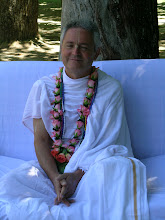
H.G. Matsyavatar Das

Showing posts with label Matsyavatara dasa. Show all posts

Tuesday, 25 May 2010

On Evaluation and Judgment


By Matsya Avatara Dasa

In life, to pursue our evolution, we must analyze what happens, understand it and make our own opinion. By analyzing the facts, we can even understand eventual mistakes made by us or by others, learn some lessons, without letting it determine our distrust in ourselves or our diminished gratitude toward others. Within ourselves and in others, there are not only light or shadow, that’s why our intelligence must be utilized to distinguish these two aspects to understand how we can correct and improve ourselves.
The analysis, the investigation and the evaluation of the facts, is everyone’s duty if we want to evolve. However, analysis and evaluation must not imply the stigmatizing judgment of condemnation of others. In the Gospel, according to Matthew (chap. 7) you may read: “Do not judge, so you are not judged, because with the same judgment that you judge other, you will be judged and with the same measurement that you will measure others you will be measured.” When we see individuals in conflict with each other, we shouldn’t ask ourselves who is right or wrong. First of all we should engage in understanding what happened and what is the right thing to do. We must be interested in doing the right thing, not in reporting who doesn’t do it or cheer who does it. Our soul pushes us upward, toward noble ideals and purity. Purity is our strength, astuteness and shrewdness are not. One can read all of the Shastra and memorize them, but, if his motivation is not a desire for an ever greater purity and harmony, he will never climb the evolutionary step. Let’s always engage ourselves in verifying our level of understanding and capability to apply these teachings. With the vaishnava, for example, we should behave with great respect, remaining close to them as we would be close to fire. We must be careful not to make offenses or we will get burned. The Scriptures inform us that staying with our spiritual master is a privilege that we get after numerous lives, just as getting the opportunity to serve the Deities or study the Shastra. To acknowledge their teachings we must be concentrated, offer mantra and express gratitude through chosen prayers to make contact not only with the book ma also with the flux or divine inspiration that will reach us when our heart is ready to accept the endless mercy. If there is no humble and devotional attitude, if we don’t approach these Realities with the consciousness of the great privilege that we have, we risk to lose the flavor for the Shastra, for Satsanga, for Prasada and for other immeasurable divine presents. We have a great fortune but we dilapidate it. Let’s engage ourselves to get conscious of the greatness of what was offered to us and of the rarity of being with people who have dedicated their lives to the purpose of reaching Love for the Creator, the create and the creatures. Let’s practice with faith, sincerity and purity, simplicity, Love for Krishna and for all of the living beings. The vaishnava works in the world to offer the opportunity to undertake this journey to all. The bhakta is not he who relegates himself in a cavern or in a hollow tree as a misanthrope but he is active among people with the sentiment of compassion to inspire all to harmonize themselves with the universe and make the experience of Life after death. This experience cannot be made if we don’t wake up spiritually, if we maintain the illusion to be happy in the matter and with the matter. Thanks to God we have received from Shrila Prabhupada and from the previous acarya not only theoretical teachings but also their example and life model. We were able to see how they behaved when they were applauded or insulted, when they were healthy or ill, in moments of abundance, or in strained circumstances. We must be grateful to the Lord because in this life we have all the instruments that we need to perform our journey and reach our destination. Are there going to be more tests to overcome, dangerous roads and perils along the way? The answer is yes, and it couldn’t be otherwise as long as we live in such a muting world. In this journey from birth to death we have the opportunity to learn many lessons to transform our existence in an evolutionary way and reach the highs of the conscience and realization with a sentiment of pure Love. The acarya describe our purpose by talking about a free way, of immense happiness, without constriction of time and space and mainly without the presence of death. Their words and realizations recall an inspiration that is in the heart of each one of us. The inspiration is of full consciousness, freedom, justice, immortality and beatitude. In the same measure that we dedicate ourselves to spiritual practices and we surrender to God and we intensely desire to evolve, we could free ourselves to the net of maya, thanks to the divine intervention and we will reach Love.

Monday, 17 May 2010

Imitating or Following Someone’s Footprints


By Matsya Avatara Dasa


Should we imitate wise men, the spiritual master, the acarya and the prophets or follow their footsteps?

Imitation or simulation of a behavior results in copying someone, sometimes it can be some kind of deceit, which is much different from following the footsteps of an elevated model in an honest and sincere attempt to activate latent faculties within ourselves that are still unexpressed. Following the steps of elevated people will allow us to grow and will help us if we practice it with humbleness by giving benefits to others.

The spiritual master must not be imitated, but followed and used as a model to creatively apply his teachings on one’s life. If we humbly strive to follow his footsteps, we gradually build in ourselves all of our inner requirements that will turn his model into our model. This would be an experience and a patrimony that step by step we can capitalize on. Vice versa, if we imitate him without performing a deep inner work, we will have the illusion to fly but we will discover that we have no wings to fly on. Only he who follows the footsteps, slowly gets close to who imprints these footsteps.

Therefore, imitating doesn’t bring any long term benefits. Instead it exposes us to many dangers. Following the footsteps allows us to develop and earn the qualities that we take as a model.

Shila Prabhupada used to say: “If you are not humble, act as if you where, If you are not a devotee yet, act like a devotee.”

“Acting as if” is a practice that can help us significantly in our spiritual journey. If I act as if I was a devotee, by maintain conscience of my limits and trying to overcome them, gradually, I will become a devotee. “Acting as if” allow us to progress in the same measure as we practice without pride and haughtiness, without pretending to ourselves and to others that we have already arrived.

If we follow the footsteps of those that are humble, we can also gradually become humble without making the mistake of building an illusion, however sincerely striving to find in ourselves that elevate quality of the soul. In reality virtue and knowledge already reside within us. We must realize existence and free ourselves from conditioners. Socrates used to define this teaching with the concept of maieutica and used to explain it as follows: what I do is simply putting people in the right conditions to
“give birth” to their knowledge. We can teach a child how to speak only because he already has in himself the faculty of speech, instead we could never do it with a monkey no matter how much effort we would put in it. By cultivating spiritual knowledge already intrinsic in our inner self and by practicing it in our life, we can awake in ourselves our superior nature, the only one that really belongs to us.

If we think that goodness, humbleness, justice, truthfulness, compassion, tolerance, mercy and love are qualities of our inner self, by practicing these values with faith and under the guide of who lives them coherently, we can gradually rediscover them by realizing who we are. We won’t realize it only at the intellectual level, but also by experiencing a superior flavor of those values, on the strength of an emotional wave that connects us permanently to our inner world. By doing this and predisposing ourselves in the best way with prayers and meditation, by looking for help from Shri Shri Guru and Krishna, we can achieve excellent progress, even though we are still prisoners in our bodies. This is because we will reconnect to the universal archetypes and to that cosmic harmony that guarantees evolution and wellbeing of all the creatures and that allows us to transcend the narrow limits of conditioners: space and time.

Imitating means depriving ourselves of that very precious personal contribution called creativity. Knowledge applied without creativity and artificially emulated, does not bring results. This is why we should not imitate the acaryas but instead follow their footsteps, by acquiring their teachings and making them ours, by expressing them through our individuality and personality with our peculiar feelings, with faith and purity. We need to ensure that those teaching become our voice, our perfume and our existence.

When a person imitates someone, that person is not himself. He can act well his part but inside him there won’t be tangible and significant changes as soon as the mask is off. If instead a person engages himself to apply the received teachings without fakeness, by expressing himself in every circumstance, without putting up any artifice, even if sometimes it would be evident that he doesn’t understand or he makes some errors, he would however have a bigger chance to evolve spiritually in comparison to a perfect imitator.

The Guru’s teachings must serve as orientation. The compass shows the destination, but we must undertake the journey to reach it.

To follow the Spiritual Master’s footsteps we must engage ourselves by utilizing every resource to continue on the indicated path. Our path leads to the same goal that we have undertaken as a model, but if we reach it on our own, maybe out feathers will be a little worn out, but we are the ones who reached the goal after we have undertaken the entire journey.

By imitating, we don’t do a true job on ourselves and therefore we don’t feel satisfied, instead by following the footsteps we experiment a great joy and a continuous increment of our gratitude toward he who has showed us the way and helped us undertaking it.

Along the path we can sometimes encounter some obstacles such a stream that interferes and confuses us because we cannot see footprints in water। That would then become the chance to deeply question ourselves, to internalize even more the received teachings and understand how to proceed by using all the means at our disposal. Following footprints requires all of our participation and this allows us to develop a taste for knowledge and for its application. When we can climb some evolutionary step, it becomes our conquest and the gratitude toward those that have inspired and educated us on our journey becomes ever greater.

Between imitating and following footsteps there is a great difference, mainly a different flavor. Following footsteps we can learn to apply teachings with our intelligence and creativity, by purifying and continuously renovating our motivation to reach ever higher equilibriums. If in this journey we wear out our feathers or our hair turn white there is no reason to complain, instead we should be proud that we spent our lives in pursuing noble ideals. There is no other valuable purpose in this world. He who dreams to be happy with the pleasures of the senses is like he who in a mirage sees water in the desert. Does our vision then oppose matter to spirit? No, the vision that the acaryas have donated to us integrates Hearth and Sky. In fact, even in this world and with the things of this world we can experience happiness, but it is real only as long as we are connected and we connect everything to the Spirit, the world and Its Creator along with the create and the creatures. Beatitude becomes possible even in this world when we contemplate and serve God in every creature.

Friday, 5 February 2010

Dante’s journey and Bhagavad-Gita - Siena, January the 29th

By Madhavipriya Dasi

Friday, 29 January at Santa Maria della Scala in Siena, artistic pole of the city and privileged reference for the European culture, Marco Ferrini hosted an event on the subject: “Dante’s journey and Bhagavad-Gita. Psychological experience of Inferno, Purgatory and Paradise for the Contemporary Man.”

The dialogue between earth and sky, Ferrini explained, is one of the central themes in both Bhagavad-Gita and the Commedia. “These two great works dialogue among each other in an extraordinary way. They both describe the cowardice and the longing of the individual in relation to the highest ideality. The spiritual message that is transmitted overpasses the limits of the paradigm of space and time. Geographical distances and millenniums disappear when we see that the journey of the protagonists of both works, Dante and Arjuna, find the same stages. They both must face inquietudes and hard trials to overcome their own limits. Even if they live in extremely different cultural, social and political contexts, both Dante and Arjuna begin their journey from a dark forest, which is their anguishing confusing and lost state. They both find the way that leads them to see the light of the soul all the way to the realization of the Divine Immortal Love which is Bhakti, in the Hindu-Vedic tradition and “the Love which moves the sun and the other stars” in the Divine Comedy .
After a social-historical and political contextualization of both works Ferrini read parts of the Divine Comedy and Bhagavad-Gita and commented and revealed surprising coincidences. At some points, the teachings seem to overlap in their universality. Even today they offer a great reference to the Oriental and Western men who wish to undertake the journey toward their inner enlightenment and happiness. A journey to realization in this life, this world, here and now, in comparison with their true society.

Virgilio leads Dante through this evolutionary journey all the way to Beatrice who represents the soul of the poet and in Bhagavad-Gita he is lead by Krishna, the Divine Manifestation that offers to his devotee eyes capable to see reality instead of appearance, with the purpose of realizing the highest spiritual essence.

“Each of us can live here and now in a state of conscience typical of Inferno, Purgatory or Paradise. To exit the Inferno, Dante had to change his point of view, detach himself from egoistical identification, see people dear to him in Inferno, look directly at human defects, identify in those infernal people that he meets what upsets him or stops his evolution in ascending the beautiful hill.

As long as we blame others for our suffering we cannot exit Inferno. Only if we take responsibility for our errors and do our best to correct them we can return to gaze at the stars and hoist the sails of the sheep of our intelligence. The beasts that block the way, Dante and Arjuna’s, are the same ones: the variegaled skin of that wild beast, or cupidity (kama), the lion which represents rage (Krodha) and greed (lobha), portrayed by the wolf which after eating she is more hungry than before. In both works the protagonists are encouraged and educated to overcome obstacles and as such it is inspired who immerges himself in the reading of these great texts entering into their deepest spirit.”

Love, Ferrini concluded, is the peak of the teaching of Bhagavad-Gita and Divine Comedy. It is a not merely human Love, it doesn’t coincide with sentimentalism, it is not of exclusive nature, but lived with universal modality which is expressed toward every creature. A kind of Love that doesn’t need expectations or compensation but it is sufficient to itself. In its purity it finds strength and total gratification. This Love allows us to enter that meta-space of the heart where man meets with God and where we can find all of the beauty, richness, knowledge and immortality that each of us is pursuing.”

For the 200 or more people who participated and for all of those that would like to participate there will be an opportunity to continue to explore the charming dialog between the Divine Comedy and Bhagavad-Gita and other lectures on this subject will be scheduled. You may find additional information on the following website www.c-s-b.org.

Tuesday, 15 September 2009

THE VALUE OF RELATIONSHIPS - Part I


By Matsyavatara dasa


The quality of any relationship is guaranteed only if we know how to appreciate the qualities of others and the quality of realization per se. The lack of such appreciation produces lack of relationships. To overcome this, the first indispensable step is learning how to recognize the value of others.

What to say, when and to who is not always easy to understand or guess. Human relationships are a complex universe. Sometimes we put our hearts into a relationship; we try to develop it at the best of our capability; however we are not successful in building with the counterpart what was within our intentions. We should commit ourselves to do the maximum with the intention to evolve, with joy and desire to grow together, however without expectations. We should always be open to answer to the other person in respect to his freedom. If we really want to learn to love others, we should not lay passively on them by developing unhealthy relationships, depending on others by loading them with our expectations and egoistical claims thus suffocating the chances for interaction and operate favorably for the well-being of all. He who cannot practice this basic principle falls with the falling of the relationship. He loses height and falls on the ground without having the chance to realize it.


Let’s invest our best energies, all of our intelligence and our heart into our relationships. Let’s do it however without falling into perfectionism, thus being humbly conscious of human limitations (ours and others’). Even this will help us appreciated the value of what we are building.

To build a relationship, whether a love one or a friendship, with relatives or between Guru and disciple, you must consider three fundamental principles that were established by Vitruvio as priority:

  1. stability

  2. functionality

  3. beauty


A building must be stable, sturdy and strong enough to withstand the collision of time and of natural events. The same is for a relationship. We cannot build on a frail soil that doesn’t hold. We must necessarily choose solid grounds. If we deal with frail grounds, we must first of all begin with solidifying the ground itself before we initiate the construction. We cannot solidify the ground and at the same time begin the construction. It won’t work. Certainly the building will not stand, just like a relationship will not withstand the collision with time and trials of life if it is not well based, well prepared, cultivated, enforced and matured.


To enable the manifestation of our and other’s talents and qualities, develop the siddhi, or perfection in relationships, and make them ever shiner, in all their expressed potentiality, we must build on solid basis. To do this we must operate with continuity, without intermittence, distractions or dispersion of energy. Vice versa, our chances for development and realization will remain unaccomplished and feeble like little fireflies that turn on and off in the darkness of the night. Discontinuity and consequent mood swings ruin relationships and everything that we do. They are the Minotaur that must be dealt with and overcome if we want to pursue our goals.


Other than operating with continuity to favor the vigor, the uphold and the stability of our relationships, we must set up our relationships based on what is most functional. Functional to what? To our and other’s evolution.


The relationship could be stable and beautiful per se, but if it is not functional for the high purpose that we have pre-defined, what would be its value?

To learn to set up our relationships in accordance to the principle of functionality, it is important to develop the qualities of flexibility, ductility and elasticity that allow us to choose, in accordance with the situation that we find ourselves in, the proper behavior for that time (kala), place (desha) and circumstance (patra) in relation to the values that we have undertaken and that we intend to pursue.


Lastly, other than being stable and functional, a building, in accordance with Vitruvio must be also beautiful and the same is for a relationship.

As much man has made all kind of efforts in establishing aesthetical standards, the sense of beauty has always remained outside of strict schemes or pre-defined categories. Beauty is proportion, harmony, perfection of the form, but also that certain “don’t know what” that represents the charm of a certain thing, person or relationship, its uniqueness. Therefore if we sharpen our look, elevate our conscience and purify our hearing, we can discover charm and beauty in every being and relationship by realizing that beauty is beyond mere appearance. It corresponds to the intimate essence of what it is. In the tradition, in fact, beauty was inseparable from goodness and from the qualities of the soul. Engaging in affective relationships based on superficial aesthetical criteria, the deceitful criteria of the forms, means settings ourselves up for sure failure. “Don’t be fouled by the width of the entrance”, said Minosse to Dante and also “Pay attention to who you trust”. This is important so we do not get into relationships that come from sudden choices which only result in frustration, suffering and many times depression and desperation.

Let’s commit ourselves to interact with others with the constant and unique desire to benefit them, to pursue their success, the true one, which is of spiritual nature. This would represent the best protection for our life, ourself and our relationships. It would be the powerful principle, even though invisible, that will lead in the evolutionary way every choice that we make and will orient us always toward the right direction at every crucial intersection of our life. Let’s learn to relate always by leaving to others the chance to accept or refuse our offer of love, because love lives of freedom.

Let’s listen to our inner voice when we act and operate in the world and we entertain relationships. If this voice gives us advice, if it urges us to be cautious, let’s pay attention to it and let’s act carefully. Let’s not jump into situations or relationships that could be dangerous and that could harm us or others more than what our little intellect could understand. The gradualness in establishing and entertaining relationships is essential. Once you have made your decision with reflection and farsightedness, do not change plans suddenly, by following indiscriminately the impulses of your mind or senses and letting instinct take over and overcome the basic principles of stability and coherence. Unfortunately the predominant setting of modern society leads to act in superficial and sudden mode, regardless of times and relationships. However, if we want to build valuable relationships, we must invest in time and attention, sensibility, maturity, care, preoccupation, sense of responsibility, coziness, tolerance, capability of open ourselves to others to communicate and listen deeply.

Lets avoid to entertain those relationships or actions that are not coherent with our life project that we intend to realize because, without a project and without following with continuity the method that will lead us to its realization, we would only start every time from scratch, wasting time and energies and showing to ourselves and to others the worst side of our personality.