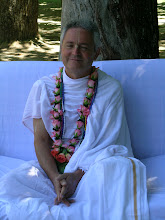
H.G. Matsyavatar Das

Showing posts with label Bhagavad Gita. Show all posts

Friday, 31 January 2014

Remembering Shrila Prabhupada


 PART II
Due to God's mercy, Shrila Prabhupada was able to undertake the adventurous and difficult missions to satisfy the desire of his Guru Maharaja. He knew how to deal with risks, dangers, loneliness, sickness and temptations... Krishna blessed Shrila Prabhupada with such a success that, while originally owning nothing, his movement gradually reached a huge development, comparable to that of the richest and most envied companies, but even so Shrila Prabhupada remained always the person of the great inner qualities: no pride, no arrogance, no material ambitions or futile interests. He was exactly the same person when He went, with only 40 rupees in his pocket, to America, always dedicated to love for Krishna and for all creatures. Shrila Prabhupada had many talents, he was versatile, with great skills, but He was first and foremost a pure Devotee of the Lord.
He loved everyone, because in Shrila Prabhupada's opinion everyone was a potential devotee. He had always the same mood and the same tone of voice, sometimes He got vibrant, speaking with strong words, sometimes He reprimanded, sometimes He praised, sometimes He was moved, but His interest was always to improve the understanding of the devotees, their health, the image of the Movement. We must unmask the so fashionable artificial way to see an Acarya as detached from everyone and everything. Prabhupada was very interested in the success of the various services, he cared about everything working and running the best way, thus satisfying Krishna and encouraging the spiritual elevation of so many people.
Spiritual life does not mean a cold, detached attitude towards the world, we cannot live without relations, without affection, without empathy, without love. We just have to be careful to those we direct these feelings to. We should not
prioritize what calls on the material level, but strive to fulfill our spiritual desires that represent our true essence. Prabhupada had Krishna in His heart and He was always thinking of what he could say or do to bring people closer to God. Krishna had a special relationship with Shrila Prabhupada who had a special relationship with Krishna: this was visible in every activity He had undertaken, either in those particular moments when, for example, He took the initiative to modify a service that maybe was stagnating, or when in the last days of life in this world He was brought in front of the Divinities on a palanquin because He was in a condition of extreme physical weakness and He could no longer walk. In every circumstance Shrila Prabhupada has proved to be a pure devotee of Krishna.
When I read the Bhagavad-gita, chapter twelve, shloka 13 to 20, I see Shrila Prabhupada. I have known many lovely devotees, but Prabhupada is the model for me.
Prabhupada was always connected to Krishna and helped everyone to offer their talents and
energies to the service of the Lord.
The most beautiful part of Shrila Prabhupada is his being so devoted!
He was good at many things: a very good cook, a grammarian, a great preacher, a prominent philosopher and scholar; He was expert in playing music and in offering praise to the Lord, but His main feature was the pure and ardent devotion to God and His constant commitment to the spiritual education, in order to help others to become pure devotees of the Lord. Great it was, and surely still is, the satisfaction of Shrila Prabhupada to see people take seriously the path of Bhakti. And this satisfaction is the source of strength to all those devotees who carry Shrila Prabhupada in their heart.
Despite the apparent departure the Acarya lives forever with us, if we live with Him. As Satsvarupa Maharaja says in his book: "He lives forever ..."

Tuesday, 19 November 2013

Remembering Shrila Prabhupada


PART I
In the sacred occasion of the departure of Bhaktivedanta Swami Shrila Prabhupada, we pray Shri Krishna to empower us with strength so that we could carry in our hearts the example of His extraordinary life, character, deeds and works forever. Those who were able to witness His life and teachings, had the greatest luck to testify the changes in their lives and in the lives of so many people.
These transformations are the great events from which we can draw an inexhaustible inspiration: Shrila Prabhupada gave us the opportunity to live in the spiritual awareness. The path traced by Him is followed by hundreds of thousands of people, and the most favored are those who welcomed Him in the heart, dedicating their service to the realization of His dream, that is make available the love of God to as many people as possible regardless of race, creed, culture, social position, politics or religion.
36 years ago Shrila Prabhupada left His physical body and this material world to return to where He came from, the spiritual universe. We pray Bhagavan Shri Krishna to give us the purity to be able to celebrate His glories properly. By celebrating His glories we become aware of his greatness, and becoming aware of the greatness of a pure devotee of the Lord, we can experience the greatness of God. In this way, practicing the nine paths of Bhakti, we can realize our divine nature and become purified from the distortions of psychic structure and its conditionings.
We take this special opportunity to increase our sincere attachment to the lotus feet of Shrila Prabhupada, to humbly serve His teachings and His way of life so as to bring us closer to Him and to Shri Krishna through the nine paths of love mentioned before.
Shrila Prabhupada allowed hundreds of thousands of people to transform their lives by changing their vision, allowing them to get rid of the identification with the material structure that covers their eternal Self. Shrila Prabhupada gave the possibility to understand the difference between the spiritual Self, the body and the mind and to realize the divine potential of each person regardless of age, gender, social status and culture. The term Acarya means exemplary. Through His example and model of life, Shrila Prabhupada made the teachings of the Shastras feasible.
A person can take the Bhagavad-gita, read some sublime passages and reflect: "How nice it would be to live like that, but who is able to? I would not be capable of doing that for sure." We need a model, an example, there must be someone who lives the teachings of the Bhagavad-gita constantly, faithfully, coherently, and joyfully. The sacred work becomes a person, and the highest aspirations become applicable in our lives. It is exactly what happened to all of us. Why? Because Shrila Prabhupada experienced Bhakti so intensely and joyfully, no matter what life presented to Him in terms of ordeals, difficulties and obstacles to overcome. His relying on Krishna at all times without ever becoming fatalistic allowed this great Acarya to live in this world in pure spiritual consciousness. Faith is not a fatalism, it is an evolutionary creativity for searching the best solution for the existential problems; if we direct our efforts towards the spiritual evolution with commitment and faith, such solution will appear as Paramatma in the heart, as well as through the expert guidance of the Spiritual Master in the outer world.

Monday, 28 October 2013

The Real Success.


The  experiences of accomplishment that one can reach in her or his lifespan, sometimes can be conflicting with the self-image, possibly being the one of an unconfident person, a weak individual, too reliant on someone else’s opinions. If this self-image will not change, the outer accomplishment will be followed by inner troubles and unsteadiness. This is because the new higher equilibrium is such only when it is achieved with harmony and stability. To avoid this kind of situation one should conceive and support a self-image corresponding to what one would like to be and should be. If one will shape her or his personality in depth, then this person will be psychologically ready when an accomplishment or a better position will be achieved. Conversely, some individuals are afraid of their own success because they have not built yet an objective and positive self-image.
Powerful desires move things and alter reality. A person becomes what she or he craves to be. Egoistical ambitions do not lead to real accomplishment: the apparent success sooner or later will turn into calamity.
The immature management of resources and of desire's energy produces derangement and deep emotional troubles. Any waste and any improper use of the above is the cause of personal failure.
Anything we have: objects, affections, talents, must be employed to reconnect ourselves to the deep divine matrix, the raison d'ĂȘtre and foundation of our existence. If we do not do this, as explained by Shrila Rupa Gosvami, one of the greatest Vedic Tradition Master, anything gets contaminated and turns into poison. 
The perfection of existence (yukta vairagya) can be archived if we are closely connected to the Istha Devata and place all our resources to its service. Ambarisha Maharaja was the sovereign of the world, in spite of this he was not ruling it for his own egoistic enjoyment, but as a tool to serve God.  In order to run suitably that function maturity and awareness were needed, because who has so much energy can do great good things, but, if one is not cautious and do not have uncontaminated motivation in the way this energy is used, can cause great damages and bring harm to himself and everybody nearby. 
The most valuable resources, never to be neglected and never to be abused, are our fellow human beings, with their desires for advancement, their wishes for good, their projects, with their search for self-realization. We should not dare to waste even the smallest bit of their energy, we have to support instead their convergence, channeling, and sublimation toward elevated motivations of real good and real success. Sublimation will be possible if we encourage for taking a solid commitment for spiritual activities, with an active and energetic service offered with awareness and dedication to our spiritual Master and the Istha Devata. According to one of the most important and recurrent Shrila Prabhupada’s statements: "Bhakti Yoga is not just an idle meditation". Nor meditation means escaping from the world.
 Authentic meditation inspires and motivates actions in the world, and it is able to solve real problems, to disentangle knots that grew in the mind. Authentic meditation does not evade or remove practical problems: it resolves them. It is based on the consciousness of spiritual matrix of all things, and the understanding of the subtlest psychological phenomena: how minds get entangled or stuck, and how it is possible to jump-start them, reactivate them, and purify them.

Saturday, 5 October 2013

The Great Departure.


Dear devotees, please accept my obeisances;

All glories to Shrila Prabhupada and Shri Shri Radha Govinda Deva.

Jaya Shri Shri Nityananda Gauranga!

Jaya Shri Jagannath, Shri Baladeva, Subhadra Maharani Shrimati!

I hope to find you in good health and spiritually inspired.

Some days ago my dear disciple - Omkrishna Mataji - left the body and this mortal world and headed for the supreme eternal abode of Shri Krishna.

The two sons, daughters in law and grandchildren attended to her all the time in high spiritual consciousness, lovingly and with devotion.

Besides being herself a sincere devotee, Omkrishna Mataji had the great blessing in this life to live in a family of special devotees, all of them very dear to me.

One of her sons was next to her at the very moment she passed away, and has accompanied and sustained her by chanting uninterruptedly the Holy Names.

My most fervent prayers go to this disciple so dear to me, who was always cheerful, playful and joyful, who was so moved every time we met, and I’m also asking you to pray for her too.

I pray she can soon play happily in the company of Lord Krishna and His eternal companions and friends.

With deep emotion,

Matsyavatara dasa

Saturday, 22 June 2013

Pilgrimage: a Journey of Search and Discovery.


Part I
A pilgrimage is a journey in search of the Divine inside and outside us.
It does not take place within a physical space, rather it occurs in one's mind and consciousness. Its most intimate purpose is a deep purification of the heart, of the intellect, of the memory, and of our being in its wholeness. If we live the Pilgrimage deeply and authentically, it may represent a turning point, a special experience, that, due to an extraordinary combination of elements, favouring the purification of consciousness, may allow us a sudden advancement, which possibly we would have not been able to achieve even through a number of  previous lives.
According to the Indovedic literature, the spiritual vitality of the pilgrimage location is related to the daily renovation of its sanctity by the holy people living there.
In the Shrimad Bhagavatam this concept is explained very clearly: they believe that holy people themselves are pilgrimage places. In the first canto of this wonderful masterpiece,  King Yudhisthira says to the great sage Vidura:

Noble soul, the devotee who have the qualities of Your Divine Grace are themselves regarded as pilgrimage places. As you bring God in your heart wherever you go, the places you visit become holy places” (I.13.10)

When we enter a sacred place, in Sanskrit called tirtha, we meet the Divine (murti) and awaken people, sadhu, and this way, if we incline ourselves  properly, we can be pervaded by a great spiritual power, the same energy that permeates those places, behaviours and gestures of ancient sacred value.  This spiritual energy, which, in holy places, is brilliant and vibrating, can strengthen us in order to improve our personality and our changes in life, that, otherwise, we would have  never accomplished for lack of will and courage. Like a magnet that energy and spiritual strength attracts our  deepest thoughts and feelings, our ideal aspirations,  and brings us along a path of wonderful search for rediscovering ourselves, the origins of our life, and our highest realization.
First of all the pilgrimage place is an instrument to acquire virtue and knowledge, not a “horizontal” knowledge, limited to the things of this world, but a “vertical” knowledge that rises up to the highest pinnacles of awareness. For this reason we consider a pilgrimage like a journey between the earth and the sky: from the earth it takes us to the sky and from the sky it brings us back to earth, transferring in our daily life the intuitions, the comprehensions, and the realizations that we have experienced, welcomed, and harboured during the Journey.
All the efforts and inconveniences connected to travelling are part of the path of elevation. They should not to be seen as obstacles, rather they are extraordinary opportunities to overcome our limits, to dispose of  illusions and attachments. When we travel, it is easier to understand that none of the things outside of us belong to us. Who can claim to own wealth? Can we have power over youth or health? For how long? Those resources are given to us for a brief length of time and their quality and evolving utility depends on how we use them. Who can say “I possess a body”?  In truth, we are not even the owners of our body, and if we want to keep it forever, we would not be able to do it: it would be impossible. Sooner o later it will be taken away from us regardless of our will. We do not own whatever is outside us, we can only take care of it temporarily. However the soul and its powers belong to us, and they are inalienable and immensely great: the knowledge of the truth, the joy of the self, the nature of eternity. The essence of  life is to regain awareness of those intrinsic qualities we have lost, choked by the conditionings, and the contaminations of our character. During the Journey each one of us has the rare opportunity to achieve the discovery of the soul’s treasures.
Furthermore the journey exhorts us for a continuous effort of discerning, to separate virtuosity from vice, reality from illusion, sacredness from profane, the inner world from the outside world, aimed to avoid the mistake of exchanging the pure from the impure and vice versa. Holy places are not meant to be seen with your own eyes, we need to predispose ourselves with an elevated consciousness and visit them with the company of people who live and search santity, otherwise we run the risk to limit our vision at the physical level, and to be confused by external appearances.
The sacred place is a state of mind, not a physical reality. It is the reality of the soul where there is genuine love, control over impulses, caring for each other, awareness of the presence of God. During our pilgrimage in sacred places we may come across holy scenes, moments of eternal sacredness, but also situations of degradation and low civilization, exactly like one person may harbour elevated expressions of geniality and kindness together with abysses of degradation. This is why it is fundamental to develop and keep a clear vision about brightness and darkness, without letting slip from memory what is holy just because we saw what is not holy, taking a distance from the degradation only because it is often placed next to what is sacred.
For this reason, in order to feel the spirit of a holy place with this high sense of discernment, it is fundamental to be in company of people motivated like us, sharing the same purposes, and even better - with people who are already able to perceive the essence separated from what is redundant and superficial, via the teachings of the sacred scriptures.

Monday, 18 July 2011

Against violence, towards animals as well. By Matsyavatara das (Marco Ferrini)

In every religious tradition, the commandment “Do not kill” represents the main teaching. In the Veda such principle is spread out with the concept of ahimsa, “do not damage the others”, which is the core of the sadhaka, the scholar who attains a spiritual discipline, religious life. “No Violence” is a law carved in the heart of every human being, even before one starts studying the Sacred Scriptures. The act of killing repels everyone and hurts one’s sensitivity, therefore it is clear that this principle, as stated in the Sacred Scriptures, is referred not only to the killing of human beings.

Glories to You My Lord with all Your living creatures!". St Francis of Assisi

The world of living beings is a whole organism. The general life of this organism is not God, but it is only a partial aspect of His manifestations, the same as our planet is a part of the solar system which itself is a part of another greater system and so on”. Lev Tolstoj

There will be a time when man will not have to kill for food and even the killing of one single animal will be considered as harmful and immoral”. Leonardo da Vinci

Along the long path of evolution with the purpose of perfection, humanity has not yet become aware of the need for compassion, towards animals too.

The list below outlines the lack of sensitivity that still affects the majority of human species, according to the statistics of 2009 regarding butchering of animals in the world reported by the National Geographic in the issue of May 2011.

1.7 million camels

24 million Indian buffalos

293 million cows

398 million goats

518 million sheep

633 million turkeys

1.1 billion rabbits

1.3 billion pigs

2.3 billion ducks

52 billion chickens

The magazine editors point out that the above statistics do not include fish!

In Bhagavad-gita, Krishna offers a perspective that can help each sensitive person to avoid becoming an accomplice, neither in active or passive way, of the horror of slaughtering the great number of poor animals. The fundamental ethical principle is to act for the good of every being and it is stated by Krishna in a straight forward way, by explaining how this principle can be fulfilled on earth, in this world, by showing benevolence and compassion towards all creatures.

“The devotee of Mine who is non-envious, who bears benevolence towards all living entities, free from false ego, equal in distress and happiness, forgiving, always content by performing devotional service with unflinching determination, who relies his mind and spiritual intelligence upon Me is very dear to Me.

One who do not cause disturbance to others, who is never disturbed by anybody and who is freed from mundane pleasures, anger, fear and anxiety such a person is very dear to Me.

The devotee of Mine who is pure, detached, expert, free from worry, or agitation and unconcerned with any mundane endeavor, such a person is very dear to Me”.

Bhagavad-gita XII.13-16.

Friday, 5 February 2010

Dante’s journey and Bhagavad-Gita - Siena, January the 29th

By Madhavipriya Dasi

Friday, 29 January at Santa Maria della Scala in Siena, artistic pole of the city and privileged reference for the European culture, Marco Ferrini hosted an event on the subject: “Dante’s journey and Bhagavad-Gita. Psychological experience of Inferno, Purgatory and Paradise for the Contemporary Man.”

The dialogue between earth and sky, Ferrini explained, is one of the central themes in both Bhagavad-Gita and the Commedia. “These two great works dialogue among each other in an extraordinary way. They both describe the cowardice and the longing of the individual in relation to the highest ideality. The spiritual message that is transmitted overpasses the limits of the paradigm of space and time. Geographical distances and millenniums disappear when we see that the journey of the protagonists of both works, Dante and Arjuna, find the same stages. They both must face inquietudes and hard trials to overcome their own limits. Even if they live in extremely different cultural, social and political contexts, both Dante and Arjuna begin their journey from a dark forest, which is their anguishing confusing and lost state. They both find the way that leads them to see the light of the soul all the way to the realization of the Divine Immortal Love which is Bhakti, in the Hindu-Vedic tradition and “the Love which moves the sun and the other stars” in the Divine Comedy .
After a social-historical and political contextualization of both works Ferrini read parts of the Divine Comedy and Bhagavad-Gita and commented and revealed surprising coincidences. At some points, the teachings seem to overlap in their universality. Even today they offer a great reference to the Oriental and Western men who wish to undertake the journey toward their inner enlightenment and happiness. A journey to realization in this life, this world, here and now, in comparison with their true society.

Virgilio leads Dante through this evolutionary journey all the way to Beatrice who represents the soul of the poet and in Bhagavad-Gita he is lead by Krishna, the Divine Manifestation that offers to his devotee eyes capable to see reality instead of appearance, with the purpose of realizing the highest spiritual essence.

“Each of us can live here and now in a state of conscience typical of Inferno, Purgatory or Paradise. To exit the Inferno, Dante had to change his point of view, detach himself from egoistical identification, see people dear to him in Inferno, look directly at human defects, identify in those infernal people that he meets what upsets him or stops his evolution in ascending the beautiful hill.

As long as we blame others for our suffering we cannot exit Inferno. Only if we take responsibility for our errors and do our best to correct them we can return to gaze at the stars and hoist the sails of the sheep of our intelligence. The beasts that block the way, Dante and Arjuna’s, are the same ones: the variegaled skin of that wild beast, or cupidity (kama), the lion which represents rage (Krodha) and greed (lobha), portrayed by the wolf which after eating she is more hungry than before. In both works the protagonists are encouraged and educated to overcome obstacles and as such it is inspired who immerges himself in the reading of these great texts entering into their deepest spirit.”

Love, Ferrini concluded, is the peak of the teaching of Bhagavad-Gita and Divine Comedy. It is a not merely human Love, it doesn’t coincide with sentimentalism, it is not of exclusive nature, but lived with universal modality which is expressed toward every creature. A kind of Love that doesn’t need expectations or compensation but it is sufficient to itself. In its purity it finds strength and total gratification. This Love allows us to enter that meta-space of the heart where man meets with God and where we can find all of the beauty, richness, knowledge and immortality that each of us is pursuing.”

For the 200 or more people who participated and for all of those that would like to participate there will be an opportunity to continue to explore the charming dialog between the Divine Comedy and Bhagavad-Gita and other lectures on this subject will be scheduled. You may find additional information on the following website www.c-s-b.org.