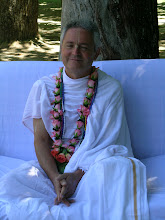
H.G. Matsyavatar Das

Friday, 5 February 2010

Dante’s journey and Bhagavad-Gita - Siena, January the 29th

By Madhavipriya Dasi

Friday, 29 January at Santa Maria della Scala in Siena, artistic pole of the city and privileged reference for the European culture, Marco Ferrini hosted an event on the subject: “Dante’s journey and Bhagavad-Gita. Psychological experience of Inferno, Purgatory and Paradise for the Contemporary Man.”

The dialogue between earth and sky, Ferrini explained, is one of the central themes in both Bhagavad-Gita and the Commedia. “These two great works dialogue among each other in an extraordinary way. They both describe the cowardice and the longing of the individual in relation to the highest ideality. The spiritual message that is transmitted overpasses the limits of the paradigm of space and time. Geographical distances and millenniums disappear when we see that the journey of the protagonists of both works, Dante and Arjuna, find the same stages. They both must face inquietudes and hard trials to overcome their own limits. Even if they live in extremely different cultural, social and political contexts, both Dante and Arjuna begin their journey from a dark forest, which is their anguishing confusing and lost state. They both find the way that leads them to see the light of the soul all the way to the realization of the Divine Immortal Love which is Bhakti, in the Hindu-Vedic tradition and “the Love which moves the sun and the other stars” in the Divine Comedy .
After a social-historical and political contextualization of both works Ferrini read parts of the Divine Comedy and Bhagavad-Gita and commented and revealed surprising coincidences. At some points, the teachings seem to overlap in their universality. Even today they offer a great reference to the Oriental and Western men who wish to undertake the journey toward their inner enlightenment and happiness. A journey to realization in this life, this world, here and now, in comparison with their true society.

Virgilio leads Dante through this evolutionary journey all the way to Beatrice who represents the soul of the poet and in Bhagavad-Gita he is lead by Krishna, the Divine Manifestation that offers to his devotee eyes capable to see reality instead of appearance, with the purpose of realizing the highest spiritual essence.

“Each of us can live here and now in a state of conscience typical of Inferno, Purgatory or Paradise. To exit the Inferno, Dante had to change his point of view, detach himself from egoistical identification, see people dear to him in Inferno, look directly at human defects, identify in those infernal people that he meets what upsets him or stops his evolution in ascending the beautiful hill.

As long as we blame others for our suffering we cannot exit Inferno. Only if we take responsibility for our errors and do our best to correct them we can return to gaze at the stars and hoist the sails of the sheep of our intelligence. The beasts that block the way, Dante and Arjuna’s, are the same ones: the variegaled skin of that wild beast, or cupidity (kama), the lion which represents rage (Krodha) and greed (lobha), portrayed by the wolf which after eating she is more hungry than before. In both works the protagonists are encouraged and educated to overcome obstacles and as such it is inspired who immerges himself in the reading of these great texts entering into their deepest spirit.”

Love, Ferrini concluded, is the peak of the teaching of Bhagavad-Gita and Divine Comedy. It is a not merely human Love, it doesn’t coincide with sentimentalism, it is not of exclusive nature, but lived with universal modality which is expressed toward every creature. A kind of Love that doesn’t need expectations or compensation but it is sufficient to itself. In its purity it finds strength and total gratification. This Love allows us to enter that meta-space of the heart where man meets with God and where we can find all of the beauty, richness, knowledge and immortality that each of us is pursuing.”

For the 200 or more people who participated and for all of those that would like to participate there will be an opportunity to continue to explore the charming dialog between the Divine Comedy and Bhagavad-Gita and other lectures on this subject will be scheduled. You may find additional information on the following website www.c-s-b.org.

Thursday, 21 January 2010

Christmas class

By Madhavipriya Dasi

We depart for Villa Vrindavana for the lecture given every year on Christmas day by Shriman Matsyavatara Prabhu.

On the path of Villa Vrindavana a huge holm-oak has fallen down and obstructs the road. We see its gigantic roots torn-off from the dirt. In this world, even what looks so impressive and seems almost unassailable, falls down. The search for another dimension, in which to live, is such a priority that it is the only thing really important to do.

We enter the Temple and we immerse ourselves in a sweet song dedicated to Shri Krishna-Gopala. The devotees are dancing and offering prayers. The Deities are dressed in pink and blue shine of a light that is not of this world. The lecture begins.

Today we celebrate the glories of a great devotee of the Lord, Jesus Christ, a pure son of God, a shakti-avesha avatara, as He was defined by Shrila Prabhupada. With Christ we celebrate the glories of all the pure devotees of all the authentic spiritual traditions of all languages and skin color. The common denominator of these great personalities is that they all brought a message from another world, another dimension, where there is not only peace and justice but also freedom and love. Their message is of freedom.” What does freedom mean? The Shrimad Bhagavatam explains that moksha consists of freedom from any identification with the dimension time-space sarvo upadhir vinir muktam. Our predisposition to freedom will be more or less in accordance with our way of life, sattvic or rajo-tamasic. In Bhagavad-Gita (II.25) it is explained that the spiritual soul is not contaminated, nor transformed, then what hamper our predisposition to reach heaven while we are alive? What detours us? What interrupts our march toward freedom? The conditioners of the psyche. More precisely, the ancient samskara that produce memories that generate a renewal of egotistical attachments. If the good discerning tattva viveka is not constant, where it is lacking, the good predisposition to reach heaven is interrupted and obstacle elements enter the conscience. We reach freedom only if we learn how to handle our emotions and our thoughts without depending on them any longer.

The free souls are free from resentment, rancor and other negative emotions that contaminate and paralyze the conscience, such as revenge and hate, which hamper the evolution with their presence. The capability to dominate the mind opens the door to freedom and to the best way to dominate and harmonize the mind is focalizing it on Krishna. If the psychic emotions do not attach themselves to a center, they are like planets without an orbit. This center, in religious terminology, is God, the Handsome Supreme Who has the capability to attract all the energies, and in psychological terminology the Inner-Self. The devotee puts any thought, emotion and desire at the service of the Lord. He offers to Him any action and it is in this manner that he disconnects from the dependence and influence of the psychic fields and from the consequences of his actions. This is why in Bhagavad-Gita (IX.34) He says to Arjuna:”If you meditate constantly on Me, if you act as My devotee and you offer to Me all your actions with spirit of sacrifice, if you respect Me and offer Me your prayers, and you bow in front of Me, you will obtain freedom and will come to Me.”

As Bhagavad-Gita explains in VII.14, you can overcome the influence of the gunas only if we give ourselves to God, by offering everything to Him, by founding our life on the modality of sacrifice. Sacrifice ourselves means become sacred. It is the modality of offering to God in the Bhakti spirit that allows for the consecration of the waters of the mind and makes our rapid evolution possible.

Special souls descend from the everlasting reality to give us the message of freedom, to inspire us with a divine life and immortal love. Without their teachings and their mercy we cannot relight our spiritual desire to make it Divine love. Only if we can understand their mercy, we can purify our desires, thoughts and emotions and divert them toward the research for God.”

Shriman Matsyavatara Prabhu reads and comments wonderful excerpts from Bhagavad-Gita that describe the characteristics of the freed dimension.

Moksha means freedom from death but also from birth, from suffering but also from the so called pleasure which in reality is the source of pain. In the Hindu-Vedic literature we often see the image of the wheel of samsara which produces death and rebirths. This wheel is composed of six rays: virtue and vice, pleasure and pain, attachment and repulsion.

When we act egotistically, whether in sattva guna or tamo guna, we start the wheel with the six rays where living as deva in the celestial planets or as asura in the dark planets, will always entail death and rebirth. It is why the pure devotees always speak to us of a world which is beyond the sky and the infernos, beyond the worldly goodness, beyond the cycle of deaths and rebirths.

The great stories of freedom that we find in the holy books are metaphors of that dimension that is the true purpose of those that descend from there to bring us news from that transcendent world. Transcendence is the dimension of immortal Love (Bhagavad-Gita XVIII.54).”

The attending devotees asked various questions. Freedom and transcendence are the center of our attention.

What does living in transcendence mean and is it possible to do it while we are still in this world? Yes, at the same rate as our developed heart purity! Even a small and short experience of the transcendent reality can change our life because it allows us to experience that dimension which is pervaded by sentiments, tastes, or rasa, so fascinating that nothing else, in comparison, has value as explained by Jiva Gosvami when he commented the second verse of Bhaktirasasmrita sindhu.”

There are more questions in reference to Buddhi-yoga, analogies between Bhagavad-Gita and the Gospel, the meaning of shloka XVIII.66 of Bhagavad-Gita. We understand ever more that the teachings and life models of the pure devotees are like lighthouses in the dark night of incarnation. We can hope to proceed without incidents, by freeing ourselves from conditioners and reaching that transcendent dimension of immortal Love only in accordance to the path lightened by their teachings and life examples.

Tuesday, 22 December 2009

Segments of Life: Looking at Death Under Another Prospective

By Matsya Avatara Dasa


Nowadays the great innovations of medical and scientific science can maintain patients alive, even those that in the past were given no hope to survive. These innovations can prolong the patient’s existence artificially even knowing that they will never regain acceptable health and life conditions. This situation is commonly called over-medication. The definition of cerebral death, since the end of the sixties has allowed for the development of transplant surgery. Before that time, the extraction of organs from a patient with a heartbeat was deemed a felony. Among this scientific and social debate there are ever more crucial questions. Up to which point is it right to keep alive a body that is worn out and unable to grant a minimum of dignity to the psycho-physical entity called person? What is the line that marks the decisive boundary between the unavoidable medical assistance and the over-medication?
The recent story of Eluana Englaro and other similar stories such as those of Piergiorgio Welby and Terry Schiavo, made the whole world think by highlighting the urgency of a serious thinking.
The incomparable value of freedom and of the sacredness and dignity of life and respect to all creatures should be a common patrimony in every social body regardless of its scientific or individual religious orientation. This should be true not only toward human beings but also toward every living being. Life must be protected in each of its manifestation. In the complex human, social and scientific context, it is becoming ever more important and urgent to offer information and teaching on the process of dying and also on the post-mortem phenomena in accordance to medical-scientific prospective but also in accordance to spiritual, humanistic and existential prospective. It should be done by sensibly operating with sincerity so that each person can build, without intrusion or cultural prejudices a clear vision of his will and give and explicit and clear indication through a biological testament and other useful instruments that society indicates and uses for this purpose. We can have better opportunities to self-determine our present and our future if we open ourselves to a deeper comprehension of the death phenomena by taking a distance from various taboos and from the many things removed by the collective imagination that usually hamper a mature elaboration. In fact, only by growing in consciousness we can grow in responsibility and freedom.
For this purpose who is writing has been personally taking care of those so called “incurable” patients and of those medical personnel involved with the taking care and assistance of these patients. He does this by offering instruments of reflection based on the sociological, psychological, philosophical and spiritual Hindu-Vedic tradition. This tradition can significantly extend our perception and conception of the individual and of the death event. We can understand how to extend our perception, through a continuous string of considerations intimately connected among each other and we can also find them in the text: Psychology of the cycle of life – Experience beyond birth and death” (edizioni Centro Studi Bhaktivedante www.c-s-b.org). Let’s not only wonder what to do with the organs of a body that has reached the end of this life. Let’s also think of the future of that person that lived in it and that in accordance with the Hindu-Vedic prospective will continue his existence even after he has left that physical body. How can we help that person still imprisoned in that suit that is now worn-out? How can we stimulate him to prepare himself to abandon it? How can we orient the evolutionary journey that will begin after his clinical death is confirmed?
The answer to these questions is important not only for those that work in the medical field but also for every individual. Welcome, assistance and accompanying are three key concepts in this area.
The meaning of welcoming is meeting the other person, opening not only our arms but also our heart and our mind. The meaning of assisting is intervening with sensitiveness by becoming emphatic and listening to the modalities and the needs of others. The meaning of accompanying is being by the side of a person, without preceding him, but staying almost behind him, being a humble and affectionate person and stimulate him to proceed. Accompanying means staying sensibly alongside and helping him to reach his destination by providing warmth, goodness, empathy, compassion and mercy.
The Hindu-Vedic tradition doesn’t use psychotherapeutic techniques, but offers teachings toward the development of a cosmic vision of life, man and the world that doesn’t concentrate on the resolution of psychological discomfort but on the elevation of a global consciousness. This allows those who apply it to re-discover the entirety of their nature on the bio-physical-spiritual level and express all of their most noble potentialities and aspirations by facing even death in an inner-peace state.
Why does death exist? Who or what dies? How can we prepare ourselves? What does dying consists of? How can we assist a terminally ill person? How can we interact with his family and with medical personnel? By asking ourselves these questions we can reach surprising intuitions, sometimes they make us feel beyond the changing flow of this shining and deceiving world (Veda define it maya which means illusory).
The first question to ask ourselves is: when the objective cure-doctor-medication is no longer reachable, what can we do to take care of the person? Can we transform a traumatic even such as death into an evolutionary experience? The answer is Yes!
The phenomena of death is usually lived as the end of everything, dissolution, disappearance, with tonalities that go from resigned to dramatic all the way to desperate. However, according to the Hindu-Vedic philosophical-spiritual tradition death doesn’t exist as an entity, but only as a concept or a moment of transaction from a segment of life to another. Through a consciousness journey, every human being can learn to “live” it by perceiving that his identity is different from the one of the body and discovering in front of him a new phase of his eternal existence to be projected constructively.
Bhagavad-Gita (II.20) says: “The living being is not born, nor will die. He is eternal. He doesn’t die when the body is destroyed. Tagore writes: we walk when we lift our foot just as much as when we put it down. Like daybreak prepares the new day that will later reaches the sunset, the sunset, through the night, will lead to a new daybreak. Life goes on incessantly and if we understand its evolutionary sense and finally its arcane transcendental meaning, we can overcome even the greatest fear, the fear of death and realize the immortality of our essence, and give a new hope to the deep aspirations of every living being toward authentic freedom and happiness, beyond the limits of space and time.
Readings
Renate Greinert, Cerebral Death and Donation of the Organs, the doubts and inquires of a mother that has donated her son’s organs. Macro Editions 2009.

Thursday, 3 December 2009

SHANTA (serene, peaceful)


By Matsya Avatara Dasa

From the book: The 26 Qualities of the Spiritual Researcher

Other meanings:

satisfied
having control over the mind impulses

This is a special, universally valid virtue. Shanti means "serenity, peace, quiet" and one who possesses such characteristics is called shanta. The effects of this virtue are very relevant on the physiological, psychic and spiritual levels. This state of mind is rather easy to attain but it is almost impossible to maintain unless in presence of the condition called yukta, that is to say unless the individual is situated in Yoga, a state of consciousness that enables him to be and remain connected to the Reality.

Several times we have mentioned a higher level of reality that we call Spiritual Reality; the connection with this level enables us to remain shanta. We have already seen, while analyzing some of these qualities, that around such qualities there is a constellation of pseudo-qualities. A person who has satisfied a material desire, for example, can appear to be shanta but he actually is not, because when the same desire returns stronger than before because it was not satisfied in the proper way, it will produce greater agitation and anxiety.

The dictionary gives different meanings for the two terms, anxiety and anguish; the different is not in quality but in quantity: a growing anxiety becomes anguish. The intensity defines if a state is anxiety or anguish. Some events are capable of generating anxiety in themselves.

Now let's try to separate the wheat from the chaff, the serenity and inner calmness that is a pearl of the character from pseudo-virtues that are the result of fatigue or satisfaction of a material desire but that disappear when the ego returns to its original strength and the need shows up again and even greater than before, causing anxiety due to the impossibility of fulfillment.

It is not easy to tell the difference between real virtues and pseudo-virtues. Unfortunately today we see an even worse phenomenon, because while the inability to see the spiritual qualities of an individual is perfectly normal, in our society people even mistake defects for virtues. For example some parents do not want to have a generous child, they want him cunning, and this end up to be a disaster for the parents themselves, who will have to suffer because of their selfish son. They do not say so explicitly but they have been the ones who wanted the son to become what he is now; they did not want him to grow and progress, but to remain a slave, and they encourage him to become tied to money, impressing the anxiety of profit on him. The "Money God" has many worshipers, because this is part of the mainstream mentality. Today those who are not trained to know a higher reality have problems in seeing the inner qualities, but even renunciation to the objects of the world is seen as abnormality, almost as a disease; one who is not attracted by sex, does not dress in a particular way, does not go on holidays in the typical way, does not run here and there madly, is considered sick. The need for God is seen as a neurosis even by a pseudo-scientific section of literature; Freud stated that religion is a form of neurosis, probably because this was his experience - anyway in the world there are many examples of neurotic religionists, just think about 11th September 2001.

Let's go back to the need of satisfying our desires. Think about the night roaming of youngsters on Saturday evenings, so many people die on the roads, looking for what? For the satisfaction of their needs; they are running in the wrong direction, but the desire is the same - to satisfy a need. Very often the problem is due to loneliness, usually with a strong implication: the fear of remaining alone with oneself.

When a person looks for company and finds it or he believes he has found it he becomes quiet, but it is a temporary situation and has nothing to do with shanti, that implies enjoying the good company of one's self. According to our level we may be in the company of ourselves or in the company of God; we are connected to a higher reality. When a person is afraid to remain with himself, he desperately looks for company and if he does not find it, or if he is not satisfied by the company he finds, he keeps going around without a solution and without a hope to obtain what he needs, because the does not know where it is, or how to find it.

Anguish is a more intense emotional charge than anxiety. Anxiety is caused by the fear of not being able to satisfy a need, but when this is satisfied only in an artificial way it returns, with the two possibilities of being fulfilled or not; if there is no fulfillment, anxiety grows into anguish. If on the other hand it is truly and genuinely fulfilled, it will not return, or better, it will return weaker and weaker. Thus through direct experience the individual understands that a need that is fulfilled in the correct way will become weaker and will not cause anxiety, because we know we can satisfy it in the correct way. Shanta is the result of satisfied needs. What is their nature? Psychology comes to our help indicating that affections are the most complete and widest field of human needs, therefore shanta is primarily the result of satisfied affection. Affection is the sum total of all the psychic processes or the entire living experience. Shanta is a healthy person with a healthy mind.

In our course on comparative Indo-Christian studies (the compared texts were specifically Bhagavad-gita and New Testament) we have seen that this virtue is present in both Traditions, and is precisely possessed by persons who have developed the same qualities in spite of belonging to cultures that are so distant from each other.

In Bhagavad-gita V.29 it is said that by recognizing the Lord as the supreme Enjoyer of all sacrifices, as the Lord of all the worlds and Friend of all creatures, one attains shanti, peace. When we are harmoniously connected to the cosmic project and its supreme planner, the effect is that nothing is worrisome or cause of agitation any more.

Child psychology describes this state of tranquility in the relationship between father and son; when the child keeps his father's hand he is not afraid of anything; even if around him he sees apparently dangerous things happening, his father's hand is sufficient to give a sense of security and peacefulness. Another example is given about the calming effect of mother's voice on the child, irrespective of what the mother is saying; similar results can be obtained by stroking or hugging.

Any trace of identification with the body or the mind modifies our state of consciousness and the structured sense of the distorted ego, or ahamkara, prevents us from accessing the complete development of shanta. In some measure, everybody can develop a certain measure of serenity, but it is always something transitory, connected to temporary situations. On the other hand, shanti has a special character: it is stable and does not depend on external circumstances.

Bhagavata Purana (X.1.2-8) confirms that when a need is satisfied in an artificial way, it will come back even stronger, like a fire that seems to be extinguishing when we throw more wood on it, but then rises stronger and higher than before. The connection with performing devotional activities and hearing stories about the divine plays represents the royal path to extinguish the fire of the desires that can never be truly fulfilled in this dimension of existence, because what we are pursuing here is almost always a form of hallucination. This is affirmed by great sages and by the Sacred Scriptures of all times and cultures.

Only through sadhana, discipline, we can decontaminate the mind from conditionings. By decontaminating our deep mind we also purify the feelings that vastly condition our lives from their deep seat. Because of the material influence, the embodied being is naturally conditioned; being conditioned is normal. What is not ordinary is to overcome conditionings, and in fact in order to do that we need a transcendent action - this is also Jung's opinion.

Although shanti or inner peace is a valuable attainment, it corresponds to the first step in the staircase towards spiritual realization; it is the beginning of the journey. We could say that it is a point of arrival and departure at the same time, a coincidence, a turning point. It is a state of mind that corresponds to the first of the rasas and favors the further and more mature development of the personality.

In all lives we find attachments that disrupt the levels of serenity. This is not a planet suitable to live serenely; it is not possible to become happy with the mundane ingredients. We can attain bliss in this life too, but not with the physical or mental objects of this world. I perfectly realize that this statement is a heavy blow for those who have greatly invested into matter; on the other hand it is better not to generate false hopes. Living and experimenting divine virtues is possible and desirable, but the necessary condition is to be connected to a Higher Reality.

A great Master said: "You are in the world but you are not of the World". If we are connected to the spiritual platform we can live states of mind that are not characteristic of Maya's energy even while we live in this world. Maya promises happiness but then does not give it. Each pleasure we catch with great effort is followed by a painful consequence. As Gita1 explains, intelligent people take their distance from some so-called pleasures because they know that soon they will transform into pain, acute sufferings and conditionings; rather they taste the pleasure that is created by the development of virtues, which is closely connected to reality.

Matter is illusory in the sense that it generates illusion, not because it is non-existing. It is a mirror that produces many distorted images, but the mirror exists. To attain the state of shanta we need to understand matter as divine energy and "live" it in connection to the Supreme, without wanting to enjoy it selfishly and delusionally.


1 Bg, V.22.

Wednesday, 25 November 2009

SARVOPAKARAKA (who does good to everyone)


By Matsya Avatara Dasa

From the book: The 26 Qualities of the Spiritual Researcher

Other meanings:

working for the benefit of everyone

doing good to all living entities

putting the good of others before one's own

well-wisher to everyone


A genuine spiritual researcher works for the good of everyone because he is aware of his own spiritual nature that he shares with all the beings, of the eternal relationship that the jiva, the spiritual being, has with God, and of the ultimate purpose of human life that consists in Yoga, or the reconnection of the individual soul with the cosmic Soul.

Through this deep awareness the evolved spiritual researcher is able, with his every action, to bring about the good for all creatures and to make all situations auspicious. Shrimad Bhagavatam states: "Every living being has the duty to engage in activities that are beneficial for others, with his life, his wealth, his intelligence and his words”1.

A person who is able to be sarva-upakaraka does not see friends or enemies any more, his vision is not influenced by the ego any more and is therefore free from dualism. He sees each being, evolved or unevolved, as a radiant spiritual soul, complete with the ontological qualities of sat, cit, ananda (eternity, consciousness and bliss) and close to him he sees the Supreme Soul, the Supreme sarva-upakaraka. With this spiritual vision, the advanced devotee can work for the benefit of all, because he has understood that the good of others is not different from his own good. In Bhagavad-gita we read:

One who sees the Supreme Soul in each being, everywhere the same, does not let his mind be dragged into degradation. Thus he comes closer to the transcendental destination2.

Only by possessing this vision that goes beyond the bodies and appearances, beyond the superficial layers of the personality, it is possible to establish genuine relationships from soul to soul, and to do something concrete to help the people around us: real help consists in favoring the understanding of one's own spiritual nature, encouraging life within the respect of dharma to rediscover our eternal relationship with God and all creatures.

1 SB. X.22.35

2 Bg. XIII.29

Wednesday, 11 November 2009

Dante's Journey and the Bhagavad-gita


The psychological experience of Hell, Purgatory and Paradise for contemporary man


Saturday, 26 September, in Florence Palazzo Vecchio, Bhagavad-Gita from the Vedic-Vaishnava Tradition translated and spread by Shrila Prabhupada, and the Divine Comedy of Dante Alighieri met in such a suggestive location which inspired and charmed about six hundred people from all over Italy.


This Historical-Artistic context has hosted this event conducted by Matsyavatara Prabhu in a superb fashion. It was held in the De' Cinquecento Room and projected in the De' Dugento Room. The battle scenes of Vasari’s paintings, the Victory Genius of Michelangelo and the statues of Vincenzo De Rossi, representing Hercules fatigues seemed to evocate the crucial moments of the existential journey of Arjuna in Bhagavad-Gita and Dante's in the Divine Comedy. The anguishing crisis that they both live, which seems to them worse than death, takes them through a hard battle (la Guerra si del cammino e si de la pietade) from which they both come out victorious.


At first, Matsyavatara Prabhu, drew a cultural and social-historical-political contextualization of both works. He described the peculiar traits of the ancient Hindu-Vedic tradition and the medieval civilization of Dante’s times with reference to their respective sources. The speaker offered a widespread cultural prospective through a stimulating comparison-dialogue between East and West, tracing the connections between cultures that are only apparently far from each other: the great Greek and Classic Latin works, the ancient Vedic Rishi, the alchemic medieval tradition and the Dolce Stil Novo, the Islamic literature and the mystical sufi, Christianity and the tradition of the Vaishnava Bhakti.


On two big screens there were images that showed the contents of both works. Meanwhile Ferrini explained the psychological profiles of Arjuna and Dante’s characters in their surprising convergences. Two great political individuals, a prince and a prior who, in their existential and social drama, passionately undertake the search for an evolutionary path which will take them from the dark forest to the light of high consciousness, which are the nice intellect for Dante and the buddhi-yukta from Krishna in Bhagavad-Gita.


Through Matsyavatara Prabhu's explanations, the voices of Arjuna and Dante seemed to talk to each other and express the same existential problems of which we can experience the surprising reality. These crucial questions were answered by Krishna in Bhagavad-Gita and Virgilio and Beatrice’s teachings in the Divine Comedy and offered convergent solutions and values of reference. In both cases, the crisis experience shows to be the greatest stimulus for ones evolution which passes through the recognition and the overcome of one’s limits all the way to his illumination and his meeting with God. Dante re-conquers light through his descent into hell where he recognizes his vices and human mean actions and Arjuna finds his peace by fighting in spirit of offer to God, a battle that each individual is called to face in his life.


By answering questions from the public the characteristics of the levels of conscience of inferno, purgatory and paradise emerged vividly. They correspond to bhur, bhuvah, svahah in the Hindu-Vedic psycho-cosmogony.

The protagonists of Bhagavad-Gita and of the Divine Comedy were identified and represented in their deepest meaning. By exiting the halo of a merely literal and academic interpretation, they have strongly and clearly expressed their instances. The spectators were able to see themselves in their vicissitudes, they have met them in their lives, they have found them inside themselves because they are a surprising expression of weakness and virtues and of different tendencies and levels of consciousness.


Following are some subjects discussed during the comparison between Bhagavad-gita and the Divine Comedy. The archetypical image of the teacher, the obstacles found in a journey, the individual-society relationship, the alchemic ways of purification of the hearth and mainly, love as the top of the realization experience in both initiative paths. Bhakti in Hindu-Vedic tradition and the divine love of the Divine Comedy represent in both works the common goal to reach and, at the same time, the common way that leads to that supreme goal. In this goal is the sense of life before death and beyond death.

The journey between Earth and Heaven, between death and immortality, darkness and light, man and God, and egoistical passions and immortal love is the adventurous journey undertaken by Arjuna and Dante in parallel fashion and it is the same journey that each individual had the chance to undertake to regain his harmonic position in the universe and realize himself beyond the conditioners of ego, time and space.


Bhagavad-Gita and the Divine Comedy, Matsyavatara Prabhu concluded, are operas of never ending value and their extraordinary convergences remove the contrapositions between Orient and the West. They destroy lay and religious fanaticisms and teach to integrate the human being with the Divine and realize the Divine without neglecting the human being. Bhagavad-Gita and the Divine Comedy cannot only profitably talk between each other, but also enable the dialogue between today’s people, the individual and society, the creatures, the create and the Creator, by leading, with their highest expressions, to the realization of the divine wisdom and immortal love. “L’amor che move il sole e le altre stelle. “


Bhakti is such a supreme purifying strenght and transcendes time and space and constitutes the peak of any authentic spiritual journey.

We can provide a video of this event to those that are interested.

For more informations please contact us at csbinternational@c-s-b.org.

Friday, 9 October 2009

PREDISPOSITION

From a lecture of Matsyavatara das held at the Bhaktivedanta Ashram on 25 September 2009

In every endeavor, good predisposition pays a decisive role. If there is no good predisposition, there is no success. Real success is spiritual success. All the rest has no consistence, it doesn’t last and has no value.

Since the Shastra undoubtedly explain that power, energy and strength come from purity, we deduct that the most important aspect to prepare ourselves for action is purification of the mind and of the heart. We could read and study many books but from this we would not draw strength for acting good and the capability of inspire others.

Strength comes from purity and purity couples with transparency. As it is possible to see an object through clear water, it is not possible to see it if the water is murky. The same is for a veiled mind, a mind that is dimmed, darkened by conditioners and doesn’t allow for the vision and discernment of reality. To see reality we need a state of transparency and inner purity.

The necessity of a good predisposition to act, funded on purity, must be understood well beyond its merely literal meaning because superficial or dogmatic interpretations cannot help us in times of need.

Even in communication, to be successful it is indispensible to have a good attitude for both who is talking and who is listening. When one of the interlocutor misses this sensibility and of this engagement, the dialogue inevitably is interrupted and doesn’t lead to the expected results. The intense desire of communicate of one of them is not sufficient. It is necessary for both to have the same desire.

The Lord talks to us through our heart, but if we do not have a good predisposition to listen we could not understand what He is saying to us. Shri Krishna is the highest Goodness, the Immortal Love, the Clemente, the Merciful, the Lord of Grace and Mercy toward every creature. The Lord loves us and the love that we can experience is nothing else than a reflection of His Supreme Love. It is His Love that makes us falling in love with Him, with life, with every creature and gives joy to our heart. So that we don’t disperse or contaminate our sentiments we must feel them only for what has value, without contaminate them with lasiviousness, greed, egoism and greedy. By cultivating purity we can reconstruct our whole reservoir of love and invest it all in our relationship with God and with His creatures. When this happens, visible signs will manifest in the person. This signs are: peacefulness, serenity, inner satisfaction and faith in the Divine providence.

He who is satisfied within his soul doesn’t need gold, silver or brilliants, doesn’t need recognition or honors because he has already found everything that satisfy him within himself. As Krishna explains in Bhagavad-Gita (XVIII.54), this person as no regrets, nor craving. He is deeply humble because he has realized that the illusory power of the energy of the matter is insuperable and that only by letting ourselves go to God we can overcome the borders of appearance and enter into reality (ref. Bhagavad-Gita VII.14). In its higher teaching, Yoga is that renewed vision, it is the reintegration of the Inner Self into the universal reality, the reconnection of love with God and with all of His creatures.

Inner freedom, the inalienable patrimony of each living being, must be utilized to turn to purification and pursue the supreme wellbeing. Even though many dynamics can escape our control, we always have the chance to modulate and choose our response to events and our inner attitude. If there are disturbing thoughts that hamper the correct acting, we can evoke exactly their opposite, as Patanjali rishi teaches in Sadhan a Pada (II 33): vitarka badhane pratipaksha bhavanam. For example, proudly thinking of being the center of the attention and aspiring only to our egoistical selfishness is lethal for our conscience. If we get such though, we must move to the opposite such as: “I act not for me but for the wellbeing of all creatures. I offer my actions to God with all my love. I hope God likes my sincerity and my humble offer, despite my limitations, and that He, in His endless mercy would give it real value.”

If Shri Krishna sees our humbleness and the sincerity of our efforts, He will give us the necessary intelligence and strength to act in any circumstance in a constructive way for our and other’s evolution. The secret of success is pure spirit of offering, predisposition to humility, tolerance, faith and joy, being ready to recognize other’s value and act for common wellbeing. With this attitude we can positively face any endeavor or event, even an illness, a serious loss or a betrayal.

When we face obstacle we must be determined and tenacious. Never get disheartened but rather face difficulties with serenity and trust, like an athlete that practices with enthusiasm for the hurdle race knowing that the hurdles spur him to improve his performance and overcome his limits.

Every event must be accepted as an important chance to grow and learn in the great school of life to realize a harmonic integration between body, psyche and soul, between varna and ashram, between individual and society, between immanence and transcendence.

On the worlds stage we see a game of opposed forces. Sometimes negative weaves submerge us and hamper the realization of our projects. By maintaining our goal fixed, we must learn to swim in the great sea of the being to find our safe harbor, our center, our balance, no matter how many continuous sollecitations that we are exposed to. In this hard but charming endeavor, good predisposition is essential.