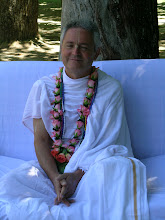
H.G. Matsyavatar Das

Tuesday, 17 January 2012

The Science of Meditation (part 2). By Matsyavatara dasa (Marco Ferrini)


Krishna in the Bhagavad-Gita, one of the most well-known and loved scripts shared among different Schools of Thought in the Indian Continent, says that Knowledge means to distinguish the field (body) from the knower of the field (Self). To detach oneself from the body does not mean to refuse or despise it, in this wise there would not be real detachment since, as Heraclitus said, what attracts will disgust and vice versa.
In order to overcome the opposites of attraction and disgust, in Sanskrit called raga and dvesha, it is necessary to balance the opposites, to find the conjunction and to harmonize them. In this research of balance and harmonization, yoga, points out the importance of mediation. The term yoga derives from the Sanskrit root yuj, literally meaning “to unify, to connect”. As a matter of fact, yoga is the science for the Reintegration of the individual self with the Supreme Self, of infinitesimal consciousness with the Cosmic Consciousness. In the Bhagavad-Gita are described different types of yoga and Patanjali, in his famous treatise on Yogasutra that is one of the first and most relevant Schools of Mankind Psychology, describes eight phases to develop the Yogic Discipline (ashtanga yoga) where meditation is placed just as penultimate phase. Before entering a meditative state, the aspirant yogi has to purify his mind and heart by abstaining from activities that are against the spiritual evolution, yama, and engaging himself in favorable ones , niyama. Then, one has to become an expert in postures, asana, that enable to perceive the body as little as possible and afterward to learn the art of breathing, pranayama. By turning inside himself and detaching sense-organs from objects, pratyahara, trying to concentrate on his attentional resources towards an unique direction, dharana, the yogi predisposes himself to the very meditation, dyhana, where the flow of attention is not anymore called away by exterior interferences and thanks to which he will reach a stage of complete interior absorption, defined samadhi. The Pre-samadhi stages are necessary to resolve conflicts between the different psychic structures and functions, through the harmonization of personality and before aspiring to the complete absorption of the meditative seed, bija, all the more so the Self. The approach to meditation must be gradual, since first it is necessary to develop a certain knowledge arising from awareness of small realnesses, without the presumption from time to time to have conquered Reality and Truth thinking to be definitely illuminated. What happens by meditating is a continuous and progressive realization of Reality, that reveals itself slowly until it is clear, evident, bright and natural, so natural that it would be impossible to conceive it differently.
For example, the awareness of being different than the body can arise suddenly, as in the case of diagnosis of terminal illness, of irreversible and degenerative pathology, boosting the patient not to concentrate just on the physical structure that is subject to such a devastation, but on himself. From this perspective, as explained through different MCE works for several Italian Hospitals and Health Care Institutions, death must not be seen as a physical event, something concrete, but more as an abstract concept, since there is not concrete end of something, but the transformation in something else. On the other hand, the aim of disidentification may be progressively reached through an introspective process that enables to understand that the body is our external means, we must not identify ourselves in it, but consider it precious, useful and dear to us serving to future experiences and acquaintances. The human body and personality do not represent exhaustly the entirety of the person, but are simple aspects. The eminent divine part of us considers these aspects, as in general the human dimension, like reduction and constraint, a sort of prison.
Nevertheless, in Plato’s Metaphor the soul cage must not be considered obsessively as an oppression, since it is evolved material structure equal to the elevation degree of the consciousness housed in it. Therefore, everyone inhabits a certain body and consequently takes with it determined pathologies or a healthy state.

Wednesday, 11 January 2012

The Science of Meditation (part 1). By Matsyavatara dasa (Marco Ferrini)

20th December 2008,
Naples, Castello Angioino

First of all, I’d like to draw the attention on some cosmogonical aspects, in order to facilitate the comprehension of Men context. The Modern Man does not know anymore where he comes from, where he is going, above all he does not know who he is, being fully identified with an external and transitory identity. His decontextualization is one of the most serious problems afflicting today’s society and cannot be simply solved through erudition. The search of oneself is the substrate of meditation and it is confirmed by the great Indovedic tradition works as Samhita, Upanishad, Itihasa and Purana, that can lead a very interesting dialogue with modern Western Tradition. Among numerous authors and Thought Masters which have drawn resources, cues and concepts from the very extensive Vedic culture for their doctrines and theories, we should mention Carl Gustav Jung and his “individuation process”. To individuate oneself means to get acquainted with one’s deepest nature, instead of restricting oneself just on the superficial and fallacious level of sensory perception. The signs and information reaching our consciousness from the external environment, through our sense organs and next elaboration at cortical level, are just a fraction of reality, even less than 10% as indicated by Prof. Genovesi during his speech. Knowledge of reality through the senses is a null result, as well as our capability to understand, since it is conditioned and subject to sensory perception. Hence, not only senses (indriya) are misleading, but also the perceptive information fields related to the mind (manas), being based on sensory perception.
The tendency (vasana) of the mind to depend on sensory information brings to a preconceived, rigid and generally structure perception of the world, that when not integrated and enriched is useless to define the individual identity.
The issue about the nature of personal identity is crucial for meditation. Indovedic psychology identifies human being in its entirety: as well as the universe involves three interacting worlds, being constituted from earth, in-between dimensions and heaven, the incarnated human being has a triple nature: physical, psychic and spiritual. The solid, earthy and physical constitution is the material body that includes a complex structure – the most complex structure known today – called nervous system, but also an apparatus that is more subtle, although of material nature, not definable neither graphically nor spatially, not even temporally: the psychic structure. In the end, there is the inmost nature of man, the first cause of life, his essence and real identity: the spiritual one. According to Vedic wisdom every human being is ontologically “atman”, a spiritual and eternal sparkle. To simplify even further, we can say that man’s identity is split into two different aspects: one is related to the psycho-physical conditions that the individual historically experienced during his different life’s cycles, that is called historical self or false ego, the sum of the psychic contents, defined in sanskrit as “ahamkara”. The other one is real, eternal and immutable, beyond time and space and is the spiritual nature. The basic faculty to reach the meditative dimension is attentiveness, that is not controlled by the nervous system, contrary to what is stated by the extreme positivism embraced by the modern western psychology, but in the first instance is promoted by “atman”, the unifying center that holds and gives an unique and unrepeatable characterization to the personality. The spiritual self makes use just of the physiological and biological part of the so called “human being” and feeds and moves his energies. All the Indian classic tradition schools (sampradaya), all the great Masters lines of disciplic succession, who practiced the Vedic teachings in their daily life, recognize that atman is the fundamental principle.

Thursday, 22 December 2011

Class about Markandeay Rishi on Bhaktisiddhanta Sarasvati's anniversary. By Matsyavatara dasa (Marco Ferrini)

This part of the Shrimad Bhagavatam could be defined: “The allegory of death”. Whatever Markandeya rishi witnesses in the macrocosm, I believe it is not different from all that each of us will witness at the moment of dissolution, of the microcosm of our body because, as it is explained in the Upanishad, macrocosm and microcosm are one the reflection of the other.
At the time of death, we will be carried away like a floating leaf into space and, in a second, under the influence of a powerful driving force, we will be projected out of the body.
Only through a spiritual realization we will be reminded of our origin, by understanding what is happening and acting in a sensible manner.
Markandeya rishi’s tale is the story of a realized soul who through the passage beyond death meets the Lord. In the ocean of universal devastation, the Lord appears to him as a toddler who floats on a leaf and sucks his big toe in tenderness, whilst the light that emanates from his body entirely disperses darkness.
Markandeya protects Him in his heart with deep devotion.
Today is His Holy Grace Bhaktisiddhanta Sarasvati's anniversary. I remember one of Shrila Prabhupada’s lessons held in this occasion in order to glorify his Master for the great work made to value the Vaishnava image and that one of an authentic Brahmin. During this lesson Shrila Prabhupada narrates the story taken from the Shrimad Bhagavatam. Naradamuni meets the sons of a Brahmin, of a king and of a butcher. Each of them asks him in turn: “Tell me what my future will be like. Is it better for me to live or to die?”. Narada answers to the Brahmin’s son: “Living or dying does not matter to you because you are practising spiritual activities and you will do the same after death”. Narada’s answer to the prince is: “It is better for you to live because you have made so many sins, therefore having ceased the pleasures of this life, you will have to suffer a great deal in your next life”. What is the answer to the butcher’s son? Narada says: “Living or dying is the same for you. You are suffering in this life and likewise you will suffer after death".

Tuesday, 6 December 2011

Scientific exploration for the Existence of God. By Matsyavatara dasa (Marco Ferrini)


It is time for science and religion to reconcile and complement each other; this is possible only by realizing the difference in fields of application and results of each discipline.
Prof. V.V. Raman defined science as the collective endeavour to understand the universe in a consistent and coherent way, based on reason, rationality and empirical evidence. By exploring the concept of multiverse, prof. Mann indicated thelogy and science as having different approches to address the question of what is reality; theology’s approach is teleology, a goal-oriented search for the scope of the universe, which the theologies of all traditions share; while science’s approach is ecbatology, that is the search for a necssity and/or chance for the universe as it is to emerge. The exploration of biophilic selection effects, that is life-friendly conditions, reveals that the universe seems fine-tuned for life; two possible explanations for this arise: the existence of a super-intelligent Agent, that is God, or the succession of similar attempts which sooner or later will lead to conditions conducive for live, that is a multiverse.
On the other hand the concept of transcendence in Vedic literature, is beyond space and time, as it is not a physical reality and is knowable only beyond the domain of facts and logic, specifically the domain of science. It seems therefore important to remember that scientific knowledge is basically what the human brain can make of the universe; as prof. Raman wrote, scientific objectivity is but collective subjectivity, while the universe is structured on different levels of information, ranging from a first order composed of physical and biological laws, to a superior order producing experience and reflection. The concept of consciousness, as explored by Dr. Sushant Sharma, comes to play a very important role in our understainding of reality. Alternative models of reality, as in Penrose’s quantum gravity model or in Vedanta and Yoga psychology, state that consciousness is not a result of any mechanistic process, rather it is a symptom of the conscious living force that dwells in the body. Even the brain is treated as non-intelligent, rather it is but a computing instrument, a device that the consciousness uses to express itself.
The concepts presented by the speakers in this session, seem to address the question of what is life, and I would like to propose the exploration of such concepts also with the aid of basic views present in Vedic literature, such as the structure of reality on multiple levels (adhibautika, adhidaivika, adhiatmika) and consciousness as a fundamental attribute of the atman, the conscious, immortal living being and as the very foundation of any representation of reality.

Friday, 21 October 2011

Love and Freedom: Betrayal, Rancour and Forgiveness. By Matsyavatara dasa (Marco Ferrini)

Turin, May 21st 2011

Everyone is in search of freedom and love, but very often our actions imprison us instead of making us free, and we suffer instead of loving.
Love and freedom are the signs of triumph that shows we make realizations by listening and following the voice that we hear from within: the voice of consciousness. The same voice resounds in the prisons, in the hospitals, in the innocent children’s hearts and in the life of tired elderly people and it reminds us of the real purpose of life: to evolve in order to become aware of our divine nature and learn to love.
Without freedom, without love, without forgiveness and compassion, the human being is no more than a spiritual dwarf: he may walk but certainly he does not fly, he may stutter or speak, but certainly his heart does not sing because he does not know the joy of the people who live in harmony within themselves, with the others, with the whole world.
Power intimidates people, whereas compassion generates love. By forgiving the person finds the divine power and relieves oneself from attachments, resentments and feelings of guilt, anger and revenge. The one who forgives is able to love and enjoys love of the others.

Thursday, 29 September 2011

DEATH. A stage of life (part 2/2). By Matsyavatara dasa (Marco Ferrini)

In the Fedone, Platone makes Socrate say, in one of his last phrases: “The time has come that I must go; every one of us continues with his or her program: I go off to die, you all go on to live, but no one knows who will be better off, only God knows”. And Tagore wrote: “Birth and death are two parts of life, just like to walk you must lift a foot and then lay it down”.
Birth and death are two dots in a circle that the sages of the Veda call samsara, the repeated cycle of birth and death, since, like the Bhagavad gita teaches, all that is born will die and all that dies will be reborn.
Birth and death are like awakening and going to sleep: we are here before we awake and we are here again after we have fallen asleep. The similitude between dream and death is very close.
The fear of death, besides the terror generated from the unknown, from the journey to an unknown destination, is primarily constituted from the fact that we must leave the objective world, the body, our dearest people, the social position, the prestige, the richness, the pleasure of food, of sex and various possessions. Yet, doesn’t the same happen during our dreams? In the dream doesn’t the subject abandon its physical body? Doesn’t he abandon the social prestige? He abandons a large quantity of things for which he has often developed a morbid attachment. The realization of the self permanence in a different dimension from the one of the wake state of consciousness, is something to be reinforced when we have the resources to make an investment of knowledge, to resolve the problem of death in life.
Death, as the Veda teache, is a passage towards another dimension, passage through which we renew our lives’ projects; it is not the end, but the beginning of a successive existential cycle. It is like exiting from a theatre scene and entering into another; the actor does not disappear, he is gone only to the observer’s eyes; the same is for the living being at the death moment: the protagonist does not disappear, but simply goes elsewhere. The Gita compares the body to a dress; death is like undressing from old clothes and wearing new ones.
Our prejudices, the social schemes, the way of facing certain phenomena and certain passages of life, are to be reconsidered at the renovated light of intelligence. The image of the self is not what the mirror shows. Death can lose its dramatic power if we come to a new vision of reality, by acknowledging and experiencing ourselves beyond the multiple masks of ego.
The fear of being annulled, zeroed, terminated, is the product of a certain culture, a prejudice, a negative dogma that generates tormenting thoughts, swinging between remorse and irony. Many make irony on death trying to exorcise their fear, but the right approach to the phenomenon must be honest, serious, through an in-depth study, not only intellectual, but experimental.
The subjective world and the objective world, the psychical introverted and extroverted functions and the needs of all the living being should be harmonized. It is by harmonizing these functions that we can grow up, that we can illuminate our personality. Life is a continuum, birth and death correspond to the appearing and disappearing of a physical body, and the same is for the appearing and disappearing of thoughts, illusions, wishes, opinions. If emotionally detached we put ourselves in the position of observers, we can see that the psychical contents float in our conscience as objects on the surface of a river, and therefore we can manage them at our best. What slips off our control, instead, is all that we identify ourselves with and obviously what we ignore.
The fear of death is caused by the identification with our body. Who identifies himself/herself with the body they are wearing will experiment, as years go by, growing fear and terror of death.
What wins death is love, together with consciousness. Love is the strongest feeling, it outlives death, because living means to give and receive love. To love in its widest meaning is to love life itself, therefore all that is living: all creatures. This should set our way of life, of eating, of relating with others. The more we love life and we understand its nature, the less we will fear death.

Monday, 19 September 2011

DEATH. A stage of life (part 1/2) By Matsyavatara dasa (Marco Ferrini)


No matter what our descendant roots are, noble or of humble origin, rich or poor, old or young, illuminated or not, we are all destined to die. We know that it is inevitable, but we deceive ourselves by thinking that others will die before us, that we will be the last to go. Death always seams far away. Isn’t it a misleading way of thinking? Isn’t it an illusion, a dream? This makes us negligent and we shouldn’t believe it. We should be courageous and prepare ourselves, because sooner or later death will knock at our door. (Yamamoto Tsunetomo, samurai monk of ending 1600)

Death is most likely the most complex, painful and captivating phenomenon with which man has always had to deal with; generally it irrupts very strongly in the story of an individual, of a family unit and society reality, often leaving behind desperation, emptiness, and mental derangement.
Intelligent people of every era, though living in health, have come across this problem with genuine spirit of research, looking for the comprehension of the events that obligatorily move to a different level from the one merely pertinent to the sensorial perception.
The thought of death is located deep in the human soul and strongly affects the entire course of life and the character, mostly operating at a deep conscience level.
The objective of this analysis is the reinterpretation of the phenomenon, reinterpretation that takes the abandoning of those preconceptions structured in our mind since the green age, and connected to apparent realities and to the destructive image that the idea of death carries with itself.
To face this arcane and dramatic argument in the over-rational perspective, lightly expressed and surely unusual for the western culture, we need to take an “inner journey” , to the roots of our deepest and concealed experiences. The rational mind can capture and encode the physical reality, but not all the reality is reconductible to this level. How can the rational function explain in a full and satisfactory way the “intra-psychic” dynamics? How can it answer the existential questions on the imperceptible nature of oneself and explain the mystery of life? In front of death or of a disconcerting medical report even the most solid rationality will vacillate showing all its limits.
The sages of the Veda, mind and life scientists who belong to a millenary tradition, indicate how the human being complexity must be studied in its entire bio-psychic-spiritual reality. The classic Indian works explain that barriers between the physical, psychic-energetic and spiritual-metaphysic do not exist; the same human life is a combination of these three interactive dimensions of reality. Man does not only have a physical body but also a psychic body, which represents one of the fundamental bases for the development of the personality. But physical and psychic do not complete the picture of a human being: the physical body and the mental structure are two tools utilized from the purusha, the spiritual self, the subject that perceives, thinks and acts using in fact the body and the mind. Only those that are fully conscious of their self can influence deeply and with determination their physical and psychic bodies, activating inner resources that allows the rediscovering of the auto-healing path. What unifies the physical world and the psychical world, that makes them interactive and gives them a meaning is the self, the vital spark, the witness, the one that sees, that hears, that understands; all the rest are tools.
We need to underline that every living being is eternal, therefore the living entity does not have a beginning (anadi) or an end (ananta). The Veda knowledge teaches that we do not die with the body but at the moment of the spiritual journey out of the body we are moved elsewhere aboard of the psychic structure. From this perspective we can transcend the mistaken contraposition of the binomial life-death, rediscovering the living being’s dimension in which death, being a life phase, is not in opposition with life, but with birth. Similarly, the “asleep” state of consciousness, the one without dreams, is not in opposition with the “wake” state of consciousness. If we made life coincide exclusively with the wake experience, then we can say that sleep has nothing to do with life, but we know very well that it is not true at all. Without sleep there could not be the wake state: during sleep the neurons healthily interact, all the cells easily surrender their wasted products and regenerate.