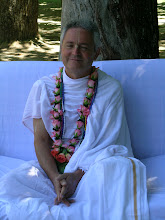
H.G. Matsyavatar Das

Showing posts with label freedom. Show all posts

Tuesday, 11 March 2014

How to Build Good Relationships


Every our action implies a feedback from others (as a rule, the response we get is very much the same as our approach, whether it has just happened in the present or it happened in the past), this is the meaning of relationship.
A:B = C:D
The relation between A and B, affects the relation between C and D too. We are all connected in the big game of life.
It is just through the relationships that we have the possibility to express our divine nature, that is developing and experiencing our best original spiritual qualities. However we can experience a lot of sufferance as well.
Our inner well-being greatly depends on the way we trust people in the relationships and the way others respond to us. A sensible, caring person usually realizes within a short time, whether his or her words, actions and even thoughts has a positive or destructive effect on the others.
When a person suffers and seeks relief, compassion and trust, turning to somebody who can help, how can one find the cause of sufferance? Where do disbelief, depression, pain or negative feelings come from, what is missing? The deep cause is often rooted in the relationships.
Everything in the universe is ruled by the divine laws and this order is based on a dialogue, as Galileo’s quote recites: “Dialogue between Two Chief World Systems". Dialogue re-establishes an order, and such order should govern our relations too, so in any dialogue the first priority is to meet the needs of other person through attentive listening and sincere interest.
The more virtuous relations are, the higher is their quality and greater the standard quality of listening and speech skills.
Sattva is order, virtue, harmony. It is the condition that most of all favors our evolution. It is a conditioning state, it is not complete freedom, therefore even sattva guna is to be transcended. The conditioning that arises from sattva guna is the feeling of attachment to a kind of freedom that is always anchored to a mundane layer, in spite of a prevalent virtuous nature. Someone may think: sattva guna is good enough for me, because I am satisfied with one kind of pleasure and one kind of mundane virtues. However a person cannot be satisfied with this vision because there are negative sides and sorrows that cannot be avoid with sattva guna alone, unless one ascends to a spiritual awareness.
Among such sorrows, which cause a great deal of sufferance, is old age. Aging is a heavy humiliation because the person is not able to take care of one’s own basic personal needs, and sattva guna itself cannot free us from such great pain. Sattva is the condition we can easily obtain in our embodied life, although we ought to make another step forward to approach transcendence, in order to reach the abode and original nature of our spiritual eternal Self.

Thursday, 25 July 2013

Pilgrimage: a Journey of Search and Discovery.


Part II
It is not by chance that Masters of Bhakti speak of an inseparable unity which is necessary for our evolution: Bhagavata sacred work and Bhagavata person, both of them are able to transfer the knowledge and the consciousness of  the Divine, Bhagavan.
If our visit to a sacred place is made with these predispositions, it may become an experience of great meaning that allows us to get in touch with timeless memories that bring us in other elevated dimensions of consciousness, and allow us to hear and accept the messages conveyed to mankind from another dimensions.
At times life faces us with very difficult situations so that we have to be ready and able to make our pilgrimage even in a hospital's room after the announcement of a terrible medical report, in front of the lifeless body of a dear person, suffering a devastating moral pain because of the betrayal of the person we most loved; or in a prison's cell where we had been locked in spite of our innocence, destroyed  by defamation. In these circumstances we need to start our journey even sooner, loading ourselves with inspiration and starting our inner journey to find a safe place, a shelter, an oasis in which to connect with our spiritual eternal self, which is unchangeable, together with God who is the giver of Knowledge, Love and Mercy. More than ever in these situations, in order to withstand sufferance, we have to fight against time in order to reach the space in the centre of our heart, where, the Upanishads say, time and space ultimately do not exist. That dimension is pure Transcendence. It is the place where all our desires are fulfilled. But the human being, deviated by the unreal world of vanishing impressions,  has lost the route to find it, because that dimension is invisible to the senses and to the physical eyes, the voice of that place speaks to the soul and the ears are not meant to hear it. For this reason Krishna says to Arjuna in the Bhagavad-gita: “In order to see me the way I am, I give you spiritual senses”. Why does Krishna offer to Arjuna such a great opportunity? Because Arjuna asked Him with a humble manner, because he desired it with intensity, because he wanted to get in touch with Krishna in his original and intimate divine nature.
Only with a burning desire to perceive a spiritual dimension and connect with God, a person may receive the divine strength to achieve it, to make the journey that from the realm of death will take us to immortality, from darkness to light, from sufferance to beatitude. A pilgrimage is that journey, it is rejoining.
How long does that journey last? Patanjali in the Yoga-sutras explains that the distance depends mainly on two factors: continuity and intensity of desire, and the required effort. In order to reach our target soon, we need to keep our course steady, with constant determination, and to increase the speed of motion by rising the intensity of the desire. Dante in the Divine Comedy accomplishes that journey too. At one point he describes his emotion as “feeling a pull from the sky while being still alive”. Once we loosen our conditionings and get rid of  bad habits, ascending is fast.
A pilgrimage  is that  ascension, it is an upward shift, it means heading toward holiness, and the spirit we hold while facing the journey is crucial. If we have the right attitude, that feeling of serenity we  have been looking for, the one that we thought we would experiment only once we reached our destination - instead it arrives step by step during our pilgrimage: then we find it in the predetermined place we have chosen and elected as our home, the heart.
Life will become then, day after day, a wonderful journey of research and discovery.

Friday, 21 October 2011

Love and Freedom: Betrayal, Rancour and Forgiveness. By Matsyavatara dasa (Marco Ferrini)

Turin, May 21st 2011

Everyone is in search of freedom and love, but very often our actions imprison us instead of making us free, and we suffer instead of loving.
Love and freedom are the signs of triumph that shows we make realizations by listening and following the voice that we hear from within: the voice of consciousness. The same voice resounds in the prisons, in the hospitals, in the innocent children’s hearts and in the life of tired elderly people and it reminds us of the real purpose of life: to evolve in order to become aware of our divine nature and learn to love.
Without freedom, without love, without forgiveness and compassion, the human being is no more than a spiritual dwarf: he may walk but certainly he does not fly, he may stutter or speak, but certainly his heart does not sing because he does not know the joy of the people who live in harmony within themselves, with the others, with the whole world.
Power intimidates people, whereas compassion generates love. By forgiving the person finds the divine power and relieves oneself from attachments, resentments and feelings of guilt, anger and revenge. The one who forgives is able to love and enjoys love of the others.

Monday, 14 February 2011

About religious freedom By Matsyavatara Dasa (Marco Ferrini)


On December 10, 1948 the General Assembly of the United Nations adopted the Universal Declaration of Human Rights.

Article 18

-Everyone has the right to freedom of thought, consciousness and religion; this right includes freedom to change one's religion or belief, and freedom, either alone or in community with others and in public or private, to manifest one's religion or belief in teaching, practice, worship and observance.-

Article 19

-Everyone has the right to freedom of opinion and expression; this right includes freedom to hold opinions without interference and to seek, receive and impart information and ideas through any media and regardless of frontiers.-

In the last days we were ashamed to hear about the disrespectful behaviour resulted in barbarous acts against Christians, mostly in Countries of Muslim tradition, that caused the death of many people. By witnessing so many frequent episodes of violence, with regards to religious intolerance, more than ever today we feel the moral need to remark a fundamental concept for the human welfare society, to favour its ethical and spiritual development: the importance to respect one’s freedom to seek a religious belief as a civil way of living. Everyone has the right – women and men at the same level – to freedom of thought and expression of one’s own belief or religion. We make a strong and clear claim first of all to our conscience and to the sensitive people who spend time to listen, in order to reject any form of violence and whether possible to promote, to defend and value the respect for practising any form of religion, not only by granting to each individual the possibility to choose in one’s own private life which religion to follow and how. Furthermore to grant the faculty to become a follower of that particular beleif, self-guarding the right to become a witness of that faith, to convey and spread the message in the society we live in, with full respect for the others and for the basic values of living together in a civil society.
Episodes of violence claimed in the name of religion, with the aim to repress a faith different from the one accepted by the majority of the population, appear to us as heavy as those offences made towards us, against our own religious values that attain to our person, because such acts of violence are by far contrary to the essential freedom of every human being.
By repressing the rispectful expression of one’s belief, we deny the principle of religious freedom in itself, which is a fundamental part of a wider concept of individual freedom. As a matter of fact if we lack the freedom to practise spiritual values, what other kind of freedom could we ever talk about?
Freedom on the political and social level without the respect for a religious freedom, that attains to the more intimate and deeper instances of each human being, is considered neither real freedom nor justice. As History may very well teach us, where there is no justice there can never be peace and freedom.
Besides the kind of belief it may concern, each religious fundamentalism is an attack to freedom and to spiritual realization, the same as every exasperated laicizing of spiritual values is an attack to the expression of freedom, of one’s own way of being, feeling and projecting life in accordance to an evolutive and creative purpose.
For this reason, if we really want a better human world, it is essential, today more than ever, to become witnesses and leaders of an authentic expression of religion on the basis of a rightful freedom.