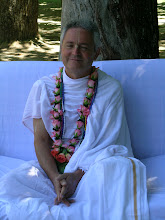
H.G. Matsyavatar Das

Showing posts with label soul. Show all posts

Monday, 21 July 2014

Spiritual Values to Win the Shadow.


Many people look for tangible and concrete things in life, but it is important to know that the so-called "abstract values" are even more substantial than those perceived through the senses – the true values which we should refer to in our life, such as compassion, freedom, happiness and Love.
The empiricists are prone to "measure and touch" happiness, to grasp all the things in the world. Such attitude is not an evil in itself, it becomes such when a man ignore his spiritual essence, sometimes even denying it completely. As far as, according to the positivist criterion, happiness is not tangible, in its absence a person falls into the dark malaise and depression.
Thus, lacking the feelings of compassion, charity, devotion to God and affection towards all His creatures, without solidarity with the creation, the experience of love cannot be realized. As a result, one's life turns to be boring and meaningless due to the lack of spiritual awareness.
Why do we make mistakes and suffer
so much?
The reason is that we do not cultivate spiritual values sufficiently. Slowly forgetting these real values ​​that substantiate the human life, one tries to compensate such values by attachments to the worldly projects and goods, as illusory as ephemeral. Thus, while creating one's false identity, a man lives in a sort of a perpetual alienation.
In such a state of alienation, oblivious of his spiritual nature and ultimate destination, an individual lose the sense of life. Joy and sorrow, health and disease, birth and death follow each other as impermanent manifestations of existance.
Therefore a spiritual being,
incarnated in the material world, despite an overwhelming aspiration for eternity, wisdom and happiness, experiences a considerable frustration, helplessness and fear because of an inability to access the bliss of its ontological nature, while struggling in the duality of the material world.
A wise man does not dream of becoming happy due to the impermanet things of this world. In all the traditions, albeit with different words, it was stated that "man cannot live on bread alone."
If we learn what to desire and how to value our life, we will become happy enjoying every moment of it, in spite of any psychophysical limit. By the grace of God, living in the prospect of immortality and love for God, a man can overcome loneliness and suffering so to experience fulfillment and spiritual satisfaction, always and everywhere.

Wednesday, 21 May 2014

True Freedom


A sober person who can tolerate the urge to speak, the mind's demands, the flashes of anger and the urges of the tongue, belly and genitals is really qualified to educate the disciples all over the world”
The Nectar of Instruction” (Upadeshamrita) Verse 1

The Vedic Rishis (the wise’ seers’ of the Vedas) were not only mystic poets, they were experts of the deep knowledge of the mind; these sages widely observed and experimented all the psychic functions of the human being. The rishis could clearly see that the so-called spontaneousness of the human being with the ordinary level of consciousness is just a satisfaction of the conditionings, imposed by one's mind; therefore, in an ultimate analysis, it is the exact opposite of a free, healthy and spontaneous attitude. In order to make free decisions without being affected by conditionings and attachments, a person has to conquer the six urges mentioned above.
Only then a progressive realization of the Self will take place, so that the individual will be able to reach the pure feeling of Love for God. In order to overcome obstacles and to achieve high levels of awareness, one should proceed with a harmonious transformation of personality, along with well pondered choices. Such choices are the result of wisely coordinated and constant efforts, so as to allow the passage from human understanding of things to the spiritual awareness and protection, until a complete development of the most elevated qualities of the Soul.
If we learn to re-direct passionate egoistic feelings and emotions towards spiritual goals, they will enhance a propensity to inner evolution and will lead to a supreme bliss of Bhakti and Love in freedom.

Thursday, 29 September 2011

DEATH. A stage of life (part 2/2). By Matsyavatara dasa (Marco Ferrini)

In the Fedone, Platone makes Socrate say, in one of his last phrases: “The time has come that I must go; every one of us continues with his or her program: I go off to die, you all go on to live, but no one knows who will be better off, only God knows”. And Tagore wrote: “Birth and death are two parts of life, just like to walk you must lift a foot and then lay it down”.
Birth and death are two dots in a circle that the sages of the Veda call samsara, the repeated cycle of birth and death, since, like the Bhagavad gita teaches, all that is born will die and all that dies will be reborn.
Birth and death are like awakening and going to sleep: we are here before we awake and we are here again after we have fallen asleep. The similitude between dream and death is very close.
The fear of death, besides the terror generated from the unknown, from the journey to an unknown destination, is primarily constituted from the fact that we must leave the objective world, the body, our dearest people, the social position, the prestige, the richness, the pleasure of food, of sex and various possessions. Yet, doesn’t the same happen during our dreams? In the dream doesn’t the subject abandon its physical body? Doesn’t he abandon the social prestige? He abandons a large quantity of things for which he has often developed a morbid attachment. The realization of the self permanence in a different dimension from the one of the wake state of consciousness, is something to be reinforced when we have the resources to make an investment of knowledge, to resolve the problem of death in life.
Death, as the Veda teache, is a passage towards another dimension, passage through which we renew our lives’ projects; it is not the end, but the beginning of a successive existential cycle. It is like exiting from a theatre scene and entering into another; the actor does not disappear, he is gone only to the observer’s eyes; the same is for the living being at the death moment: the protagonist does not disappear, but simply goes elsewhere. The Gita compares the body to a dress; death is like undressing from old clothes and wearing new ones.
Our prejudices, the social schemes, the way of facing certain phenomena and certain passages of life, are to be reconsidered at the renovated light of intelligence. The image of the self is not what the mirror shows. Death can lose its dramatic power if we come to a new vision of reality, by acknowledging and experiencing ourselves beyond the multiple masks of ego.
The fear of being annulled, zeroed, terminated, is the product of a certain culture, a prejudice, a negative dogma that generates tormenting thoughts, swinging between remorse and irony. Many make irony on death trying to exorcise their fear, but the right approach to the phenomenon must be honest, serious, through an in-depth study, not only intellectual, but experimental.
The subjective world and the objective world, the psychical introverted and extroverted functions and the needs of all the living being should be harmonized. It is by harmonizing these functions that we can grow up, that we can illuminate our personality. Life is a continuum, birth and death correspond to the appearing and disappearing of a physical body, and the same is for the appearing and disappearing of thoughts, illusions, wishes, opinions. If emotionally detached we put ourselves in the position of observers, we can see that the psychical contents float in our conscience as objects on the surface of a river, and therefore we can manage them at our best. What slips off our control, instead, is all that we identify ourselves with and obviously what we ignore.
The fear of death is caused by the identification with our body. Who identifies himself/herself with the body they are wearing will experiment, as years go by, growing fear and terror of death.
What wins death is love, together with consciousness. Love is the strongest feeling, it outlives death, because living means to give and receive love. To love in its widest meaning is to love life itself, therefore all that is living: all creatures. This should set our way of life, of eating, of relating with others. The more we love life and we understand its nature, the less we will fear death.

Monday, 19 September 2011

DEATH. A stage of life (part 1/2) By Matsyavatara dasa (Marco Ferrini)


No matter what our descendant roots are, noble or of humble origin, rich or poor, old or young, illuminated or not, we are all destined to die. We know that it is inevitable, but we deceive ourselves by thinking that others will die before us, that we will be the last to go. Death always seams far away. Isn’t it a misleading way of thinking? Isn’t it an illusion, a dream? This makes us negligent and we shouldn’t believe it. We should be courageous and prepare ourselves, because sooner or later death will knock at our door. (Yamamoto Tsunetomo, samurai monk of ending 1600)

Death is most likely the most complex, painful and captivating phenomenon with which man has always had to deal with; generally it irrupts very strongly in the story of an individual, of a family unit and society reality, often leaving behind desperation, emptiness, and mental derangement.
Intelligent people of every era, though living in health, have come across this problem with genuine spirit of research, looking for the comprehension of the events that obligatorily move to a different level from the one merely pertinent to the sensorial perception.
The thought of death is located deep in the human soul and strongly affects the entire course of life and the character, mostly operating at a deep conscience level.
The objective of this analysis is the reinterpretation of the phenomenon, reinterpretation that takes the abandoning of those preconceptions structured in our mind since the green age, and connected to apparent realities and to the destructive image that the idea of death carries with itself.
To face this arcane and dramatic argument in the over-rational perspective, lightly expressed and surely unusual for the western culture, we need to take an “inner journey” , to the roots of our deepest and concealed experiences. The rational mind can capture and encode the physical reality, but not all the reality is reconductible to this level. How can the rational function explain in a full and satisfactory way the “intra-psychic” dynamics? How can it answer the existential questions on the imperceptible nature of oneself and explain the mystery of life? In front of death or of a disconcerting medical report even the most solid rationality will vacillate showing all its limits.
The sages of the Veda, mind and life scientists who belong to a millenary tradition, indicate how the human being complexity must be studied in its entire bio-psychic-spiritual reality. The classic Indian works explain that barriers between the physical, psychic-energetic and spiritual-metaphysic do not exist; the same human life is a combination of these three interactive dimensions of reality. Man does not only have a physical body but also a psychic body, which represents one of the fundamental bases for the development of the personality. But physical and psychic do not complete the picture of a human being: the physical body and the mental structure are two tools utilized from the purusha, the spiritual self, the subject that perceives, thinks and acts using in fact the body and the mind. Only those that are fully conscious of their self can influence deeply and with determination their physical and psychic bodies, activating inner resources that allows the rediscovering of the auto-healing path. What unifies the physical world and the psychical world, that makes them interactive and gives them a meaning is the self, the vital spark, the witness, the one that sees, that hears, that understands; all the rest are tools.
We need to underline that every living being is eternal, therefore the living entity does not have a beginning (anadi) or an end (ananta). The Veda knowledge teaches that we do not die with the body but at the moment of the spiritual journey out of the body we are moved elsewhere aboard of the psychic structure. From this perspective we can transcend the mistaken contraposition of the binomial life-death, rediscovering the living being’s dimension in which death, being a life phase, is not in opposition with life, but with birth. Similarly, the “asleep” state of consciousness, the one without dreams, is not in opposition with the “wake” state of consciousness. If we made life coincide exclusively with the wake experience, then we can say that sleep has nothing to do with life, but we know very well that it is not true at all. Without sleep there could not be the wake state: during sleep the neurons healthily interact, all the cells easily surrender their wasted products and regenerate.

Tuesday, 30 August 2011

The most blessed event of my life. By Matsyavatara das (Marco Ferrini)

2011, August 30th

Today, thirty five years back, I had Your Divine Grace darshana for the first time.
I thank You again and again and in occasion of this holy day, please accept my humble offering as a praise at Your glorious life.
In all of these past years I have repeatedly gone over the scenario of our first encounter and, after deep meditation, I always come back to the same conclusion: even though I approached You that first time with insufficient purity and spiritual feelings, You took my sincerity very seriously and, as if in a dream or a play, You instilled in my heart faith in God, in His devotional service and in His pure devotees. As if under a spell, the chains of material nature that had me solidly bound loosened their hold, my attachment to illusory pleasures almost vanished and I desired to serve the Supreme Lord Sri Krishna, experiencing feelings of intense transcendental happiness and sharp compassion for those still spiritually unaware.
If having given so little I received so much I can guess what could happen if one day, following Your sacred teachings, I will be able to abandon myself completely to the mercy of the Supreme Will, to Lord Sri Krishna.
Dear Srila Prabhupada, since it is not in my power to perform this change of hearth and consciousness and since You are an authentic patita pavana, who just came for this job, I humbly beg Your Divine Grace to have compassion for me and to infuse me with the spiritual strength necessary to situate myself constantly at Your glorious lotus feet: an indispensable position for obtaining divine loving service unto the lotus feet of Lord Sri Krishna.
Your ever grateful disciple,
Matsyavatara Dasa

Wednesday, 6 July 2011

How to transform a rebellious mind into a Wonderful Mind (2/2). By Matsyavatara das (Marco Ferrini)

The act of offering the Supreme all that we possess is defined by Shri Caitanya as the highest form of renunciation: yukta vairagya. The bad weed of ego is uprooted by the constant and humble practice of sadhana bhakti in a spirit of loving service. Authentic humbleness comes from the awareness of our nature, which means to be God’s servants; it’s the humbleness of the part which stands in relationship with the whole, with the Creator, with the creatures and with the creation. Humbleness grows by learning to respect and to value the good qualities of every being, no matter which body it temporarily wears. Having such an attitude, thanks to divine mercy, the mistakes and the offences which hinder spiritual realization cease, and our journey towards the supreme Destination, param gatih, goes on rapidly. Freedom, justice, serenity, wisdom, happiness and love. The more we care about spiritual teachings, the more we stick to them and bring them inside our everyday life, the more our inner voice awakens and grows stronger. This inner voice is our inborn wisdom concerning discernment, and in the Krishna-bhakti tradition, in the Gaudiya-Vaishnavism, it is called tattva-viveka, discerning awareness. If we start to distinguish the inexistent, tempting as well as deceitful voices of the false self - which indeed has no ontological existence - from the truthful voice of the real self - immortal reality, and if we deliberately and irrevocably choose to let us guide by the latter, the real self will clear us the way to freedom, to salvation, to joy and Love. Only then the bright memory of our authentic nature - the spiritual one, which is undivided from the Whole - starts to reveal itself in all its splendour and divine truth. At this point the ravings of the false ego don’t thwart anymore the right vision and even the last doubts, together with the whims of the once rebellious mind, cease. As a rebellious mind is the real obstacle to spiritual realization, once it is subdued and turned into a docile instrument controlled by the soul, we can promptly experience an ineffable ecstatic bliss. The psychological experience of hell precedes the ascent to Heaven, almost unavoidably going through the intermediate stage of the purgatory. The first, concrete step on this path is to surrender to God, formally carried out through the initiation rite (Hari-nama diksha). Besides, life blessed by initiation is a divine gift that allows us to turn our mind into a pure diamond - requires clearness, honesty, courage and steadiness. Indeed, when we have sufficiently practised and strengthened in our personality these basic qualities, Divine Mercy descends upon us and everything becomes enlightened; the once overshadowed mind assumes golden dazzling colours, the soul is released from the slavery of matter and hovers in Heaven… Only then spiritual evolution proceeds rapidly and turns into a concrete reality, even in the tridimensional world.

Friday, 1 July 2011

How to transform a rebellious mind into a Wonderful Mind (1/2). By Matsyavatara das (Marco Ferrini)

From time immemorial it seems that inside us two “persons” have been dwelling together. There is an everlasting battle going on in order to gain supremacy over our personality between the superior self and the ordinary self. For a human being subject to the conditionings the most painful dilemmas are caused by the exhausting tension between these two poles, which produce different solutions depending on different motivations. These tensions continue until the ordinary self - which is a product of the arbitrary choices of our psyche - is harmoniously reintegrated in the energetic field of the superior self, the soul. The doubts which are sometimes alluded by the mind are connected to the ever changing and mutable world of transience, and it is normal that this phenomenon becomes more intense when we approach choices of vital importance. When we deal with such choices, the ordinary self protests, but one shouldn't be frightened. For a long time the ordinary self, the false ego, had the command over an individual, obscuring one's real self; unpunished, ego has dominated one's personality one life after another, turning it into a slave of mere illusory dreams of happiness, of delirious ambitions and of the fear of death. Trying to dethrone this tyrant, we are winning back our freedom: obviously it becomes rebellious. The ordinary self, also called “false ego”, is suspicious, presumptuous, proud, self-centred, unsatisfied and irritable. It is like a sly and ravenous beast, always looking for a prey in the form of prestige and illusory pleasures. The superior self is the real self, the hidden spiritual being, the atman, whose clear and wise voice we seldom have heard and listened to. False ego is the Destroyer, the principle of separation. It is the antagonist of Love. Ego gives us the illusion of reaching happiness, but if we are connected to it, we can experience only fleeting pleasure.
Ego gives us the illusion to possess love, but when this feeling gets in touch with the ego, it turns into an unwholesome attachment. Divine immortal love belongs to the soul; selfish and conditioned attachments belong to false ego, to the ordinary self. The first and most important work an aspiring spiritualist has to carry out is to free oneself from the false ego’s prison (ahamkara), no matter which tradition or religious path he chooses to follow. To free oneself from ahamkara doesn’t mean that one loses his own identity; on the contrary, one’s real identity can rise again only when the false identifications and the masks of our personality have been cast down (sarvo upadhir vinir muktam). Until we cling to false ego and delight ourselves in it, we won’t be able to get acquainted neither with God nor with ourselves. The path of inner transformation requires efforts and responsibility, but it is also grandiose, magnificent and fascinating. It leads us to see ourselves, the others and everything in the world with the eyes of the superior self, to perceive ourselves as God’s creatures who are acting thanks to His grace and mercy, in harmony with the Whole. Buddhism describes ego as the cause of pain and of every evil; and it opposes to it a radical renunciation to the mundane things. The Middle Eastern Traditions: Judaism, Christianity, Islam, oppose to it renunciation, prayer and fasting. In the works of Vedanta and Samkhya ego is considered to be the main cause of avidya, of one’s turning away from God, of Fall and degradation, of the loss of one’s spiritual identity. It is the biggest obstacle to self-realization and to happiness; it is the power opposing the soul and God. It is the main cause of envy and of the Fall for angels and for human beings: from Lucifer to Macbeth, both in ancient and in modern events. Due to the ego Lucifer becomes Satan (“the Antagonist”, in Hebrew) and Lord Macbeth becomes a murderer, a degraded and horrible person. To him the destroying ego manifests itself as his wife, Lady Macbeth, who awakens and fosters his negative tendencies. The principle of Eva and Adam is inside each of us, and so are inside us both the angel and the demon. If we choose to foster the demon, he will win. If we foster the angel and his bright spiritual nature, the angel will win. In each of us there are Vritra and Indra, Lucifer and Michael. Our fate depends on our choices, on our decision to favour the one rather than the other. Together with pride and arrogance, false ego is the main distinctive feature of the asura. Humbleness is the opposite attitude and, partly, it is even its antidote. In a famous metaphor through which Shri Caitanya Mahaprabhu gives teachings to his main disciple, Shrila Rupa Goswami, the devotion of the aspiring spiritualist is compared to a delicate little plant, bhakti lata bija, surrounded by the ego’s infesting plants which tend to choke her. If we wish evolution and happiness, we should take care with all our forces of the delicate little bhakti plant, protecting her by practising spiritual discipline (sadhana) constantly (abhyasa) and with emotional detachment from the material phenomena (vairagya), strengthening the pure wish of serving God and offering everything to Him.

Monday, 17 January 2011

Family Matters (Part Two) - By Matsya Avatara Dasa (Marco Ferrini)


Dealing with Illicit Sex

Question: In ISKCON we are taught to follow the four regulative principles, among which avoiding illicit sex is often the most crucial one. However, there are situations where one member of the couple doesn’t agree on practicing sexual restraint, and this could lead to the drastic break-up of the marriage. What can be done in such cases?
This is a burning issue, which requires an honest and urgent clarification. It is not the first time I talk about it, but so far I have done it only with very intimate students.
According to my understanding of Srila Prabhupada’s teachings, I distinguish between two categories of illicit sex: the first is pre-marital and outside marriage―they belong to the same category―and the second is within wedlock, between a regular couple united before God, with the authorization and blessing of the spiritual master, who sanctifies the marriage. Both categories are classified as illicit sex―to use the classic terminology, but for me there is no comparison between the consequences of extra-conjugal illicit sex and those from illicit sex within a religiously constituted couple. The term “illicit sex” is used to point out that sexual organs are not toys and, for both men and women, their proper function is procreation. Sexual organs are parts of the body with a precise function, and every other function is improper or “illicit.” Having said this, the embodied being experiences many conditionings, arriving to this body with a huge karmic load of samskara (1) and vasana (2). For some people, therefore, the urges could be so strong that, despite all good intentions, there could be some lapses. But one thing is the lapse occurring within the married couple, and quite another thing is the lapse outside marriage. Outside the regular couple the failure is disastrous, both personally and socially, whereas within the regularly constituted couple the damage is contained, but I am still talking of damage, don't misunderstand. There is no comparison between the two damages. By the mercy of the divine grace, I have always strongly stressed the importance of following the regulative principles, and I am not talking like this to promote a different behavior, a different standard. I do believe that those who seek spiritual realization and aspire to develop pure love of God should strictly follow the regulative principles, and therefore should not engage in illicit sexual activities. At the same time, in my many years of experience counseling people, I have witnessed a lot of suffering caused by the uncritical, uncompromising application of the law.
People live on different planes of consciousness: it is exceptional to find two people on the same level, even if they both sincerely desire to become devotees at the same time. In a couple, there is often a partner who makes quick advancement, while the other might remain stationary for some time. This usually generates a gap. I have been advising couples for more than twenty years to help each other, be patient and tolerant. If one of the two needs help, the other should offer it generously. Perhaps I have not stressed this enough… I consider that one should rigorously follow the regulative principles, but I am now talking of cases that could lead to serious turmoil in a family and usually leading to betrayal. I don't want to suggest that anyone should abandon the principle of purity, but it should be understood that people can be cured through constant love and affection. If between husband and wife there is real sincerity and friendship, in some measure there will also be real love and affection; if there is the willingness to overcome one's limitations, some careful concessions can be excused, thus avoiding very big, serious and irreparable havoc.
In my answer I limit myself to saying that we shouldn't put extra-conjugal illicit sex on the same level as the occasional weaknesses in married life. Considering them the same would show a lack of spiritual comprehension and maturity and a misunderstanding of the function of controlling sexual energies. To rectify a person, to rectify the character, to cure a disease, we need to follow the path of recovery. An expert doctor always knows how to administer the medicine. I am not surprised or astonished if a young couple of my students once in a while indulge in effusions that go beyond the limit. Of course, I absolutely don't encourage such things because they dissipate emotional resources and increase bodily identification, distracting the devotee from the real purpose of life: Krishna-bhakti. At the same time, I am in my late fifties and I have some knowledge and experience of psychology, I have seen people who have rigidly negated their impulses for a long time and later, even in the guise of renouncers, have abandoned their religious vows.

Repression and Sublimation

Whoever represses his sexual instincts without being able to sublimate them, which means increasing his sadhana and connection to guru and Krishna, won't be able to resist long enough, and will inevitably head for a falldown. These falldowns could be so serious that the individual thrown in such a state of moral and spiritual prostration, might not be able to rise again, at least in that lifetime. As the Vaisnava scriptures explain, only a few people in this age are already so elevated that they can immediately and completely abstain from sexual activity. The majority of people need gradual distancing, protected by the institution of marriage and regulated by the four principles, the necessary groundwork for ethical life and the pursuit of spiritual realization. The management of emotions requires great competence and maturity, both cultural and spiritual. The guidance and direct assistance of the spiritual master is therefore essential, especially in crucial moments of life, when one is called to make fundamental choices (e.g.: choice of ashrama) that, if wrongly handled, could jeopardize or stop spiritual advancement.
Both repression of instincts and indiscriminate indulgence can produce neurosis and serious personality disorders. Our Vaishnava literature explains that psycho-physical energies, indispensable for the journey towards transcendence, should be neither negated or repressed, nor indiscriminately dispersed; they should be correctly used, beneficially and propaedeutically to the development of personality. In other words, they should be sublimated by engaging in devotional service. Hari-nama japa and nama sankirtana, Deity worship and spiritual association are the best means to overcome problems of lust.
Experience teaches us that through the discipline of bhakti-yoga it is not only possible to sublimate impulses, by the elimination of their self-destructive unconscious charge, but also to re-integrate them on the plane of pure consciousness, as divine rasa. Otherwise, when one gives in to such impulses without discrimination, they obnubilate and obscure the consciousness, provoking confusion, frustration and suffering; they enslave the subject in ephemeral conceptions and bodily identities, in destructive tendencies and instincts. The science of bhakti aims at the exact opposite: making the person fully conscious of his divine nature, his own relationship with God and an instrument for everybody’s well being, including his own.
The second and third chapter of the Bhagavad-gita teach us that whoever represses certain impulses but keeps cultivating attachment for the sense objects in the mind, persisting in their contemplation and internally longing for them, won't succeed in the path of yoga (3). We need to learn how to dissociate from the sense objects also psychologically, transcending the problem, and for this there is a discipline or a route to follow, with arrangements and methods that partially differ from person to person, according to the various states of consciousness and psychological conditioning. Such different arrangements are obviously all finalized to reach the same objective: overcome bodily identification and selfish gratification, and develop pure bhakti. Krishna says that discovering a higher taste is necessary to abandon the inferior, conditioned and conditioning taste, source of multiple sufferings, and to reorient physical and mental dynamics. "The embodied soul may be restricted from sense enjoyment, though the taste for sense objects [the desire for them] remains. By experiencing a higher taste and ceasing such engagements, he becomes fixed in [Krishna] consciousness."

(1) Traces or engrams in the memory that determine the conformation of the deep psyche or unconscious, and which are the origin of mental tendencies and automatisms.
(2) Latent tendencies that condition the individual character and behavior.
(3) "While contemplating the objects of the senses, a person develops attachment for them, and from such attachment lust develops, and from [frustrated] lust anger arises. From anger, complete delusion arises, and from delusion bewilderment of memory. When memory is bewildered, intelligence is lost, and when intelligence is lost one falls down again into the material pool." Bhagavad-gita 2.62-63.