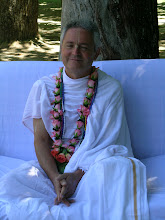
H.G. Matsyavatar Das

Showing posts with label Hare Krishna. Show all posts

Tuesday, 30 August 2011

The most blessed event of my life. By Matsyavatara das (Marco Ferrini)

2011, August 30th

Today, thirty five years back, I had Your Divine Grace darshana for the first time.
I thank You again and again and in occasion of this holy day, please accept my humble offering as a praise at Your glorious life.
In all of these past years I have repeatedly gone over the scenario of our first encounter and, after deep meditation, I always come back to the same conclusion: even though I approached You that first time with insufficient purity and spiritual feelings, You took my sincerity very seriously and, as if in a dream or a play, You instilled in my heart faith in God, in His devotional service and in His pure devotees. As if under a spell, the chains of material nature that had me solidly bound loosened their hold, my attachment to illusory pleasures almost vanished and I desired to serve the Supreme Lord Sri Krishna, experiencing feelings of intense transcendental happiness and sharp compassion for those still spiritually unaware.
If having given so little I received so much I can guess what could happen if one day, following Your sacred teachings, I will be able to abandon myself completely to the mercy of the Supreme Will, to Lord Sri Krishna.
Dear Srila Prabhupada, since it is not in my power to perform this change of hearth and consciousness and since You are an authentic patita pavana, who just came for this job, I humbly beg Your Divine Grace to have compassion for me and to infuse me with the spiritual strength necessary to situate myself constantly at Your glorious lotus feet: an indispensable position for obtaining divine loving service unto the lotus feet of Lord Sri Krishna.
Your ever grateful disciple,
Matsyavatara Dasa

Wednesday, 6 July 2011

How to transform a rebellious mind into a Wonderful Mind (2/2). By Matsyavatara das (Marco Ferrini)

The act of offering the Supreme all that we possess is defined by Shri Caitanya as the highest form of renunciation: yukta vairagya. The bad weed of ego is uprooted by the constant and humble practice of sadhana bhakti in a spirit of loving service. Authentic humbleness comes from the awareness of our nature, which means to be God’s servants; it’s the humbleness of the part which stands in relationship with the whole, with the Creator, with the creatures and with the creation. Humbleness grows by learning to respect and to value the good qualities of every being, no matter which body it temporarily wears. Having such an attitude, thanks to divine mercy, the mistakes and the offences which hinder spiritual realization cease, and our journey towards the supreme Destination, param gatih, goes on rapidly. Freedom, justice, serenity, wisdom, happiness and love. The more we care about spiritual teachings, the more we stick to them and bring them inside our everyday life, the more our inner voice awakens and grows stronger. This inner voice is our inborn wisdom concerning discernment, and in the Krishna-bhakti tradition, in the Gaudiya-Vaishnavism, it is called tattva-viveka, discerning awareness. If we start to distinguish the inexistent, tempting as well as deceitful voices of the false self - which indeed has no ontological existence - from the truthful voice of the real self - immortal reality, and if we deliberately and irrevocably choose to let us guide by the latter, the real self will clear us the way to freedom, to salvation, to joy and Love. Only then the bright memory of our authentic nature - the spiritual one, which is undivided from the Whole - starts to reveal itself in all its splendour and divine truth. At this point the ravings of the false ego don’t thwart anymore the right vision and even the last doubts, together with the whims of the once rebellious mind, cease. As a rebellious mind is the real obstacle to spiritual realization, once it is subdued and turned into a docile instrument controlled by the soul, we can promptly experience an ineffable ecstatic bliss. The psychological experience of hell precedes the ascent to Heaven, almost unavoidably going through the intermediate stage of the purgatory. The first, concrete step on this path is to surrender to God, formally carried out through the initiation rite (Hari-nama diksha). Besides, life blessed by initiation is a divine gift that allows us to turn our mind into a pure diamond - requires clearness, honesty, courage and steadiness. Indeed, when we have sufficiently practised and strengthened in our personality these basic qualities, Divine Mercy descends upon us and everything becomes enlightened; the once overshadowed mind assumes golden dazzling colours, the soul is released from the slavery of matter and hovers in Heaven… Only then spiritual evolution proceeds rapidly and turns into a concrete reality, even in the tridimensional world.

Friday, 1 July 2011

How to transform a rebellious mind into a Wonderful Mind (1/2). By Matsyavatara das (Marco Ferrini)

From time immemorial it seems that inside us two “persons” have been dwelling together. There is an everlasting battle going on in order to gain supremacy over our personality between the superior self and the ordinary self. For a human being subject to the conditionings the most painful dilemmas are caused by the exhausting tension between these two poles, which produce different solutions depending on different motivations. These tensions continue until the ordinary self - which is a product of the arbitrary choices of our psyche - is harmoniously reintegrated in the energetic field of the superior self, the soul. The doubts which are sometimes alluded by the mind are connected to the ever changing and mutable world of transience, and it is normal that this phenomenon becomes more intense when we approach choices of vital importance. When we deal with such choices, the ordinary self protests, but one shouldn't be frightened. For a long time the ordinary self, the false ego, had the command over an individual, obscuring one's real self; unpunished, ego has dominated one's personality one life after another, turning it into a slave of mere illusory dreams of happiness, of delirious ambitions and of the fear of death. Trying to dethrone this tyrant, we are winning back our freedom: obviously it becomes rebellious. The ordinary self, also called “false ego”, is suspicious, presumptuous, proud, self-centred, unsatisfied and irritable. It is like a sly and ravenous beast, always looking for a prey in the form of prestige and illusory pleasures. The superior self is the real self, the hidden spiritual being, the atman, whose clear and wise voice we seldom have heard and listened to. False ego is the Destroyer, the principle of separation. It is the antagonist of Love. Ego gives us the illusion of reaching happiness, but if we are connected to it, we can experience only fleeting pleasure.
Ego gives us the illusion to possess love, but when this feeling gets in touch with the ego, it turns into an unwholesome attachment. Divine immortal love belongs to the soul; selfish and conditioned attachments belong to false ego, to the ordinary self. The first and most important work an aspiring spiritualist has to carry out is to free oneself from the false ego’s prison (ahamkara), no matter which tradition or religious path he chooses to follow. To free oneself from ahamkara doesn’t mean that one loses his own identity; on the contrary, one’s real identity can rise again only when the false identifications and the masks of our personality have been cast down (sarvo upadhir vinir muktam). Until we cling to false ego and delight ourselves in it, we won’t be able to get acquainted neither with God nor with ourselves. The path of inner transformation requires efforts and responsibility, but it is also grandiose, magnificent and fascinating. It leads us to see ourselves, the others and everything in the world with the eyes of the superior self, to perceive ourselves as God’s creatures who are acting thanks to His grace and mercy, in harmony with the Whole. Buddhism describes ego as the cause of pain and of every evil; and it opposes to it a radical renunciation to the mundane things. The Middle Eastern Traditions: Judaism, Christianity, Islam, oppose to it renunciation, prayer and fasting. In the works of Vedanta and Samkhya ego is considered to be the main cause of avidya, of one’s turning away from God, of Fall and degradation, of the loss of one’s spiritual identity. It is the biggest obstacle to self-realization and to happiness; it is the power opposing the soul and God. It is the main cause of envy and of the Fall for angels and for human beings: from Lucifer to Macbeth, both in ancient and in modern events. Due to the ego Lucifer becomes Satan (“the Antagonist”, in Hebrew) and Lord Macbeth becomes a murderer, a degraded and horrible person. To him the destroying ego manifests itself as his wife, Lady Macbeth, who awakens and fosters his negative tendencies. The principle of Eva and Adam is inside each of us, and so are inside us both the angel and the demon. If we choose to foster the demon, he will win. If we foster the angel and his bright spiritual nature, the angel will win. In each of us there are Vritra and Indra, Lucifer and Michael. Our fate depends on our choices, on our decision to favour the one rather than the other. Together with pride and arrogance, false ego is the main distinctive feature of the asura. Humbleness is the opposite attitude and, partly, it is even its antidote. In a famous metaphor through which Shri Caitanya Mahaprabhu gives teachings to his main disciple, Shrila Rupa Goswami, the devotion of the aspiring spiritualist is compared to a delicate little plant, bhakti lata bija, surrounded by the ego’s infesting plants which tend to choke her. If we wish evolution and happiness, we should take care with all our forces of the delicate little bhakti plant, protecting her by practising spiritual discipline (sadhana) constantly (abhyasa) and with emotional detachment from the material phenomena (vairagya), strengthening the pure wish of serving God and offering everything to Him.

Thursday, 23 June 2011

The role of will power for the harmonization and development of Personality, determination and perseverance (2/2). By Matsyavatara das (Marco Ferrini)


Self-determination and
Perseverance Exercise.

Determination is a state of mind that can be cultivated and developed with a right predisposition. Like all mental states, determination arises from psycho emotional factors and attitudes like:

1. Desire. In the presence of a well defined and intense desire it is easier to develop and maintain determination for the pursuit of the target we aim at.
2. Definition of Purpose. Knowing what a person wants is the first thing, and perhaps the most important one, to develop self-determination. A strong motivation will help to overcome initial and unpredicted difficulties.
3. Self confidence. Trusting our own abilities to achieve a target, will encourage us to follow our program with determination.
4. Program definition. Organized programs, even when they are not well defined and focused, will encourage determination and strengthen perseverance.
5. The accuracy of acknowledgment. Knowing that our projects are based on solid reality and experiences that attain to our evolving nature, will favor determination. “Presumption of Knowledge” opposite to “real knowledge”, will weaken determination.
6. Cooperation. Empathy, tolerance, comprehension, harmonic cooperation among members of a team will strengthen determination for each member or element of the group.
7. Will power and planning capacity. Constant practice of will power and concentration on our thoughts – in a profitable manner – for the definition of a project, with the intention to schedule the targets we aim at, will develop determination.
8. Habit. Determination is the straightforward result of our mental frame, of a habit, of a deliberate performance, of an action used as a constant conscious behavior pattern. Our mental frame is modified in relation to our actions that, even unconsciously will influence the psychological structure with behavior models that are acquired and represented automatically in accordance with the adopted and acquired schemes. Fear, one of the worst and most powerful, destructive emotions, can be cured by the voluntary repetition of acts of courage. All the people that have made this experience know it well enough.

Friday, 17 June 2011

The role of will power for the harmonization and development of Personality, determination and perseverance (1/2). By Matsyavatara das (Marco Ferrini)


By analyzing, the relation between the inner self and will power and, on the other hand, the various psychological functions of the mind, we can very well notice how strong the link between will power and the inner self is: it is almost an identification of one another. Furthermore, by using will power, the self works on the other functions of the mind, governing and directing them. We are open to consider the existence of other two relations: firstly between the spiritual self and its reflex as a distorted self, the ego: the total of psychological contents in which the subject identifies himself. Secondly, between the individual (spiritual) self and the cosmic Self, the Supreme Soul or God for religious believers and theologists. Whereas the first relation is often contradictory, because the soul interacts with a distorted image (with the ego, the historic and transitory personality), the second version instead, related to the cosmic Self, is blessed, it is the source of complete harmony, of ecstasy. The problem of which will power to privilege depends on the relation we choose, either the first or the second one.
The unconscious process does not have a will power of its own, it is rather a self automatism, we cannot see its movement with our visual power, nor examine it with a rational thinking. However we can experience the existence of a dynamic process for which it functions spontaneously by responding to inputs that we provide for it with our conscious thinking, with or without a voluntary deliberated action. Our conscious thinking chooses the targets, selects the material, makes calculations, values and comes to a conclusion and, generally without knowing it, activates an unconscious process. Through the power of will – that represents the most immediate and direct function of the ego personality - we can produce a mental image of the target we aim at. It works straight forward in the subconscious in order to achieve its purpose, even though we do not know the way it works.
The conscious thought is not the doer of the material result, but it makes the mechanism work. Therefore, by acting here and now in the most ethical and correct way as possible (dharmya) the unconscious process is able to reach spontaneously the best results, without making any efforts. This is the reason why by acting properly and trustfully here and now, there is no need to worry about the future, because the targets will be achieved by the unconscious process that has been activated. The will power works at its best when we provide for the initial start- up and we let the unconscious elaboration to carry on naturally and spontaneously.
In order to fulfill a satisfactory and lasting success by using will power, we have to act accordingly, with no concern for the final result, rather by dealing with the psychological functions. As a matter of fact, the best way to use will power occurs when we activate and direct all the powers of the mind.
Before acting, likewise the physical world, the complex system of the ruling laws is taken into account, similarly before an action of will we need to consider the psychological dynamics and the ruling laws that such action implies.
Faith, discipline, courage, interest, optimism, to favor either an evolutionary or destructive purpose, will strengthen the power of will and vitality. Futility, pessimism, frustration, resentment, remorse, envy, jealousy, fears, nostalgia: they activate destructive dynamics that reduce the power of will, vitality and, as a consequence, the perspective of life. In turn such kind of attitude will accelerate the aging process. Every person in life feels the urge to satisfy fundamental needs, by following and realizing them in a healthy and ethical method (dharmya) they favor the development of will and strengthen it.
These major needs are:
- giving and receiving love
- finding and giving security
- being able to express one’s own creativeness and encourage others to do so
- feeling one’s own value and appreciating the value of others
- living new experiences and encourage others to make new changes
- developing self esteem and trusting mankind and divine providence
- living with a wholesome and fulfilling sense of satisfaction, inspiring others to do likewise

Tuesday, 7 June 2011

How to build up constructive and lasting relationships. By Matsyavatara dasa (Marco Ferrini)

People suffer for not being able to bring harmony in relationships and at the same time tend to start new conflicts due to their conditionings. There are more people suffering from relational difficulties than people suffering for the wars or for epidemics and, on the other hand, good relationships are the biggest patrimony we can build up for our well-being; and this doesn’t cost anything. Experiencing peaceful and tension-free relationships is the very basis for building up relationships set on a shared system of values and lofty principles. These are the grounds, while the top of the structure is made up of common purposes and of the mutual reliance on the fact that nothing can ruin the relationship anymore, not even the hardest trials or difficulties, because we don’t bring forward any suspects, doubts, misunderstandings, but, on the contrary, estimation, affection, love rule the relationship. The duration of a relationship is not the only principle on which we can judge its quality. What really makes the difference is a constructive and developing attitude.
On which basis should we found our relations?
The human being is struggling between his impelling need of freedom and harmony on one hand, and the strings with which he constantly binds himself through his bad choices, on the other. It’s a terrible paradox: we wish we could be free and happy, but we continue to bind ourselves through our own actions. For this reason human relationships are that difficult, and only few people are able to manage them at the best. Our personality is on the way: we build it up trough our decisions, one after another, and for this reason it’s essential to learn how to act with a clear consciousness. In this growing process of harmonization, our willpower has a central role. If we manage to use our willpower properly we can understand the great truth the rishi convey to us: the difference between being and not-being, between life and death. The worst suffering is caused by a situation of struggle between opposites; if we experience this situation inside ourselves, we can’t help bursting it out even outside, on our relationships with the others. Contraposition tears. It’s an engagement to make our opposite parts dialogue with one another: it implies the wish of becoming disciples of enlightened guides, because if we continue to judge people and situations from our limited subjective perspective, we will never be able to cross the threshold of our limits. In the Bhagavad-gita Krishna explains that the one who relies on Him with faith has an unbiased vision. This equanimity is the essential presupposition to cultivate good relationships. Samah darshinah is “the one who has an impartial vision”. Darshana is inner vision, the only one that allows us, despite the differences we perceive externally, to join us to the essence. Differences refer to immanence. Equanimity is the natural impulse when we experience the transcendental dimension. Even more, in the Gita Krishna says: “The one who sees everybody inside Me and Me inside everybody, is extremely dear to Me”: this is the very basis of equanimity. In the origin nobody is, from an ontological point of view, good or wicked: everybody is good. The one who has a vision which transcends time, loves the spiritual essence of any person, without disregarding the personal historical experience of that particular individual in order to understand how to relate with him at the best. Another essential element to keep good relationships is having a bent for forgiveness. The one who feels offended by the mistakes of others, often going wrong in judging his own responsibilities and those of the others, isn’t able to build up harmonic and deep relationships. If you don’t practise a spiritual discipline, you can easily mistake an ant for an elephant or vice versa, while a wise person isn’t prone to distortions; on the contrary he is an expert in the art of all arts: forgiveness. We are conquering our own freedom when we practise forgiveness in all circumstances, when we forgive small as well as big mistakes. If we learn to forgive small mistakes, step by step, we will be able to forgive even big mistakes. Another important ingredient to build up healthy relationships is the ability to understand the peculiar characteristics of the others, accepting the diversity. To do this, first we have to know ourselves deeply. In relationships concerning love we should not burn out the stages: we need to act gradually. Prudence is the life of relationships. Step by step we should try to identify the elective affinities which link us to the others, the only ones which can connect us deeply. Excitement makes us move jerkily and makes us experience the hell in this world, being unable to weigh what are the right decisions to take. Without an orientation we experience an everlasting anxiety. If we act frenetically, we lose a far-sighted view, while the control over our impulses is the essential basis to recover harmony within ourselves and with the world.

Tuesday, 24 May 2011

FAMILY, PARENTS AND CHILDREN (Part 2/2) by Matsyavatara dasa (Marco Ferrini)

Nowadays, most of people hardly consider family as a sacred entity but rather as a kind of limited liability company that can be broken up at anytime on the basis of an economical agreement. Abortion, betrayal and divorce as a result of a free and irresponsible sexual behavior, has become an ordinary practice. By dreaming of such an illusory freedom, this idea of moral degradation is mistaken for emancipation. Parents work hard to provide for the increasing pseudo demands required by a consumerist culture. On the other hand it is a negative attitude for the youngsters, who suffer the lack of education and the lack of a leading example from parents. Children education is always more often delegated to strangers and to the media. According to the traditional Indovedic culture, the family (griha) is one of the four evolving stages of human path towards liberation, with the final aim to offer affection, protection and education to its members. The traditional family used to be a solid institution because it was built on the strong ethical and spiritual principles. The family members included grandparents, parents, brothers and sisters, uncles and aunts, cousins. Responsibilities and roles were well defined and used to be learnt since childhood. Social values included respect for civil laws, respect for the elderly, for the sages and love for God. The Creator, the world and all creatures, human and not human - all had the right to exist in their own earthly and cosmic dimension.
In a family only the parents had the decisive role to raise the kids. Teaching is efficient in relation to the strength of the model. Only highly-civilized parents, at the same time strong and loving, loyal to everybody, correct and generous, would be able to inspire their kids to behave in the same way.
At the time of Indovedic civilization, young people used to attend the guru school until the age of maturity. At school they used to be educated to a spiritual life by accepting family responsibilities. They were encouraged not to get married until recognition of their spiritual, social and ethical maturity by the guru, which was essential in order to begin a family life successfully. It was highly recommended not to take the role of a parent if a person resulted unable to facilitate spiritual and human progress of the children, and by means of complex liturgies, to facilitate the post-mortem journey of the elderly people in the family, by helping them towards a final liberation.
In a traditional family the father is the social-spiritual guide, he teaches with the example, he provides for the needs of the family members and protects them from any danger; he educates the kids and helps them to choose the spiritual master who will give them initiation (diksha guru) and who will gradually guide them towards their divine and luminous nature and their relation to God. A woman is brought up since early age to develop the virtues to succeed in the family life, cultivating qualities like: kindness, welcome approach, patience, faith, loving cooperation with the husband, children care and care for the guests and the household. A wife, besides being a generous and loving mother with her own children, is an indispensable teacher and the most intimate assistant to her husband too. Therefore she is loved and respected as a queen (Rig-Veda X.85, 20-47) by all the family members. On the other hand, husband is educated to take care of his wife by providing all she needs according to one’s possibilities, but most of all by helping the spouse in her spiritual growth, teaching with his own example. According to the Vedic tradition wife is treated as the better half of the husband’s personality and she knows that she cannot reach liberation (moksha) without fulfilling her duties to him and the family. A husband is aware not be able to evolve unless he takes care, from a human and spiritual point of view, of his family which depends on him. Job, prayers, food, relationships, weddings, birth and death rituals, the whole family life is seen as a series of activities aimed at a spiritual consciousness purification and development, until man can achieve the pure feeling of love and devotion to God (bhakti-yoga). In this traditional context the home is like a temple and the family is like a community permeated by spirituality: it is a tribute to devotion where man rejoices in serving and praying God; it is a place to lead a pure, simple and holy existence. Children’s education becomes the main purpose of parents so that the kids as adults would be able to organize their life successfully. Nothing is left by chance: delivering and raising of children is regulated by religious rites (samskara) with the aim to sanctify the path of their existence. In the Sanskrit language “son” is called putra, which means ‘the saver who redeems the consequences of failure’ (literally the word pu means hell). A parent who spends energies for the spiritual education of the children will gain as many rewards as those obtained by people who made every kind of sacrifice (yajna), austerities (tapas), pilgrimages (dharma, tirtha), donations (dhana) and study of the Veda (svadhyaya). A great sage who lived in India 2.300 years ago, Canakya Pandita, in his famous work about ethical behavior (Niti-shastra) taught that children have to be treated sweetly until the age of five, have to be taken care of firmly until the age of fifteen and treated as friends for the rest of their life. By speaking reproachfully to the kids in their late teens, if they did not receive a proper education and did not develop a sufficient awareness of their responsibilities, of the esteem and affection towards the parents, such behavior would make them enemies. The sage Canakya said that to have kids with no devotion for God and who do not study the sacred science, it is like having blind eyes, worthless accessories that cause only pain.
In our days social conditions have got worse so much that many people fear to create a new family; they do not trust one another and worry for the future; they fear betrayals, challenges and wrongdoings from the family members, they worry for a tormented life. However, considering the huge and objective difficulties that, nowadays more than ever, people have to face when starting a family, the one who is not willing to give up dreaming to become husband or wife, father or mother, should know that, in the modern society a constructive alternative to family life has not been created yet. All the attempts to try a different approach turned out like painful failures. If the family as it appears today does not look reliable, if husband and wife do not trust one another, if the parents and kids look at each other with suspicion, what to do then?
As human beings we suffer from our limits, but we ought not to forget our divine matrix, it is better to ask for the Lord's mercy and follow the path of spiritual progress so as to destroy unconscious conditionings, for the harmonization of our personality and the elevation of our consciousness, in order to improve the relationship with ourselves and with the others, the perception and visualization of superior levels of reality. With an enlightened consciousness it is so possible to organize the family and social life without phobia, anxiety, gradually structuring habits and human relations according to the model of universal values given by the sages of all times.

About procreation
Before making a decision on whether to give birth to a child, it would be necessary to check a series of preconditions from a physiological point of view; good health condition and age are important. By consulting a gynecologist the parent will receive all the necessary information.
Physical fitness is very important, but even more important are: tendencies, inclinations, emotions that build a good, steady and harmonious character, with qualities that inspire trustfulness and serenity. With opposite psychological conditions, consequences would be unexpected.
Far more important than a psychological state is the genuine vocation to motherhood, that means: self-abnegation, hospitality, carefulness for the others, inclination to assist, to feed, to cure, to teach, to correct, to provide for the ordinary needs knowing that this commitment will last at least thirty years for every child, a time long enough to spend with serenity, joy, dedication, perseverance and sense of responsibility.
A specific background is required for pregnancy. The house is the container, the family is the institution, the economical tools are the necessary resources, but nothing of this, although indispensable, is itself sufficient. The feeling of love is an essential quality that each parent should convey to the child.
A constant attention is required for the children, an intense desire to take care, to give affection, to sacrifice oneself for a superior wellness. If mother or father has no vocation to become so, it will affect the role of being a parent and it will be a psychological disadvantage for the child.
As the Scriptures teach and as life experience points out, becoming a parent means to accept responsibilities which require an adequate preparation so as to enlighten a trustful vocation without being conditioned by social pressure.

Tuesday, 17 May 2011

FAMILY, PARENTS AND CHILDREN (Part 1/2) by Matsyavatara dasa (Marco Ferrini)

We are living in a particular age of rapid social and cultural changes and it is our responsibility to ask ourself whether and how delicate and essential family relationships between parents and children can endure, without missing the meaning and purpose of a basic relationship, for the sake of every person and for a human and spiritual development.
Nowadays, there are parents and children whose family structure is poor of ethical and spiritual values. Therefore we risk to sink in a ‘no land man’ with uncertain boundaries, with feelings, roles and attitudes that need to be arranged and experimented by paying a high price for human, individual and collective damages.
The influence of a hedonistic-consumerist culture, has progressively diverted the attention of the majority of people from a spiritual oriented path to a pseudo-value alternative which has deeply transformed and distorted people and family concepts.
Technology has given a strong support to science in many fields, but it has not been able to develop a similar ethical model in order to solve all those problems that new technological developments have dramatically and urgently made us to face with. Some of the problems are: a low supply of energetic and nutritious ailments, uncertainty about the use of nuclear power, finance and economy, genetic contamination. Because of old and new tensions and because of the impoverishment of a religious spirit, a wide degenerated ethical behavior has spread all around.
All this has contributed to afflict the traditional relations within a family household, in particular between husband and wife, between parents and children. By taking into account modern changes, family rights have been revised. We can think, for example, of single mothers’ rights, most of whom are very young ladies. We can also think of the increased number of abortions, or of the million drug, smoking and alcoholism addiction victims. Another clear sign of sorrow is the kid’s sufferance because of divorced parents and others who suffer from family violence. In this crazy world, the first victims are children, who are always more affected by character disturbances.
By reading these facts carefully, we cannot avoid to notice the lack of ethical and spiritual values which has been the cause of its development, neither can we avoid to notice that the family has lost the motivation of its well-being: the purpose of transcendental living. Nowadays more than ever, religion has become a formality and we call God only to demand a social wellness which has become the sole purpose of life. With such low morality, parents and children, even husbands and wives, very often show egoistic interests which contrast the spirit of the family. Therefore most of them live together for convenience, sharing an empty relationship with no sacred meaning and without a superior love. When one of the two parents, in fact, does not gain anything in return, very soon one shows weariness, lack of spirit of sacrifice and without thinking and with no regret leaves the family.

Monday, 2 May 2011

A DAY DEDICATED TO LOVE. By Matsyavatara dasa (Marco Ferrini)

March 18th 2011,
the day before Shri Gaura Purnima
Ponsacco, PI

Dear fellow devotees, please accept my obeisances; all praises and glories to Shrila Prabhupada and to Shri Shri Gaura Nitai! Shri Gaura Purnima, ki jay! He Krishna! He Govinda! He Gopala! Param vijayate Shri Krishna Sankirtanam! I'd like to share with you the rasa with which I hope we can spend the time tomorrow, celebrating the sacred recurrence of Shri Caitanya Deva's birth in this world.
I wish we could celebrate Gaura Purnima dipped in God’s Love, praying the merciful Lord by an uninterrupted invocation of His sacred Nouns, in order to give Him the chance of purifying us from all contaminations. Even though there are great faults in our personality which trouble our spiritual life, you have to know that the day of tomorrow is so powerful - thanks to Shri Caitanya Deva’s mercy - that, if we devote ourselves to Nama-yajna with a sincere longing for freeing and for purifying ourselves from all material desires, in a short time we can make great improvements on the way towards real Happiness and real Love. From mangala arati until evening we will devote ourselves to chanting japa, to singing bhajans, to reading from the Scriptures, meditating on episodes of Shri Caitanya’s life, in order to get dipped in His spiritual qualities, relying for our salvation on that extremely powerful strength - God’s love - which has become human through the divine figure of Shri Caitanya himself. May the Divine Name resound in our minds, straight into the deepness of the soul, and may we appeal to the unconditioned mercy of Shri Caitanya, begging sincerely with mind, body, intellect and soul to take part in His Love. As Shri Caitanya is God’s Love himself in its highest expression of pitifulness and mercy, for all of us the day of tomorrow could be an unforgettable day, if we dedicate it to that divine Love which can allow us to turn towards the right, constructive, virtuous and spiritual direction all our energies, our wishes and affection, in order to turn them to clear, flowing water that nourishes and gives life, instead of keeping them as foul stuff that taints with the conditionings, the claims and the greediness of the ego. The day of tomorrow should be spent merged in the invocation of God’s glories, in order to go back to our original purity, to that Happiness and Love which are already inside ourselves, but which in daily life are hardly able to show themselves and for which we feel an undescribable longing. Shri Caitanya Deva, ki jaya! Shri Gaura Purnima, ki jaya! Hoping you can be with us tomorrow at Bhakti Bhavan to celebrate Shri Caitanya Deva, with love!

Friday, 15 April 2011

Being or becoming conscious of God. By Matsyavatara dasa (Marco Ferrini)


24th march 2011
Morning class at Bhaktivedanta ashrama,
Perignano (PI)

In the conditioned state it is a difficult undertaking to be Krishna conscious, due to the heavy and uninterrupted conditionings we are subject to. A thought which has helped me many times and which I offer you, hoping it will help you too, is the one which leads you to concentrate your attention non only on being, but on becoming Krishna conscious. The idea as well as the wish of “becoming” it, has an enormous power, extraordinarily greater and stronger than the one of “being”. Indeed, “becoming” points out a dynamic movement, it implies that you have to apply yourself to a task with devotion and clear orientation. While the idea of “being” is static, the one of “becoming” includes the awareness of the need of one’s application and engagement to reach what we know is the result of a daily achievement. To become Krishna conscious means thus uninterrupted devotion and engagement, considering that at the moment our consciousness is conditioned. We live neither inside a bell-glass which protects us from every contamination, nor in a state of definitely and irrevocably obtained bliss. In the most blissful moments we can taste states of happiness which follow one another, but each of these is the result of an uninterrupted work on ourselves to renew in every moment our connection to God. Unfortunately we are not Krishna conscious, but thanks to His unconditioned mercy, we are trying to become it. I think that the following image could be of some inspiration: let’s think about ourselves as on the way, marching towards perfection, towards spiritual realization, liberation and, beyond that, towards bhakti. As we live states of consciousness which are still subject to conditioning, we should always keep a good watch on ourselves, pointing straight towards the goal. We haven’t yet reached our destination, so anything but resting or taking our attention off: it can take just a moment to be heavily off road. For us it’s essential to have a constant sadhana, an uninterrupted discipline, abhyasa. The mood we have when we know we have to conquer something is much more stimulating and productive than the thought that we already achieved a goal and just have to maintain it. To tell the truth, to maintain an achievement is very difficult, because the idea of having already achieved the goal leads you to a condition of mental steadiness and makes the task even harder. As it is difficult to keep the balance on a stationary bike, similarly it is difficult to maintain personal balance or the achieved spiritual goal if our interior life is not dynamic. Only if you pedal you can win the trend of losing the balance, and even more: you can restore the balance by pedalling. This uninterrupted movement and acting in view of the goal is essential and exactly in this lies the sadhana carried on unceasingly, abhyasa. For the mentioned reasons, maintaining oneself Krishna conscious is much more difficult than becoming it. Becoming conscious of God doesn’t imply in this case greed for contaminating material objects. Having the wish of becoming God conscious means acting to escape from the snare of the gunas and it is the most beautiful and the biggest discovery we can make: it’s the discovery of our divine nature. In the ordinary state of embodied life our consciousness is dominated by two basic impulses: sexuality and aggressiveness, which are functional to the survival of the species. The reconquest of a divine consciousness, which exceeds the limits of the ordinary, conditioned one, is the result of an uninterrupted effort, undertaken deliberately thanks to an aware and strong will which, blessed by Divine Grace, can lead us where we always long to be and stay. I wished to offer you this reflection in an attitude of spiritual friendship; as during time, always with a renewed consciousness, it has been helpful to me, I hope it will be for you, too. All that is true, that concerns spiritual reality, blossoms again and again as in spring, bringing renewed vision, faith and enthusiasm and stimulating an always greater effort in order to reach the goal”.

Wednesday, 6 April 2011

Marriage and Family (Part 2/2). Lecture by Matsya Avatar dasa (Marco Ferrini), dated May 13th, 2008

Unfortunately it is proved by several clinic experiences that ideals and values are often neglected in pathological and psychopathic families. A bossy father, for example, may block the evolution of a child for decades because of a violent leadership, likewise an irresponsible parent who wastes time fooling around may induce such negative attitude in the children, producing ill effects, which require efforts, time and suffering to be eradicated.
A preliminary, accurate education is essential before even thinking of making a family. Nowadays marriage and divorce are easy targets, but this is not a reason to think it harmless. It shows instead the sign of a degrading society. Although we can appreciate the good sides of modern society, it is also important to see the wrong doings, the stains, the incongruities, the paradox, the abuses: like considering abortion a civil right which is not, as the child is not given the right to live.
A proper education is required to get married and live marriage as a real success, lasting through time and in harmony, favouring the evolution of our own and others’ personality. A woman should be given the right education to become a wife and a mother, the same as a man to become a responsible husband able to fulfil his role, giving shelter to his wife and children. Nowadays there are no schools to teach this job, or at least they are very rare. There is a lack of culture on this topic and there are no models or living examples to inspire a correct way of thinking, acting and caring for our affectionate relationships; again, such models are very rare to find.
Once again, marriage is not about choosing a man or a woman; it is the choice of a husband or wife in order to build a family. Marriage implies procreation and procreation implies education, being aware of the psycho-spiritual laws which rule the world and the life of each human being. Education means loving continuously, caring for the children, helping them to achieve positive and developing results, so that in the future they will also contribute to spread a message of Light and Love.
Parents should never act without love, without the wish to correct and lead towards perfection. A smack given in a state of passion is highly destructive and those who are abused violently will not be able to become good parents in the future.
Children are a vital part of marriage; getting married with no intention to have children is not recommended. Canakya Pandita explained that a marriage without children is like a desert. Children are of vital importance to strengthen the union of a couple for a noble cause, that is giving education and values to the children. In so doing, the need of love and to be loved is brought to a higher level than that of a mere sensual and passionate attraction. If it is not overcome and sublimated to reach a deeper feeling, it will become otherwise the cause of anxiety, contrasts and unbalance in the relationship. A mother who holds a baby to her breast, may completely satisfy her need for affection in a constructive and evolving way; this works also for a father who takes care of his children, trying to give protection, shelter and affection to the whole family.
The education to provide for the children ought to give them protection in life against dishonest tricks, and most of all favour their ethic and spiritual evolution. In any case the greatest way to teach is not by verbal speech but by personal example. It is not necessary for the children to know in theory their parents’ lessons, rather they need to see them applied in life. A real parent is not only the physical parent, but also the producer of his conscience: his duty is to inspire, educate, give shelter.
Rishabhadeva explains to his children: do not become a father, a mother or a spiritual master if you are not able to release your family from the suffering of conditioned life. We cannot force our will on others, but we can offer a model to be proud of. A family certainly requires an economic plan to satisfy its material needs: they are not the only, nor the most important ones, yet they cannot be ignored. If one is single, he or she may take care of oneself without any further obligation to society, but a person who has a family and children cannot follow the same logic. It is also important to consider that people who lived on their own for a long time, are not easily willing to accept a different kind of mentality.
In order to understand if we are really fit for one another it is suggested to verify it for a few years, not as a married couple, but within a period of time, long enough to make a test. There is a fundamental realization of the substantial difference between complementary and elective affinities.
The spouse is not just a shoulder to hang on to or a rescue remedy to loneliness, and of course it is neither a casual friend, one among a number of friendships. It is a person to share a life with, based on a serious and deep union consisting of noble values. Today society promotes an irresponsible way to create couples and family relationships, which kind of society will then be there for our children in the future? Which kind of world will it be? They praise the principle of sense gratification and meanwhile they paralyse true justice and freedom. Abuses and disruptive activities are made legal, but what is said to be legal is not necessarily right. If you meet someone who could become your possible partner, learn to study and observe that person accurately, and most of all try to imagine him or her as the father or mother of your children. Do you see this person: active, protective, responsible, able to give good lessons and teach well, most of all with good examples? Do you think that with the help of this person you could face life crisis, such as: economic difficulties or health problems, or you consider him or her not to be ready, not well aware, with the tendency to avoid responsibilities rather than handling them with courage and maturity? Learn to be well aware of the difficulties originating from an authoritative partner, a despotic father or a jealous spouse who sees competitors and danger everywhere. Younger couples are likely to face some dangers, but developing a certain level of maturity is required to divert dangerous situations without becoming paranoid. Women and men who live with uncertain moral principles or with a low level of responsibility have to modify such attitudes and personality features trying to improve ahead of time, not just once the decision of getting married is already made.
A family education program should include these considerations, and many more to be made with a more accurate analysis.
Family could become a good instrument for evolution, but it needs to be based on healthy principles, in relation to the deeper and more spiritual instances of the human being, beside ordinary daily necessities. If a person is not interested in evolution, has no transcendental aims, he or she may of course satisfy any private ambition, change partner every six months and fulfil personal goals in life which temporarily satisfy the ego, but do keep in mind that the number of people who commit suicide is increasing out of proportion, precisely among those who develop that type of mentality.
The battles we win for our and others’ real wellness give us strength, self-confidence, deep and long lasting satisfaction, we do not gain anything if we give them up for selfish purposes. We ought to trust high values and stick to them in order to overcome any difficulties. By surrendering to our own and others’ weaknesses, we give credit to an ill belief: “I cannot do it ….. I am worthless” and, following such bad forecast, disastrous prophesies will come true.
Making a family is not compulsory, to be a father or a mother is not a must for evolution; a person may have made such an experience in previous lives and may have reached a level of awareness so as to adjust life and grow up without the need to fulfil that kind of social duty. For those who decide to make a family, it is important to take onto themselves this responsibility and keep well in mind the purpose of a family, which actually is ending the need for a family.
The target is to release ourselves from attachments and exterior needs, to develop affectionate and spiritual autonomy, therefore husband and wife ought to help one another for the sake of their union, on the grounds of gratitude and mutual self-esteem, rather than on an emotional and psychological dependence.
The aim is not to repress love, rather to elevate our ability to love and be loved, stretching it progressively so as to become universal. In fact the necessity to exchange fulfilling affection and feelings is not granted by marriage, it will depend on our ability to transfer and live love on an even higher and more conscious level. A family is to be consumed and I say it with no lack of respect, nor with the intention to downgrade the institution of the family in itself; I mean that its function is to bring to full maturity and realization, as though it were a real sacrifice, developing wisdom, wellness and benefits to all family members.
Beware of the damages caused by betrayal and unfaithfulness: these light up the fire of passion and increase the attachment to new partners and fantasies, acting as an impediment to the spiritual and ethical ascent, and their influence is even worse on the children’s welfare.
The wish to make a family – with the right motivations – is a noble desire, it is a responsible choice, the same as the path of renunciation, whose practise also requires to take responsibilities, in order to mature and be able to give and receive affection and love. The path of renunciation does not mean giving up love, on the contrary: such choice implies learning to love everybody, being aware that each human being has a common spiritual root.
In conclusion, looking back on history: before the last two or three generations there was never a time without worthy models for humanity to aim at: the hero, the mystic, the gentleman, etc. On the contrary they now try to wipe away any noble, moral principle: we are living the era of the self-made man, the man who can make up for his own living and then becomes drug-addict, depressed, restless because of conflicts, lack of self-esteem and dissatisfactions, which can even lead to suicide. Who is the icon of the television media? The soccer player, the showgirl, the successful singer, the money-faced fashion designer who can no longer live without drinking or sexual perversions. Unfortunately young people are clutched by those false stereotypes whose lives seem easy, but how much suffering, self-commiseration and desperation is hidden behind those lives! The outlook is a cheater. True success is made of continuous and serious efforts for the achievement of positive and evolving purposes. Those who live this level of consciousness remain active, productive and creative even as years go by. In history there are outstanding examples of people such as Goethe, who wrote the Faust in his eighties, or Jung, who in his late years composed his biography “Remembrance, Dreams and Reflections”; or other wise men and Masters like Bhaktivedanta Swami Prabhupada, who in the late years of their life accomplished wonderful projects for the benefit of humanity. To be young or old does not depend on the date of birth: it depends on our life-style, on our priorities, on the quality of our motivations and the dedication we apply to the pursuit of our targets. If we live to develop Wisdom and Love, we get younger with the time passing by.
Every one has to ponder on the nature and purpose of marriage and on their personal choice of social status, observing one’s own attitudes and tendencies, because what is good for one person may result ill or even damaging for another person. Both choices, either to get married or not, are worthy; it is up to us which path to follow, and live it with consistency.

Tuesday, 29 March 2011

Marriage and Family (Part 1/2). Lecture by Matsya Avatar dasa (Marco Ferrini), dated May 13th, 2008

Family, marriage, children represent inseparable elements which compose a complex situation, and their dissociation is the cause of heavy mistakes, bearing discomfort and suffering as a consequence. Our intention is to explain this complexity according to the Shastra: Indovedic psychological thinking and philosophy texts, in relation to the teachings of Masters who have lived and realized the principles of Tradition, yet considering the cultural, social and psychological contaminations of our degraded era. It is not easy to release from the pressure they exert on all aspects of our daily life, they strengthen antic tendencies and bad habits that we assumed in the pursue of wrong doings to ourselves or others.
Those who wish to get married ought to consider well some decisive features, the most important one being the level of responsibility of the person we choose as partner; indeed such responsibility is not to be measured in words, but most of all in facts, observing the deeds and the personal history of the subject. The level and the quality of responsibility that we are allowed to take and maintain in course of time are of vital importance for a successful marriage.
Marriage means children and bringing up children implies education, therefore a long, complex and absorbing commitment, which nowadays means at least thirty years of constant care and assistance. Making decisions on impulse, resulting from not sufficiently elaborated passions, and indulging in the wrong attitude to accept or deny the husband or wife without a proper preliminary evaluation, does not appeal to the mentality of those who wish to live in wellness, which necessarily means “well-being”.
Faithfulness is not a secondary quality required in marriage, it is the first priority for both, the man and the woman. It is a life choice.
Although there are cases of men and women who separate and get married to another person, this should not be a common phenomenon, as it unfortunately occurs nowadays. It rather ought to happen occasionally, an exception based on strong motivations, not depending on a superficial attitude, weakness, vulnerability or fragile love, or due to a wrong process of evaluation and choice of the spouse. If the mind is not trained to make a deep analysis and is carried away by impulses that rebel to the conscience, it will endure in the mistake to switch from one object of desire to the next and then yet another.
Those who show such tendencies and features, lack the sufficient maturity to start a married life.
Chastity is an essential value in marriage, it is a duty for both wife and husband, although there are people who laugh at it because they believe the sensorial dimension to be the only one that matters. Nowadays many believe that those who practise chastity suffer from inhibition or brain-washing. Who is forced to brain-washing? Those who believe that life is limited to the expression of the senses and say: “enjoy it all while you can”, or those who spend life working on their own development as persons on the physical, psychological and spiritual level? Those who choose the latter engage in a discipline which neither represses nor denies the satisfaction of primary desires by intimidation, but turns them into higher emotions and activities as a natural process, an evolution step by step.
Loving is a need to be fulfilled indeed, the same as the need to love and be loved, but in order to satisfy its demand it is necessary to understand the best, appropriate and beneficial approach. Talking about a life-style without loving and love, sounds like terrorism made to kill the core of the person; it would be a threat, as though being forced to a diet without the supply of food. Exchanging love is an essential psychological process, likewise loving is a natural Spiritual propensity. Success in love depends on the authentic meaning of Love, on the conscious belief that it cannot be separated from the cosmo-ethical Order which controls the life of all creatures: the psychological, reciprocating law which connects our every action to its corresponding influence on our conscience, by which whatever we do to others is given in return, either good or bad, because our subconscious acts as a big and infallible receptive instrument – it records each of our physical and mental movement. For this reason the Upanishad recites: if you act badly you will turn to evil, likewise if you act well you will turn to goodness.
If you live your affectionate relations and feelings in a foolish way, first of all you damage yourself and as a consequence others, because the concepts of faithfulness, loyalty and love are ruined in yours and others’ eyes. Children brought up in an unhealthy household become the victims of confusion, unstable feelings and lack of loving; and it is well known that the damage may even grow and get always bigger. A family should not be a casual association, a way to cover up a mischief such as an unexpected pregnancy or simply an escape from the fear of not wanting to be alone. A family is like a Mission – if that is the choice – it requires all our best energies and consistent dedication, taking marriage as an instrument to improve ourselves, to mature and develop affectionately, psychologically and spiritually. Of course the experience of a family is not a must for everyone to reach self-realization: getting married is not an obligation, it is rather a choice to be made according to one’s own inner needs and personality features. History brings the example of spiritual people with bright lives, who – having already specific understandings and experiences – were able to follow with satisfaction the path of renunciation and that way they experienced self-realization.
Everywhere in the world we witness ill ecological conditions, heavy or pathological behaviours, and even terrible mischief is treated legally. However in history there are some schools and traditions– high examples of wise thinking and spiritual wisdom – that show us noble methods to make our passage in the world a developing journey towards freedom from attachments, favouring the evolution of authentic knowledge and genuine Love. Indovedic traditional Masters of psychological and spiritual teachings not only teach concepts and healthy models of thinking, most of all they give concrete examples of developing behaviours, which can enlighten human actions in the world, in affectionate-sentimental relationships, in professional skills and in every other aspect of living.

Tuesday, 15 March 2011

Women in the Vedic Vaishnava Tradition. By Matsya Avatara dasa (Marco Ferrini)

The Vedic civilization describes women of high and noble character and great inner strength, the real examples for humanity (Draupadi, Kunti, Damayanti,etc.).
Even today in India there are women who play the role of spiritual guide and contribute significantly to convey the message of Tradition.
Women in the Vedic tradition play a central part of great dignity, in a sense more valuable than women in the western society, not only socially but above all from anthropological and cosmic viewpoints. 
The concept of woman's freedom emerges from the Vedic revelation - mainly from Rig Veda and Atharva Veda – one can not certainly compare it to the model asseverated from the battles of '68: considerable achievements that what's more, have remained on paper.
The artificial acceptance by women of the male social pattern aimed at overcoming the gender discrimination and lack of equal opportunities is certainly not a real solution, nor can it restore to the woman the dignity she deserves.
This dignity can be restored to the extent that women and men learn to value their unique and specific qualities, complementing one another by expressing their nature, talents and potentialities. In solidarity and harmonious cooperation aimed at raising awareness is the key to the completion and realization of both, men and women.
The goal is the rediscovery of one's inner completeness, awakening to one's spiritual origin, God, beyond all duality, beyond the temporary connotations of historical personality, with all its overpowering limitations and conditionings. The Masters of the Vaishnava Bhakti teach us to view ourselves not as men-women, either black or white, but in terms of spiritual entities.
The individuality of the human being is eternal, immutable while the personality is transient and is constituted, as Jung explains, by the sum of the psychic contents with which the individual identifies himself.
Experiences, impressions, facts and external circumstances change the personality, but not individuality.
The historic personality which we can define from autobiographical point of view is often characterized by an imbalance between Logos and Eros. Logos is quest for knowledge, analysis, clarity, rigor, is the law of intellect, the prevailing characteristic of the male character.
Eros represents the principle of hospitality, unity and connection, and is the emotional sphere associated with femininity.
Generally, the person tends to give greater emphasis to one of these aspects (male and female), focusing generally on what is reflected physically.

This polarity between the masculine and feminine sides is the main feature of the human being. The imbalance between these two poles creates a sense of incompleteness and suffering.
Throughout history cultures have mainly favored the masculine aspect compared to that feminine.
Mistaking the physical strength for the moral one, considering the rationality of intellect as superior to intuition, the most important roles in society were granted to men.
Since there is a lack of understanding that the advanced personality of every man and every woman is the result of a synergy and integration between male and female aspects, a static order has been created, producing dichotomies, involution and disharmony.
In reality nobody is exclusively male or female, as in the personality of each are included male and female characteristics, in greater or lesser extent depending on the karmic residue of experiences in this life and in previous ones. The mindset of our past lives remain in our current tendencies, talents, inclinations and innate defects.
Working at the integration of personality is essential to capture the best qualities of male and female characteristics, in order to develop them irrespective of the gender to which one belongs. The goal is recover one's original completeness.
Actually each of us is unique and eternal essence (atman), characterized by a purely spiritual individuality complete in itself. 
The embodied being, although the bearer of a body of male or female, should not identify itself neither with gender nor with other psycho-physical characteristics, being aware that they are temporary and external to its inner original nature. All these characteristics represent a mask formed as a result of experiences done and tendencies gained in the course of numerous lives.
When the individual is centered in his self, the two cerebral hemispheres - the right deputed to the imaginative activity and the left to logical and rational one – work in perfect harmony and in accordance with beneficial and powerful dynamics that are activated by compensating any deficiency and karmic imbalances. In that way all the forces that the body uses become forces of development towards holistic wellbeing, and the person becomes the best expression of health and self-realization.
In the sacred Indovedic iconography the figure of God is represented as the ultimate expression of inconceivable unity and perfect combination of masculine and feminine elements.
Similarly, a fully realized human being is the one who rediscovers this divine inner unity, according to Lao-tse, the one who “knows to be male and keeps to be female”.