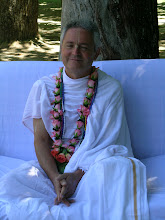
H.G. Matsyavatar Das

Showing posts with label affection. Show all posts

Friday, 31 January 2014

Remembering Shrila Prabhupada


 PART II
Due to God's mercy, Shrila Prabhupada was able to undertake the adventurous and difficult missions to satisfy the desire of his Guru Maharaja. He knew how to deal with risks, dangers, loneliness, sickness and temptations... Krishna blessed Shrila Prabhupada with such a success that, while originally owning nothing, his movement gradually reached a huge development, comparable to that of the richest and most envied companies, but even so Shrila Prabhupada remained always the person of the great inner qualities: no pride, no arrogance, no material ambitions or futile interests. He was exactly the same person when He went, with only 40 rupees in his pocket, to America, always dedicated to love for Krishna and for all creatures. Shrila Prabhupada had many talents, he was versatile, with great skills, but He was first and foremost a pure Devotee of the Lord.
He loved everyone, because in Shrila Prabhupada's opinion everyone was a potential devotee. He had always the same mood and the same tone of voice, sometimes He got vibrant, speaking with strong words, sometimes He reprimanded, sometimes He praised, sometimes He was moved, but His interest was always to improve the understanding of the devotees, their health, the image of the Movement. We must unmask the so fashionable artificial way to see an Acarya as detached from everyone and everything. Prabhupada was very interested in the success of the various services, he cared about everything working and running the best way, thus satisfying Krishna and encouraging the spiritual elevation of so many people.
Spiritual life does not mean a cold, detached attitude towards the world, we cannot live without relations, without affection, without empathy, without love. We just have to be careful to those we direct these feelings to. We should not
prioritize what calls on the material level, but strive to fulfill our spiritual desires that represent our true essence. Prabhupada had Krishna in His heart and He was always thinking of what he could say or do to bring people closer to God. Krishna had a special relationship with Shrila Prabhupada who had a special relationship with Krishna: this was visible in every activity He had undertaken, either in those particular moments when, for example, He took the initiative to modify a service that maybe was stagnating, or when in the last days of life in this world He was brought in front of the Divinities on a palanquin because He was in a condition of extreme physical weakness and He could no longer walk. In every circumstance Shrila Prabhupada has proved to be a pure devotee of Krishna.
When I read the Bhagavad-gita, chapter twelve, shloka 13 to 20, I see Shrila Prabhupada. I have known many lovely devotees, but Prabhupada is the model for me.
Prabhupada was always connected to Krishna and helped everyone to offer their talents and
energies to the service of the Lord.
The most beautiful part of Shrila Prabhupada is his being so devoted!
He was good at many things: a very good cook, a grammarian, a great preacher, a prominent philosopher and scholar; He was expert in playing music and in offering praise to the Lord, but His main feature was the pure and ardent devotion to God and His constant commitment to the spiritual education, in order to help others to become pure devotees of the Lord. Great it was, and surely still is, the satisfaction of Shrila Prabhupada to see people take seriously the path of Bhakti. And this satisfaction is the source of strength to all those devotees who carry Shrila Prabhupada in their heart.
Despite the apparent departure the Acarya lives forever with us, if we live with Him. As Satsvarupa Maharaja says in his book: "He lives forever ..."

Tuesday, 4 June 2013

Why are we lonely?


The search of love usually starts with a feeling of  loneliness, it is not just a problem of physical company, rather of awareness and inner power. Loneliness originates from a fragmented psychological image which as a consequence produces a kind of separation of a person from other people, from all the creatures, from the world and its Creator.

The solution of the problem of loneliness  is not to be found in a partner, so as to compensate the fear of being alone, nor it can be found  through the greedy possession of luxury items, nor through holidays as an “escape from reality”, nor by diving into a crowd of people, nor by burning out through a job that does not bring any satisfaction, nor by following religious principles in a conservative and passive sort of way. It will work instead, by starting to love people around us sincerely, without any selfish interest, with an attitude to expand even more the circle of love – never secluded to a single exclusive species –  and in doing so gradually heal our feelings of loneliness, uncertainty and frustration.

The charming prince or the fairy with turquoise hair of the fairy tales, that will love and trust us, will unlikely appear unless we start to appreciate and love everybody else. After all  love is not something that lands on us accidentally: we experience and grow it with the attitude and the behavior of our daily life. By learning to relate with the persons around us with love, and making this mind-set a life practice - since to feel affection is a potential capability of all living beings - by practising love this quality develops and becomes an effective ability to love.

Paradoxically enough, if nowadays couple relationships do not last it is because love is not considered as a priority any more, but other aims are being focused on: useful and comfortable means like gratification of senses,  social and economical status. But love requires respect of the beloved as a spiritual essence, as a unique person; only in this way we may be able to help the others to realize their potential values, and find deep satisfaction by rediscovering and expressing the best version of themselves. For this reason love means knowing the other deeply.
Love and thus the solution of the problem of loneliness, is the ripe fruit of a conscious, active and dynamic effort towards reaching our deep self until we experience a real feeling of communion and reunion within diversity, by appreciating the peculiarities of each person, without falling in affectionate dependency or strong attachments. We can share something with the others only when we really possess it. 
Love relationship, when thoroughly experienced, reaches its height in the realization of our relationship with God, the unique source of the variety of human beings and all that exists, being the source of love itself.
Love is a universal and indispensable quid, an intrinsic  modality of the being, that must be neither denied nor repressed, rather oriented and gradually elevated towards constructive evolutionary levels. Within love, the female and male features try to unite in order to find again the fulfilment and deep satisfaction in order to integrate themselves. By reaching maturity such integration may be conceived on the individual level as well.

Friday, 3 May 2013

Shri Nityananda: The Everlasting Beatitude


In order to understand Shri Nityananda Prabhu’s image in the Gaudiya Vaishnava tradition, we have to know the Avatara doctrine, which describes the way the Lord appears in this world in behalf of His spiritual energies. Shri Nityananda  Prabhu is a manifestation of compassion, of mercy and of divine love. He is the supreme Person, God himself who stepped into history and made His appearance in this world in the second half of the sixteenth century, according to the Western calendar. Like in the Shrimad Bhagavatam literature, which narrates Shri Krishna-Balarama’s adventures, in the Caitanya Caritamrita and the Caitanya Bhagavata, respectively written by Krishnadas Kaviraja Gosvami and Vrindavana das Thakur, they narrate Shri Krishna Caitanya Mahaprabhu’s and Shri Nityananda Prabhu’s divine adventures.
Krishna Caitanya Mahaprabhu is Krishna himself, who is manifested with a special rasa, that of Shrimati Radharani. Shrimati Radharani’s love for Krishna is experienced and manifested in full by Shri Caitanya Mahaprabhu who lives in Shrimati Radharani’s rasa and that ontologically  represents the divine union between Radha and Krishna. Shrimati Radharani is endlessly and for ever in love with Krishna, the same as Shri Caitanya Mahaprabhu’s love is everlasting and infinite.
Like Shri Krishna, whose brother and inseparable friend is Shri Balarama, Shri Caitanya has an inseparable friend too, whose name is Shri Nityananda. They are inseparable in the feelings of love that join them together. Shri Nityananda Prabhu would have shared Shri Caitanya Deva’s company all time long, however he had to fulfill his mission in behalf of His beloved associate: to travel from city to city in order to spread the holy name of the Lord. Therefore Nityananda, together with one of his best friends, Shrila Haridas Thakur, engaged himself completely in the diffusion of the sacred science, practising Harinama Kirtana and Harinama Sankirtana. In this way, by sharing this responsibility with other dear devotees, in this supreme mission that is the diffusion of love for God, Shri Nityananda Prabhu became one of the most dear Shri Krishna Caitanya Mahaprabhu’s spiritual associates.
Like Balarama, enterprising, strong, outgoing, generous, always compassionate towards the devotees, whose manifestation was considered as one of the original spiritual Master, the same Shri Nityananda Prabhu preached the sacred science and  spread his teachings to all the people of good will, in the practice of Bhakti. 

Monday, 7 February 2011

Family Matters (Part Five - Last) - By Matsya Avatara Dasa (Marco Ferrini)

Rigid versus Rigorous

Many times, listening to his tapes and reading his books, I heard Srila Prabhupada say that illicit sex is illicit sex. Very true, but I have heard him thundering against extra-conjugal illicit sex and have heard him being understanding, compassionate―not approving, not accomplice―towards those who, out of weakness, break the principles in family life. Pay attention to this point: I don't approve the breaking of principles and I am not accomplice of those who break them, even within family life. But I am ready to be quite tolerant, ready to provide help to overcome these weaknesses―without an air of catastrophe, without excessive criminalization―because those instincts, if negated or brutally repressed, slide into the unconscious and create much more damage than when they are dissolved in the sunlight. One can't avoid taking them in consideration. Either accepting such instincts or rejecting them should be done consciously, with awareness. One should use all one's resources to sublimate these instincts to a higher level, the spiritual one. And even if one succeeds nine times out of ten but the tenth time bangs his head, he should try again till perfection.
There are spirit souls who are more reawakened and those who are less reawakened; those who have more success and those who have less success, but the important thing is not to embark in disasters. I believe that in the past many tragedies occurred due to interpreting things, although in good faith, in a rigid manner instead of in a rigorous manner. There is great difference between these two concepts. What is rigid is unfortunately also very fragile. What is rigorous is much better. Rigid has a negative connotation while rigorous has a positive one. A rigid, crude, hard, radical negation―which, I repeat, could be in good faith―means repression, but if these impulses don't act on the conscious level they act, and even more powerfully, on the unconscious level. In a moment of distraction or in a moment in which our perception of God is a little hazy, in a moment of tiredness or in a moment of disappointment, these impulses surge out like a torrent overflowing its ridges and flood our consciousness. And the apparently faultless person becomes abominable.
This is a school of life. We have to learn the art of living. We have to be comprehensive towards the needs of others. We should help all those who are sincere but conditioned and with weak willpower to canalize and orient their urges upwards―without brutally negating them. If one is addicted to tobacco, let him smoke a cigarette once in a while. If one is an alcoholic, let him drink a glass once in a while. If one is addicted to sex, let him have an intercourse once in while. In this way the mind organizes itself to do always better, to improve. If a devotee is helped, cared for and inspired spiritually, receiving guidance and mercy by the spiritual master and understanding by the vaishnava, and behaving sincerely, then this process will lead to a purification of one’s samskara and desires. Bhakti is especially meant for the correction and transformation of one’s deep, unconscious tendencies (vasana). Brutal negations are a terrible teaching and it's for this reason that great thinkers have classified also organized religion―or rather the Churches―as one of the neurosis-generating environments: family, work and religion. Religions, when interpreted rigidly, to the letter, are dangerous means of serious conditioning, of neurosis, but religion, when explained by the spiritual master, sadhu and realized persons, is an extraordinarily effective means of spiritual realization.
In the same 'tree' category there are hundreds and thousands of different trees, similarly there are many different human beings. We can't make one law for everyone and make it so rigid that it doesn't work for anyone. There must be general moral definitions, but they can’t be applied in the same way to every individual. We should have general definitions because man lives in community, is a social being and can't negate his social needs. General definitions drive the group to grow; comparison among peers generates the drive for improvement, also among spiritualists. But even in law, the general definitions are not applicable to all individuals in the same way. Therefore the legislator―in our case the spiritual master, the vaishnava―has to understand the peculiarities of each person. The law remains one for everyone, but there should be personal considerations in the application.
Question: I would like to verify if I understood properly: we should see our spouse as a person who is helping us dissolve that attachment that is not spiritual―and which causes damage―and therefore we see him or her as a friend, with a sentiment of reciprocal help. This relation is like one of the various camps established in climbing a mountain, right?
Yes, if you feel alone and incapable of reaching the summit you might be overcome by desolation and by anguish. You might lack the energy to even start the climb. But you do have the desire to reach the summit and therefore we are not talking of grihamedhi but of grihastha, whose aim is spiritual realization. Sometimes it's necessary to make this journey in two, because by oneself one doesn't have enough strength, even psychologically. It's crucial that the spouses remind each other of why they got together. When a spouse has a difficult moment, the other must remind him or her of the original motivation in a consistent way. Otherwise, if they both forget, they go somewhere else.
Question: It's about continence, abstinence from sex. Sometimes the couple fails to control the sexual urge and becomes so "confidential," so familiar that they reach a point where they don't value each other any more; they can't see each other's good qualities anymore.
This is a very interesting question. There is a confidentiality that doesn't diminish respect. That's confidentiality on a spiritual basis. When familiarity becomes excessive and it's reduced to the material plane, it inevitably creates disrespect and causes disappointment. Step by step this darkness envelops the zone of light until the relation is largely consumed, depleted. During the excitement, the enthusiasm of the moment one doesn't perceive that this is happening, but it does actually happen. One whose vision is sufficiently detached―but attentive, profound, discriminating―can understand when this happens. Therefore we should try to define what love is, because this helps a lot, it helps enormously in creating categories. Life needs categories; otherwise we don't understand what's happening.

yasya deve para bhaktir
yatha deve tatha gurau
tasyaite kathita hy arthau
prakashante mahatmanau

"Only unto one who has unflinching devotion to the Lord and to the spiritual master does transcendental knowledge become automatically revealed."(Svetashvatara Upanisad VI.23)
In the path of bhakti, love is defined as the sentiment for guru and Krishna. Just like food has to be inserted in the mouth; there are innumerable other ways of inserting food but they don't work. One could make little balls of rice and stick them in one’s ears, but it doesn't work. One could even try intravenously, and also in that case there would be nourishment, but it won't give pleasure and real strength. Shrila Prabhupada said: "We teach all men to love Krishna, the Supreme Personality of Godhead. If you learn how to love Krishna, which is very easy, then immediately you love every living being simultaneously." (Letter of 10th March 1970) Only the unflinching love for God gives the strength to love all other creatures. This is an essential point; the capacity to love all others is the result of loving God. Otherwise love undergoes devolution, degeneration; it becomes egoistic. Slowly, slowly it shrinks to the level of ahamkara, false ego, the reflected self, the atman reflecting on the mental field.
What is the ahamkara? It's the sum of all the psychic contents with which we identify. Love in this form shrinks to the minute field of the psychic contents, thus practically negating all the real needs of the living being. The effect of love for God, or love "in God"(yasya deve para bhaktir―deve is in the locative case) is not like falling inside a well and getting locked up. Love of God multiplies in love for the husband, for the wife, for the children, for the parents, for the neighbors, for the so-called enemies and for the so-called friends. Therefore through bhakti we can enter into respectful affection. There is morbid affection, which has no respect―think of the pedophiles and the rapists. Criminologists working on the psychological profiles of criminals, would assure that they always talk of affection, of an overflowing affection, but they often cause huge disasters. Love of God is that affection that bubbles over, overflows, and benefits everyone.