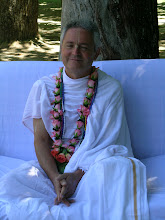
H.G. Matsyavatar Das

Wednesday, 23 February 2011

My first meeting with my Guru Maharaja: His Holiness A.C. Bhaktivedanta Swami Shrila Prabhupada -PART 1/2- Di Matsyavatara dasa (Marco Ferrini)

In the summer of 1976 I was in India, on the Himalaya. I was seriously interested in the philosophy of the sage Patanjali (yoga sutra) and I was living in an ashram in a very austere way, where I studied attentively from dawn to sunset. There nobody knew who I was; I was 31, unmarried and in excellent health. In Europe I was living a period of great material success. In Italy I had founded six companies and I was considered one of the most famous furniture designers in the world. Plenty of money, fame, and a social life studded with VIPs no longer satisfied me, rather the feeling of solitude even among my crowd of anonymous "friends" saddened me. I felt I was wasting my best years in vain and that I was moving in a direction that was completely the opposite of my aspirations. So in 1974, to everyone's great surprise, I gave a turning point to my life: with great caution I selected my friends, eliminated many worldly commitments and directed my interests more and more towards introspection. I found worldly literature nauseating, even if it was written by the most famous authors. Though I had taken part in the student movement in 1968, I had by now lost interest in their requests, which had been betrayed and politicised. Verbal and political violence, sex and drugs, had destroyed the movement's ideals of freedom and fairness, causing it to degenerate in an unacceptable and definitive way. With this state of mind, I was losing interest in the hedonistic, materialistic western culture and, thanks to some material I had read, was starting to look towards the Orient. Likewise, the course of my travels also changed and instead of going to Paris or New York, I began visiting China and India until I finally put into focus the barycentre of my research: My interest was concentrated more and more on the spiritual. I found Vedic literature very interesting, and among this, Patanjali's "Yoga Sutra" was my favorite book. In 1976 I went to India for the third time, resolved to find a satisfying answer to my existential questions. During this, as well as my previous sojourns, I had visited many ashrams and met many yogis and gurus but none of them inspired me deeply, nor did they convince me as much as I had expected. I began to think that I was not yet ready or did not have the "correct vision" and that I would have to purify myself through study and an ascetic life. I was convinced that by doing so God would reveal to me with clarity the path to follow. In this mood, I went to an anonymous ashram to "prepare" myself for spiritual research. This same year, at the end of August in the ashram I have just mentioned, I made friends with a brahmachari of my age, who looked intelligent and ascetic. We both attended the classes on Vedanta-sutra, studying together nd talking about our aspirations. Early one day, he told me gravely: " If you want to be happy you have to devote your life to Krishna and in order to do so you must meet Shrila Prabhupada personally, since he can introduce you to Krishna. Leave this place, go to Vrindavana and speak with Prabhupada". I had never heard anything about this Swami and the figure of Krishna, as it was presented in the Bhagavad-gita that I had read, did not impressed me much. Struck by my friend's attitude, I asked him for more explanations and he replied that he was a Vaishnava and that he was there to preach. We started to talk about Krishna and Prabhupada and one of the first things he told me, was that the Bhagavad-gita I had read was not authentic and that Krishna can be revealed only by one of His pure devotees which was why I should have immediately gone to meet Prabhupada in Vrindavana. We stopped attending the classes on Vedanta and we regularly met on the banks of the Ganges. We would chant the Hare Krishna Maha Mantra and I would listen to him recount Krishna's and Prabhupada's pastimes. On August 27th we affectionately parted ways and I left for Vrindavana in search of Prabhupada. I did not know exactly where Vrindavana was, nor how far it was from where I was at the present. I knew only that I had to meet Prabhupada, who would introduce me to Krishna.
In this manner, thinking intensively of Prabhupada, my trip began. I left that ashram and travelled up to Haridwara, from there I took a train to Delhi, then another to Mathura, from there I took a tanga (a cart drawn by a horse) to Vrindavana. I got to Vrindavan in the early afternoon and under an implacable sun I immediately began to look for Srila Prabhupada. I only knew that he was in a Krishna temple in Vrindavana, so I asked the driver candidly to take me to the temple of Krishna. He took me to innumerable Krishna temples, where I entered and asked about Prabhupada, but even from my first impressions, I knew I was not yet in the right place. After hours spent going in and out of many temples, the tanga driver lost his temper, afraid that I was making fun of him and would never pay him, after a series of threats, he threw my baggage in the middle of the street. I was in Vrindavana, now I knew there were thousands of Krishna temples and more then one person who was claiming to be Prabhupada, but I did not know in which temple my Prabhupada was. I was alone, tired, hungry, sitting on my luggage in the middle of a dusty street, the passerbys watching me curiously. My poor knowledge of English was not of much help. Since I was standing near a fence, after a while I decided to knock on it's large iron gate, which opened at once. A bright, clean devotee appeared and I asked him the same information I had already implored so many times that afternoon: "I am looking for Srila Prabhupada...", from the open gate I could see a coloured temple and a beautiful garden and even before the devotee answered, I felt I was in the right place. The devotee, who was Italian, invited me to come in and seeing my condition, he prepared me a room where I could rest and wash, then he told me that after taking prasada, I could meet Srila Prabhupada. I was extremely happy: I felt safe and my faith in the protection of Prabhupada and Krishna was increasing. Once I had recovered from my tiredness, the devotees informed me that Prabhupada had left for Delhi the day before, therefore the following day I also left for Delhi. Before leaving, I asked the temple president to write me a letter of introduction. When I arrived in Delhi, it was very late at night: I was to meet Prabhupada the next morning.

Monday, 14 February 2011

About religious freedom By Matsyavatara Dasa (Marco Ferrini)


On December 10, 1948 the General Assembly of the United Nations adopted the Universal Declaration of Human Rights.

Article 18

-Everyone has the right to freedom of thought, consciousness and religion; this right includes freedom to change one's religion or belief, and freedom, either alone or in community with others and in public or private, to manifest one's religion or belief in teaching, practice, worship and observance.-

Article 19

-Everyone has the right to freedom of opinion and expression; this right includes freedom to hold opinions without interference and to seek, receive and impart information and ideas through any media and regardless of frontiers.-

In the last days we were ashamed to hear about the disrespectful behaviour resulted in barbarous acts against Christians, mostly in Countries of Muslim tradition, that caused the death of many people. By witnessing so many frequent episodes of violence, with regards to religious intolerance, more than ever today we feel the moral need to remark a fundamental concept for the human welfare society, to favour its ethical and spiritual development: the importance to respect one’s freedom to seek a religious belief as a civil way of living. Everyone has the right – women and men at the same level – to freedom of thought and expression of one’s own belief or religion. We make a strong and clear claim first of all to our conscience and to the sensitive people who spend time to listen, in order to reject any form of violence and whether possible to promote, to defend and value the respect for practising any form of religion, not only by granting to each individual the possibility to choose in one’s own private life which religion to follow and how. Furthermore to grant the faculty to become a follower of that particular beleif, self-guarding the right to become a witness of that faith, to convey and spread the message in the society we live in, with full respect for the others and for the basic values of living together in a civil society.
Episodes of violence claimed in the name of religion, with the aim to repress a faith different from the one accepted by the majority of the population, appear to us as heavy as those offences made towards us, against our own religious values that attain to our person, because such acts of violence are by far contrary to the essential freedom of every human being.
By repressing the rispectful expression of one’s belief, we deny the principle of religious freedom in itself, which is a fundamental part of a wider concept of individual freedom. As a matter of fact if we lack the freedom to practise spiritual values, what other kind of freedom could we ever talk about?
Freedom on the political and social level without the respect for a religious freedom, that attains to the more intimate and deeper instances of each human being, is considered neither real freedom nor justice. As History may very well teach us, where there is no justice there can never be peace and freedom.
Besides the kind of belief it may concern, each religious fundamentalism is an attack to freedom and to spiritual realization, the same as every exasperated laicizing of spiritual values is an attack to the expression of freedom, of one’s own way of being, feeling and projecting life in accordance to an evolutive and creative purpose.
For this reason, if we really want a better human world, it is essential, today more than ever, to become witnesses and leaders of an authentic expression of religion on the basis of a rightful freedom.

Monday, 7 February 2011

Family Matters (Part Five - Last) - By Matsya Avatara Dasa (Marco Ferrini)

Rigid versus Rigorous

Many times, listening to his tapes and reading his books, I heard Srila Prabhupada say that illicit sex is illicit sex. Very true, but I have heard him thundering against extra-conjugal illicit sex and have heard him being understanding, compassionate―not approving, not accomplice―towards those who, out of weakness, break the principles in family life. Pay attention to this point: I don't approve the breaking of principles and I am not accomplice of those who break them, even within family life. But I am ready to be quite tolerant, ready to provide help to overcome these weaknesses―without an air of catastrophe, without excessive criminalization―because those instincts, if negated or brutally repressed, slide into the unconscious and create much more damage than when they are dissolved in the sunlight. One can't avoid taking them in consideration. Either accepting such instincts or rejecting them should be done consciously, with awareness. One should use all one's resources to sublimate these instincts to a higher level, the spiritual one. And even if one succeeds nine times out of ten but the tenth time bangs his head, he should try again till perfection.
There are spirit souls who are more reawakened and those who are less reawakened; those who have more success and those who have less success, but the important thing is not to embark in disasters. I believe that in the past many tragedies occurred due to interpreting things, although in good faith, in a rigid manner instead of in a rigorous manner. There is great difference between these two concepts. What is rigid is unfortunately also very fragile. What is rigorous is much better. Rigid has a negative connotation while rigorous has a positive one. A rigid, crude, hard, radical negation―which, I repeat, could be in good faith―means repression, but if these impulses don't act on the conscious level they act, and even more powerfully, on the unconscious level. In a moment of distraction or in a moment in which our perception of God is a little hazy, in a moment of tiredness or in a moment of disappointment, these impulses surge out like a torrent overflowing its ridges and flood our consciousness. And the apparently faultless person becomes abominable.
This is a school of life. We have to learn the art of living. We have to be comprehensive towards the needs of others. We should help all those who are sincere but conditioned and with weak willpower to canalize and orient their urges upwards―without brutally negating them. If one is addicted to tobacco, let him smoke a cigarette once in a while. If one is an alcoholic, let him drink a glass once in a while. If one is addicted to sex, let him have an intercourse once in while. In this way the mind organizes itself to do always better, to improve. If a devotee is helped, cared for and inspired spiritually, receiving guidance and mercy by the spiritual master and understanding by the vaishnava, and behaving sincerely, then this process will lead to a purification of one’s samskara and desires. Bhakti is especially meant for the correction and transformation of one’s deep, unconscious tendencies (vasana). Brutal negations are a terrible teaching and it's for this reason that great thinkers have classified also organized religion―or rather the Churches―as one of the neurosis-generating environments: family, work and religion. Religions, when interpreted rigidly, to the letter, are dangerous means of serious conditioning, of neurosis, but religion, when explained by the spiritual master, sadhu and realized persons, is an extraordinarily effective means of spiritual realization.
In the same 'tree' category there are hundreds and thousands of different trees, similarly there are many different human beings. We can't make one law for everyone and make it so rigid that it doesn't work for anyone. There must be general moral definitions, but they can’t be applied in the same way to every individual. We should have general definitions because man lives in community, is a social being and can't negate his social needs. General definitions drive the group to grow; comparison among peers generates the drive for improvement, also among spiritualists. But even in law, the general definitions are not applicable to all individuals in the same way. Therefore the legislator―in our case the spiritual master, the vaishnava―has to understand the peculiarities of each person. The law remains one for everyone, but there should be personal considerations in the application.
Question: I would like to verify if I understood properly: we should see our spouse as a person who is helping us dissolve that attachment that is not spiritual―and which causes damage―and therefore we see him or her as a friend, with a sentiment of reciprocal help. This relation is like one of the various camps established in climbing a mountain, right?
Yes, if you feel alone and incapable of reaching the summit you might be overcome by desolation and by anguish. You might lack the energy to even start the climb. But you do have the desire to reach the summit and therefore we are not talking of grihamedhi but of grihastha, whose aim is spiritual realization. Sometimes it's necessary to make this journey in two, because by oneself one doesn't have enough strength, even psychologically. It's crucial that the spouses remind each other of why they got together. When a spouse has a difficult moment, the other must remind him or her of the original motivation in a consistent way. Otherwise, if they both forget, they go somewhere else.
Question: It's about continence, abstinence from sex. Sometimes the couple fails to control the sexual urge and becomes so "confidential," so familiar that they reach a point where they don't value each other any more; they can't see each other's good qualities anymore.
This is a very interesting question. There is a confidentiality that doesn't diminish respect. That's confidentiality on a spiritual basis. When familiarity becomes excessive and it's reduced to the material plane, it inevitably creates disrespect and causes disappointment. Step by step this darkness envelops the zone of light until the relation is largely consumed, depleted. During the excitement, the enthusiasm of the moment one doesn't perceive that this is happening, but it does actually happen. One whose vision is sufficiently detached―but attentive, profound, discriminating―can understand when this happens. Therefore we should try to define what love is, because this helps a lot, it helps enormously in creating categories. Life needs categories; otherwise we don't understand what's happening.

yasya deve para bhaktir
yatha deve tatha gurau
tasyaite kathita hy arthau
prakashante mahatmanau

"Only unto one who has unflinching devotion to the Lord and to the spiritual master does transcendental knowledge become automatically revealed."(Svetashvatara Upanisad VI.23)
In the path of bhakti, love is defined as the sentiment for guru and Krishna. Just like food has to be inserted in the mouth; there are innumerable other ways of inserting food but they don't work. One could make little balls of rice and stick them in one’s ears, but it doesn't work. One could even try intravenously, and also in that case there would be nourishment, but it won't give pleasure and real strength. Shrila Prabhupada said: "We teach all men to love Krishna, the Supreme Personality of Godhead. If you learn how to love Krishna, which is very easy, then immediately you love every living being simultaneously." (Letter of 10th March 1970) Only the unflinching love for God gives the strength to love all other creatures. This is an essential point; the capacity to love all others is the result of loving God. Otherwise love undergoes devolution, degeneration; it becomes egoistic. Slowly, slowly it shrinks to the level of ahamkara, false ego, the reflected self, the atman reflecting on the mental field.
What is the ahamkara? It's the sum of all the psychic contents with which we identify. Love in this form shrinks to the minute field of the psychic contents, thus practically negating all the real needs of the living being. The effect of love for God, or love "in God"(yasya deve para bhaktir―deve is in the locative case) is not like falling inside a well and getting locked up. Love of God multiplies in love for the husband, for the wife, for the children, for the parents, for the neighbors, for the so-called enemies and for the so-called friends. Therefore through bhakti we can enter into respectful affection. There is morbid affection, which has no respect―think of the pedophiles and the rapists. Criminologists working on the psychological profiles of criminals, would assure that they always talk of affection, of an overflowing affection, but they often cause huge disasters. Love of God is that affection that bubbles over, overflows, and benefits everyone.

Monday, 31 January 2011

Family Matters (Part Four) - By Matsya Avatara Dasa (Marco Ferrini)


Spiritual Lovers

Question: Wife and husband should be seen more like spiritual friends or more like "spiritual lovers"? What is the difference between the two?
If the spiritual is authentic both definitions are synonymous. But only if it's authentically spiritual, because today it is a fashion to say spiritual: "Oh, today I got to know a very spiritual person!", but often people don't know anything about the dimension of the spirit. I remember, years ago, I had so much discussion on this with one person. I had to rebuke and correct him so many times. Slowly, slowly, he stopped. He had friends―some poets―that he considered spiritual but who were actually conditioned by everything: by tobacco, by alcohol, by scurrilous language; they were very conditioned. What a distorted idea of spiritual! I have explained and re-explained to him the definition of spiritual―five, seven, ten times―and it seems that lately he has grasped it. But the idea of spiritual is generally very vague, therefore it’s better to further clarify.
Let's analyze the category that indirectly emerges from your question: if the two, instead of being spiritual lovers, are carnal lovers. Then they are known as grihamedhi, which is different from grihastha. The distinction is that for the grihastha the fundamental goal is spiritual realization, while for the grihamedhi the aim is to get a beautiful wife or a handsome husband and enjoy each other. (Of course we know that it's only an attempt and than there is the other side of the coin.) These are the two categories. We have to make this essential distinction: does the person want to get married to increase his or her own potentialities of enjoyment, or does the person―in this case a sincere spiritualist―choose another sincere spiritualist in the form of the other gender to have a companion for the journey of spiritual realization?
Therefore we have two categories: those who pair for enjoying life better and those who unite for reciprocal help in self-realization. We exclusively deal with the second category; the first category is dealt with by sexologists, psychologists and other researchers. We are concerned only with those who try to have a family as a suitable, propaedeutical instrument for spiritual realization. The single man and the single woman may think, "By myself I can't make it." They may think that they are not yet ready to live as brahmacari or brahmacarini. Therefore, they look for a person with whom to walk a section of the path together, understanding from the beginning that the aim is to help each other to obtain liberation, to obtain love of God.
In this category―the grihastha―there could be some short-circuits at times, because the body is there, the senses are there, and the karma is there. Therefore by being close sometimes they find themselves too close and at times there might be exchanges of affection surpassing the level allowed in the shastra. I would say that this is not a tragedy. Some people have made a tragedy of it but then they themselves created tragedies many times greater than this. Probably I won't be acclaimed for saying what I am saying but, in all conscience, I am taking full responsibility and I have solid arguments to support my theses.

Going Beyond the Conditioning of Modern Culture

The information of the media―which the mass misinterpret as progress and emancipation―doesn't stimulate at all a 'positive' process of liberation and emancipation of the human being, but an indiscriminate consumption, which only profits the great financial and industrial groups. The disposition of modern man is to be lenient, to be accommodating with the weak side of his character, to let one's own bio-psychic impulses and the external influences dominate his personality. Even if superficially he appears original, spontaneous and self-assured, in reality he is an off-centered and fragile individual, because of being hetero-directed.
Control doesn't mean repression or suppression. Repression involves an irrational fear (taboo) that impedes the elaboration of psychic energies, which are mostly unconscious. Rather, reasonable control consists in governing the energetic manifestation, with the objective of utilizing those same energies for a constructive goal. Among the innumerable examples I could make I limit myself to the case under exam: the transformation of the sexual push into a satisfactory rapport of love, process that for years I have defined from Eros to Love.
In other words, through using a well-trained willpower, it's possible to control the bio-psychic energy through reason (Logos). This control is the opposite of repressing or suppressing one's impulses, as it can produce the transformation of the egoistic-destructive pushes in ecologic energy, beneficial to the individual, the collectivity and the environment. This process is defined transformation and sublimation.
The same principle applies to inhibition. The modern psychological literature―especially the one of Freudian school―has incorrectly attributed a negative connotation to the vital psychic function of inhibition. Evidence of the erroneousness of such idea is provided by scientific research in physiology, which has amply demonstrated that inhibition is a normal neurological function to better govern the organism. On the psychic plane also, to inhibit doesn't necessarily mean to suppress, but to apply a temporary brake to a reaction of the conditioned consciousness, in order to reflect on one’s behavior. To reflect means to activate the intellect, the buddhi, and to deliberate with emotional detachment on the present event without being overwhelmed by one’s urges. Inhibition is pathologic when used stubbornly, non-critically, but it is therapeutic when propaedeutic to sublimation: "One who is able to withdraw his senses from sense objects, as the tortoise draws his limbs within the shell, is to be understood as truly situated in knowledge" (Bg. II-58).
A person who lives the traditional values (sacrifice, work, saving, honesty, family, religion, etc.) doesn’t maximize commercial profit. To obtain maximum profit financial companies need to transform man in avid consumer, because to realize profit they need people to buy their products. Maximum profit for capital invested is given by a person who works to the maximum of his psychophysical capacity and consumes to the maximum of his financial capacity. The worker who is content leading his social or family relationships based on religious values and behavior is a bad consumer. He yields little, because to realize oneself in that way costs little or nothing and consequently doesn't push the individual to work to the maximum of his capacities. Similarly, the chaste girl who doesn't go out at night to have fun, the faithful wife who stays at home, the monk and the priest produce very little commercial profit. There arises therefore the need to create the consumerist, who seeks pleasure and entertainment, who seeks an individualistic, materialistic actualization and who frees himself from all the factors that could have inhibited such evolution, spending in goods and services whose sale produces profit. Modern culture achieved this by demolishing those ethical and social values―or motivational vectors―that checked the establishment of consumerism. Modern culture promoted liberation from duties, sexual liberation, blameworthiness of prohibitions, devaluation of the family and of family roles, emptying of religion, relativization of ethics and of authority. It created innumerable new personal fancied wants―essentially responding to the need of the industry to sell and gain: divorce, fashion, designer clothes and accessories, hankering for status symbols of every type, from classy cars to vacations in particular places.

Monday, 24 January 2011

Family Matters (Part Three) - By Matsya Avatara Dasa (Marco Ferrini)


Right and Wrong Decisions

We should try to be honest and serious, first of all with ourselves. We should have a balanced vision and not accept the people’s vow of lifelong celibacy at a young age, without having shown tangible signs of maturity and dominion over the senses. This maturity should be on different planes: cognitive, emotional and behavioral. A choice that is the best in absolute terms, can produce serious damages if made at the wrong time, due to the person's lack of preparation. If not properly helped, the person who incurs in such difficulties generally develops a sense of self-failure and a heavy sense of guilt, which eventually cause inhibition, depression, emotional blocks and a stop to spiritual progress. This sense of guilt can be defined as pathological, whereas a healthy and beneficial sense of guilt arises when the person is aware of his mistakes and deeply repents them, finding in himself, guru and Krishna, the energies to rise above them.
Regarding such sensitive issues, specifically connected to life in the grihastha ashrama, over many years I have noticed a vast symptomatology and many damages produced by hasty decisions and a rigid mentality. Many marriages have failed because the person experiencing difficulty in restraining the senses―when confronted with an overly rigid partner―has looked for satisfaction outside the marriage, starting love affairs and betraying the spouse, thus producing a hellish condition for all the people involved.
I recall a whole list of rigid people who first ruined their family members and then ruined themselves. Real affection means to come forward to the needs of others, and I believe that every real need in the family has to be taken into serious consideration. If a person thinks that he or she can't or shouldn’t concede anything, absolutely nothing, such person should not get married. And if he does get married, throughout his whole matrimonial life he will be bitterly reminded that he should not have married. Couple means two people, two people who promise to help each other for the rest of their lives. If one is in need and the other doesn't help, I don't know how this refusal could be beneficial for his spiritual advancement, and how it could be done in the name of devotion for Krishna. Of course there can be embarrassment, little enthusiasm and whatever else, but something has to be done to help.
I have seen so many cases of conflict and I have come to the deep conviction that there must be a mediation, there must be reciprocal affection, reciprocal care. When the desire for intercourse assumes a dangerous psychological proportion―producing a "fixed idea," a true neurosis―we should act as with any other disease, looking for a remedy and a cure. When I acted as a direct witness and I advised people in this way, they often solved their problem brilliantly, gradually finding balance, detachment and serenity, discovering a type of affection that was not based on sexual intercourse. Real affection, spiritual affection, has no need for sexual intercourse or physical contact. Such affection is the achievement of the target of bhakti, and is obtained after a long practice; it is not a starting point. At the beginning the couple might endeavor to overcome the problem, but to rise above it, the effort must be equipped with enough capacity and experience, and above all enough cultural and spiritual maturity in Krishna consciousness.

Cultural Conditioning

I spoke about religious duties, but now I wish to mention the cultural environment where each of us―consciously or unconsciously―lives. Over the last century, Western culture has been increasingly fascinated by rationalism and materialism, progressively polluting itself with a pseudo-scientific literature that has considerably contributed to the development of a dangerously permissive sexual behavior. Such literature has induced people to think of eroticism and sexual acts as something physiologically necessary, comparing sex desire to the need for food and air. Not only they have presented the satisfaction of such an urge as inevitable; they have even declared that whoever neglects it will develop psychological disorders. It is difficult to calculate the extent and harm that such mentality has caused and is causing. It is truly a social and psychological plague, both on the collective and on the individual level.

Spiritual Affection

On the plane of spiritual realization, of spiritual affection and friendship, sexual intercourse becomes totally needless, extraneous and artificial. But, as we know, people acquire perfection after long efforts. According to the shastra, a married couple that can transcend illicit sex is on the direct, true path towards perfection. Until there are distractions, spiritual realization is overcast and shadowed.
Besides, the authoritative sastric statements in this regard, the results of scientific research made by some American universities (Wisconsin, 1968) demonstrate that numerous couples can live well without sexual intercourse, provided they cultivate their interest for elevated ethical values.
First of all―as I said at the beginning of my answer―people should try hard to abstain from extra-conjugal sex, because this generates hellish conditions in the society, in the family, in the couple and in the relationship between parents and children. Such illicit connections, metaphorically speaking, create hell; they create great embarrassment and pain; they condemn children to experience distress and harmful life-models, and condemn the spouse to anguish and deep suffering. Illicit sex in family life is like giving methadone to a heroin-addict. Methadone is better than heroin (extra-conjugal sex), but better than methadone is to rise above the problem. Methadone also creates addiction, but not as strong and devastating as the addiction created by heroin. Illicit sex in family life creates dependence, addiction and identification with the body, besides being a great waste of energy―but there is no comparison with illicit sex out of the wedlock.
When my students intend to get married I ask them to get to know each other very well, and should thoroughly inquire about the other's choices and priorities in life. They should become deeply aware of the responsibility, the obligation, and the onerousness they assume in getting married. Then, I become the witness, and I commit myself to help both of them to overcome all the difficulties and to face their responsibilities, which include economical, social, and emotional aspects. These are all comprised in the sphere of family responsibility and, consequently, of spiritual realization.
As I told you many times, ultimately to solve this type of problems the real solution is to seriously adopt a Krishna conscious mentality... But now I believe I should stop here with the answer. Obviously, given the magnitude and complexity of the theme, this answer will not satisfactorily exhaust the various topics touched, but it will merely serve as an orientation tool for deeper study and meditation.

Monday, 17 January 2011

Family Matters (Part Two) - By Matsya Avatara Dasa (Marco Ferrini)


Dealing with Illicit Sex

Question: In ISKCON we are taught to follow the four regulative principles, among which avoiding illicit sex is often the most crucial one. However, there are situations where one member of the couple doesn’t agree on practicing sexual restraint, and this could lead to the drastic break-up of the marriage. What can be done in such cases?
This is a burning issue, which requires an honest and urgent clarification. It is not the first time I talk about it, but so far I have done it only with very intimate students.
According to my understanding of Srila Prabhupada’s teachings, I distinguish between two categories of illicit sex: the first is pre-marital and outside marriage―they belong to the same category―and the second is within wedlock, between a regular couple united before God, with the authorization and blessing of the spiritual master, who sanctifies the marriage. Both categories are classified as illicit sex―to use the classic terminology, but for me there is no comparison between the consequences of extra-conjugal illicit sex and those from illicit sex within a religiously constituted couple. The term “illicit sex” is used to point out that sexual organs are not toys and, for both men and women, their proper function is procreation. Sexual organs are parts of the body with a precise function, and every other function is improper or “illicit.” Having said this, the embodied being experiences many conditionings, arriving to this body with a huge karmic load of samskara (1) and vasana (2). For some people, therefore, the urges could be so strong that, despite all good intentions, there could be some lapses. But one thing is the lapse occurring within the married couple, and quite another thing is the lapse outside marriage. Outside the regular couple the failure is disastrous, both personally and socially, whereas within the regularly constituted couple the damage is contained, but I am still talking of damage, don't misunderstand. There is no comparison between the two damages. By the mercy of the divine grace, I have always strongly stressed the importance of following the regulative principles, and I am not talking like this to promote a different behavior, a different standard. I do believe that those who seek spiritual realization and aspire to develop pure love of God should strictly follow the regulative principles, and therefore should not engage in illicit sexual activities. At the same time, in my many years of experience counseling people, I have witnessed a lot of suffering caused by the uncritical, uncompromising application of the law.
People live on different planes of consciousness: it is exceptional to find two people on the same level, even if they both sincerely desire to become devotees at the same time. In a couple, there is often a partner who makes quick advancement, while the other might remain stationary for some time. This usually generates a gap. I have been advising couples for more than twenty years to help each other, be patient and tolerant. If one of the two needs help, the other should offer it generously. Perhaps I have not stressed this enough… I consider that one should rigorously follow the regulative principles, but I am now talking of cases that could lead to serious turmoil in a family and usually leading to betrayal. I don't want to suggest that anyone should abandon the principle of purity, but it should be understood that people can be cured through constant love and affection. If between husband and wife there is real sincerity and friendship, in some measure there will also be real love and affection; if there is the willingness to overcome one's limitations, some careful concessions can be excused, thus avoiding very big, serious and irreparable havoc.
In my answer I limit myself to saying that we shouldn't put extra-conjugal illicit sex on the same level as the occasional weaknesses in married life. Considering them the same would show a lack of spiritual comprehension and maturity and a misunderstanding of the function of controlling sexual energies. To rectify a person, to rectify the character, to cure a disease, we need to follow the path of recovery. An expert doctor always knows how to administer the medicine. I am not surprised or astonished if a young couple of my students once in a while indulge in effusions that go beyond the limit. Of course, I absolutely don't encourage such things because they dissipate emotional resources and increase bodily identification, distracting the devotee from the real purpose of life: Krishna-bhakti. At the same time, I am in my late fifties and I have some knowledge and experience of psychology, I have seen people who have rigidly negated their impulses for a long time and later, even in the guise of renouncers, have abandoned their religious vows.

Repression and Sublimation

Whoever represses his sexual instincts without being able to sublimate them, which means increasing his sadhana and connection to guru and Krishna, won't be able to resist long enough, and will inevitably head for a falldown. These falldowns could be so serious that the individual thrown in such a state of moral and spiritual prostration, might not be able to rise again, at least in that lifetime. As the Vaisnava scriptures explain, only a few people in this age are already so elevated that they can immediately and completely abstain from sexual activity. The majority of people need gradual distancing, protected by the institution of marriage and regulated by the four principles, the necessary groundwork for ethical life and the pursuit of spiritual realization. The management of emotions requires great competence and maturity, both cultural and spiritual. The guidance and direct assistance of the spiritual master is therefore essential, especially in crucial moments of life, when one is called to make fundamental choices (e.g.: choice of ashrama) that, if wrongly handled, could jeopardize or stop spiritual advancement.
Both repression of instincts and indiscriminate indulgence can produce neurosis and serious personality disorders. Our Vaishnava literature explains that psycho-physical energies, indispensable for the journey towards transcendence, should be neither negated or repressed, nor indiscriminately dispersed; they should be correctly used, beneficially and propaedeutically to the development of personality. In other words, they should be sublimated by engaging in devotional service. Hari-nama japa and nama sankirtana, Deity worship and spiritual association are the best means to overcome problems of lust.
Experience teaches us that through the discipline of bhakti-yoga it is not only possible to sublimate impulses, by the elimination of their self-destructive unconscious charge, but also to re-integrate them on the plane of pure consciousness, as divine rasa. Otherwise, when one gives in to such impulses without discrimination, they obnubilate and obscure the consciousness, provoking confusion, frustration and suffering; they enslave the subject in ephemeral conceptions and bodily identities, in destructive tendencies and instincts. The science of bhakti aims at the exact opposite: making the person fully conscious of his divine nature, his own relationship with God and an instrument for everybody’s well being, including his own.
The second and third chapter of the Bhagavad-gita teach us that whoever represses certain impulses but keeps cultivating attachment for the sense objects in the mind, persisting in their contemplation and internally longing for them, won't succeed in the path of yoga (3). We need to learn how to dissociate from the sense objects also psychologically, transcending the problem, and for this there is a discipline or a route to follow, with arrangements and methods that partially differ from person to person, according to the various states of consciousness and psychological conditioning. Such different arrangements are obviously all finalized to reach the same objective: overcome bodily identification and selfish gratification, and develop pure bhakti. Krishna says that discovering a higher taste is necessary to abandon the inferior, conditioned and conditioning taste, source of multiple sufferings, and to reorient physical and mental dynamics. "The embodied soul may be restricted from sense enjoyment, though the taste for sense objects [the desire for them] remains. By experiencing a higher taste and ceasing such engagements, he becomes fixed in [Krishna] consciousness."

(1) Traces or engrams in the memory that determine the conformation of the deep psyche or unconscious, and which are the origin of mental tendencies and automatisms.
(2) Latent tendencies that condition the individual character and behavior.
(3) "While contemplating the objects of the senses, a person develops attachment for them, and from such attachment lust develops, and from [frustrated] lust anger arises. From anger, complete delusion arises, and from delusion bewilderment of memory. When memory is bewildered, intelligence is lost, and when intelligence is lost one falls down again into the material pool." Bhagavad-gita 2.62-63.

Thursday, 13 January 2011

Family Matters (Part One) - By Matsya Avatara Dasa (Marco Ferrini)


I believe that family life, the grihastha ashrama, is a theme of universal interest. Some will get married and some will not, some will have children and some will not. But also those who don't get married and those who have already surpassed this phase of life will greatly benefit by knowing the basic dynamics, the rapport of weights and measures, the values of family life in the Vedic-Vaishnava civilization. In the past so much damage has been done by people―who had no positive experience in this area―who tried, disastrously, to handle the life of others. Therefore those directly involved in family life―as well as those who have to come in touch with those directly involved―should know about the fundamental principles and values on which family relations are based. To know such fundamentals of the grihastha asrama is an integral part of spiritual realization, not because it's in itself something spiritual, but because it's a social organization propaedeutical to spiritual realization. Even those who renounce family life for a more elevated aim will always be in touch with those in family life. Directly or indirectly everyone is interested in family life, either because one is married, or because one plans to form a family, or because one has brothers, sisters, sons, daughters, or parents in family life. In this way this ashrama is fundamental and is not completely avoidable even for those who desire to live as brahmacari―a very noble commitment and intention.
From Krishna's point of view there is no difference whatsoever between brahmacari ashrama, grihastha ashrama, vanaprastha ahsrama and sannyasa ashrama. These are four positions or stages of life in which one places oneself for self-realization. The goal of life is not to become sannyasi or brahmacari, or to become grihastha or vanaprastha. The goal of life is self-realization and this time we talk of the grihastha ashrama because in this phase many people complicate their problems and their relations. Many people have therefore proposed alternative arrangements to married life but they all have been appalling disasters. Family life is certainly the most complex stage in terms of interface with the world. One has to deal with economy and with a whole series of connections and relations―sometimes extremely difficult―such as children, parents, brothers and sisters.

Delivering One's Dependents

Question: In the Fifth Canto of Shrimad-Bhagavatam Rishabhadeva states: “One who cannot deliver his dependents from the path of repeated birth and death should never become a spiritual master, a father, a husband, a mother or a worshipable demigod.” [SB 5.5.18] Could you comment?

We can't force anyone to go to the spiritual world but we can honestly take the responsibility of doing whatever is possible to help a person to untie his or her karmic bonds. It happened that I had to advice people in debt. Their real problem is not the debt with the bank or with somebody else; their problem is their behavior and their mentality, structurally wrong. If someone in a moment of generosity would pay back their debts, they would continue to incur in debt anyway, because insolvency is ingrained in their character. They do things in the wrong way and produce debts. This is similar with karmic debts; it comes from the same source: errors inside, a deformed mind.
This statement by Rishabhadeva means that we should do our best to rectify people's mind. Diseases, for instance, are other types of debts but the dynamics are the same. There is no such thing as good and bad luck; what exists is the way of doing things, the mood, the quality of the mind and of the intellect. We have to analyze the vasanas, the latent desires. When the latent desires are negative, the negative eventually comes out. Someone may accumulate money and not make economic debts, but the same person may make debts in his relations; he might create enemies left and right, and those are extremely heavy debts. Other people are very capable in the field of relations but whatever they do and touch ends in disaster. These are also debts. Therefore the shastra teach that we should control the senses, for life becomes risky when even a single sense breaks free.
Have you seen the dependence of the smoker, who surreptitiously gets away to go and have a cigarette? Have you seen the character-deformation of an alcoholic, or of a cocaine-addict, or of a gambler? They live in great suffering and with great internal conflict. The gambler knows that he is destroying his life and the life of those around him. Well-equipped casinos had a room with a notary ready to write the will and where the loser could shoot himself, could commit suicide. Gamblers know that gambling is bad; they cry and bang their head into the wall; they know that by playing they ruin themselves and their families, but it overwhelms them. Similar dynamics are there for the women- or men-hunters, the assaulters of others' purity. Therefore we should educate people to control their senses from childhood. This is what Rishabhadeva is saying. And one must have self-control himself, otherwise how can he educate others? How someone who smokes can tell another to stop? So Rishabhadeva says that one who assumes the responsibility for others should be able to guarantee them liberation―guarantee it from his side―but they are not wood-heads, they are not automatons; they can choose. Everyone has to endeavor, but the leader should educate others to be free from the conditioning of the six degrading impulses: the urge to speak, the mind’s demands, the actions of anger and the urges of the tongue, belly and genitals. In this sense the husband, the father, the mother should be gurus, even if they don't know the sacred science in depth.

Pull quote: We can't force anyone to go to the spiritual world but we can honestly take the responsibility of doing whatever is possible to help a person to untie his or her karmic bonds.